For laboratory and research use only. Not for human consumption.
35+ countries have approved it. The FDA gave it orphan drug status for four separate indications. It’s been studied continuously since 1977. And most Western researchers couldn’t pick it out of a lineup.
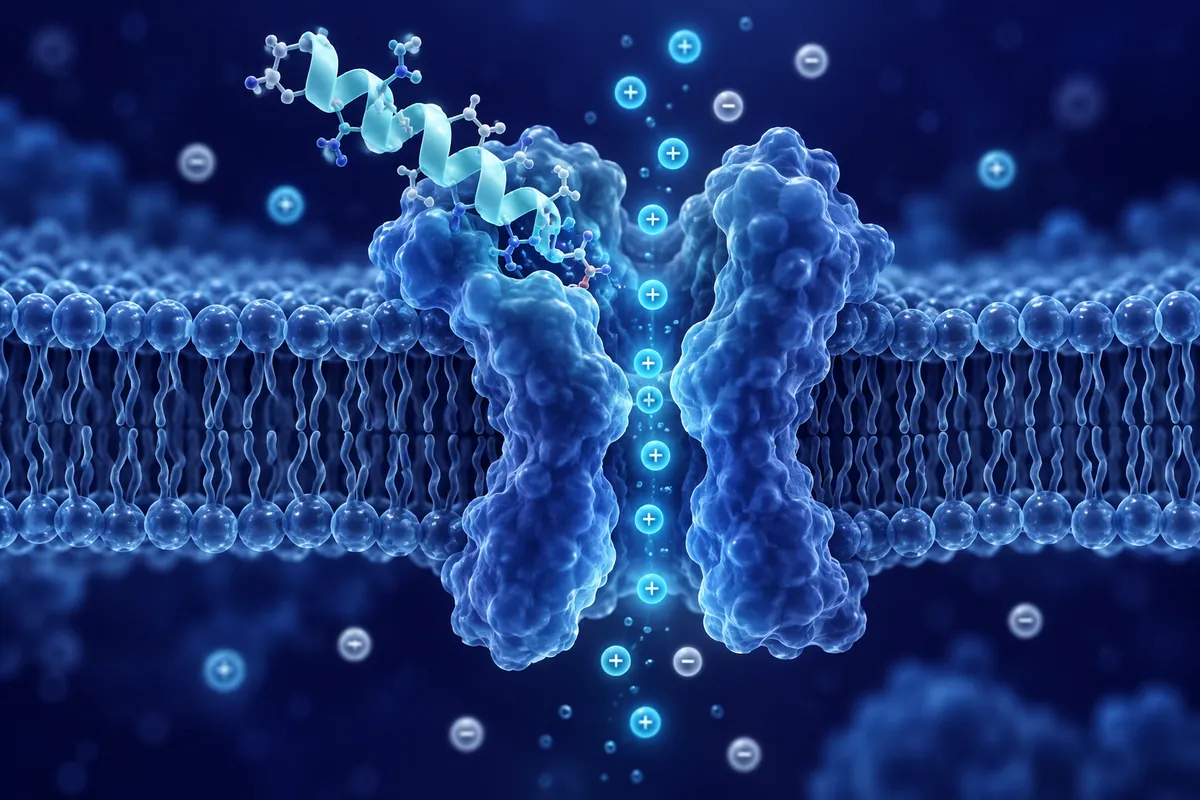
Thymosin Alpha-1 : Tα1. 28 amino acids from the thymus gland. It fires up TLR2 and TLR9 simultaneously, matures dendritic cells, pushes T-cell differentiation, and supercharges NK cell killing. The synthetic version goes by thymalfasin (brand name Zadaxin), and it’s been deployed against hepatitis B and C across Asia for years. In America? Investigational. Go figure.
Chemical Identity
Twenty-eight residues. Acetylated serine at the N-terminus. Derived from prothymosin alpha : a larger 109-amino acid precursor that thymic epithelial cells chop up and release into circulation.
- Sequence: Ac-SDAAVDTSSEITTKDLKEKKEVVEEAEN
- Molecular Formula: C₁₂₉H₂₁₅N₃₃O₅₅
- Molecular Weight: 3,108.3 g/mol
- CAS: 62304-98-7
Heavily acidic : loaded with aspartate and glutamate residues. Net negative charge at physiological pH. Same family name. Entirely different biology.
Discovery Story
1960s. Allan Goldstein and Abraham White at Albert Einstein College of Medicine. They’re studying why the thymus gland matters for immune development.
Ten years of purification work later, 1977: they pull out one specific 28-amino acid peptide from that fraction. Thymosin alpha-1. First individual peptide isolated from the thymic mixture that kept its immunological punch. The sequence got mapped. Production in rat thymus was confirmed (Hannappel & Huff, 1984; Proc Natl Acad Sci USA 81:1008-1011).
SciClone Pharmaceuticals later synthesized it as thymalfasin (Zadaxin) : identical amino acid sequence to the natural peptide. That synthetic version became the basis for regulatory filings across 35+ countries. From crude thymic extract to a defined, synthesized compound with international approvals. Took about three decades.
Mechanism of Action
Not a one-trick peptide. Multiple receptor targets. Multiple cell types.
TLR2 + TLR9: Both At Once
Most immune compounds hit one receptor. Tα1 hits two Toll-like receptors on myeloid and dendritic cells.
Through TLR9: MyD88 cascade fires. IRF-7 gets activated. Cells pump out IFN-α : type I interferon. First-line antiviral defense. Through TLR2: NF-κB translocates to the nucleus. Now you’re getting IL-12, TNF-α, IL-6. Phagocytes wake up. Microbial recognition gets cranked.
The two arms amplify each other. TLR9’s IFN-α boosts the scale of TLR2-driven responses. Coordinated, not additive (Romani et al., 2006; Blood 108(7):2265-2274).
Dendritic Cells: From Immature to Armed
Tα1 matures dendritic cells. MHC class I and II go up. Co-stimulatory molecules (CD80/CD86) come online. Antigen processing capacity ramps.
But it’s not just activation. Tα1 also flips on IDO : indoleamine 2,3-dioxygenase : in DCs. That’s tryptophan catabolism. Creates a regulatory environment. Gas pedal and brake at the same time.
T Cells: The Core Function
Classic Tα1 territory. Thymic progenitors → functional CD4+ helpers and CD8+ killers. The two pillars of cellular immunity. But there’s more:
- Tilts Th1/Th2 toward Th1 : cell-mediated over antibody-driven. Th17 and Treg populations also shift
- Immunocompromised animals: T-cell counts partially restored. Rosette percentages climb
NK Cells
Tα1 activates their killing capacity directly : activating receptors get upregulated, IFN-γ production spikes, and there’s synergy with IL-2 for proliferation.
Different immunomodulatory angle: KPV peptide works through alpha-MSH receptors instead.
Cytokine Profile
| Cytokine | Direction | How | What It Means |
|---|---|---|---|
| IFN-α | ↑ | TLR9 → IRF-7 | Antiviral innate response |
| IFN-γ | ↑ | NK and T-cell activation | |
| IL-2 | ↑ | T-cell cascade | T-cell proliferation |
| IL-10 | ↑ | Treg and DC modulation | |
| IL-12 | ↑ | TLR2 → NF-κB | |
| IL-1β | ↓ | Inflammasome regulation | |
| TNF-α | ↓ |
Protective cytokines go up. Damage cytokines come down. IL-10 : tolerance : also rises. It’s an unusually balanced profile. Most immune compounds tilt one direction. That’s rare.
Zadaxin: The Regulatory Story
Here’s where it stands:
- Phase II completed for hep B, Phase III for hep C in the US
- Not approved in the US (beyond orphan designation), Japan, or most of Europe. Italy is the notable exception
Regulatory status varies enormously by country. In the US and EU, Tα1 remains investigational.
Preclinical Data
Hepatitis B
Multiple research groups have examined thymalfasin in HBV models : Chien et al. (1998), Mutchnick et al. (1999), Zavaglia et al. (2000) : with varying designs and endpoint measurements.
Fungal Infections
TLR2 is a primary receptor for fungal cell wall components. That makes Tα1’s TLR2 agonism directly relevant.
It’s been studied as an adjunctive agent during immunosuppressive treatment.
Not TB-500. Don’t Confuse Them.
“Thymosin” is in both names. That’s where the overlap stops.
Tα1: 28 amino acids, 3,108 g/mol.
TB-500 (thymosin beta-4): 43 amino acids, 4,921 g/mol.
Same family. Completely different biology.
Safety Profile
Favorable across preclinical studies. Key points:
- Minimal adverse findings at standard research concentrations in animal models
- Thymalfasin studied at 1.6 mg subcutaneous in investigational protocols
- Anti-apoptotic: Tα1 antagonizes dexamethasone-induced thymocyte death in a time- and concentration-dependent manner (Baumann et al., 2000; Int J Immunopharmacol 22(12):1057-1066)
- Standard peptide storage requirements : temperature and handling matter for bioactivity
Where It Stands Legally
Approved in Asia and parts of Europe. FDA orphan designation but no US approval. Investigational in Japan and most Western countries except Italy. For research use : verify your jurisdiction’s rules.
Research Availability
From Loti Labs:
- Thymosin Alpha-1 10mg : $79.99
Conclusion
Forty-plus years of data. Approvals on three continents.
For a peptide that’s been studied since 1977 and is still generating new mechanistic insights, Tα1 has staying power that most research compounds don’t.
For laboratory and research use only. Not for human consumption.
References
- Goldstein AL. History of the discovery of the thymosins. Ann N Y Acad Sci. 2007;1112:1-13. PMID: 17468229
- Romani L, et al. Thymosin alpha 1 activates dendritic cell tryptophan catabolism. Blood. 2006;108(7):2265-2274. PMID: 16740584
- Hannappel E, Huff T. Thymosins: prothymosin alpha, parathymosin, and beta-thymosins. Vitam Horm. 2003;66:257-296. PMID: 12852258
- Baumann CA, et al. Tα1 antagonizes dexamethasone-induced apoptosis of murine thymocytes. Int J Immunopharmacol. 2000;22(12):1057-1066. PMID: 11137614
- Garaci E, et al. Expert Opin Biol Ther. 2015;15(Suppl 1):S31-S39. PMID: 26096835
- Costantini C, et al. Reappraisal of thymosin alpha 1 in cancer research. Front Oncol. 2019;9:873. PMID: 31572680
- Billich A. Thymosin alpha 1 : SciClone Pharmaceuticals. Curr Opin Investig Drugs. 2002;3(5):698-707. PMID: 12090542
- Armutcu F, et al. Tα1 attenuates lipid peroxidation in fructose-induced steatohepatitis. Clin Biochem. 2005;38(6):540-547.
- Yang X, et al. Effect of Tα1 on Th1, Th2, Th17, and Treg subpopulations in vitro. Braz J Med Biol Res. 2012;45(1):25-32.
- Giuliani C, et al. Tα1 regulates MHC class I expression at transcriptional level. Eur J Immunol. 2000;30(3):778-786.
- FDA. Thymosin Alpha-1 Related Bulk Drug Substances. Office of Pharmaceutical Quality Assessment II. 2024.
- Chien RN, et al. Hepatology. 1998;27(5):1383-1387. PMID: 9581696
This educational material discusses laboratory research concepts only. Loti Labs products are intended strictly for research and development use and are not for human consumption.