For laboratory and research use only. Not for human consumption.
Middle age. Half your NAD+ : gone. It gets worse. Up to 80% depleted between your twenties and sixty. That’s not a minor biomarker shift. That’s a wholesale biochemical collapse.
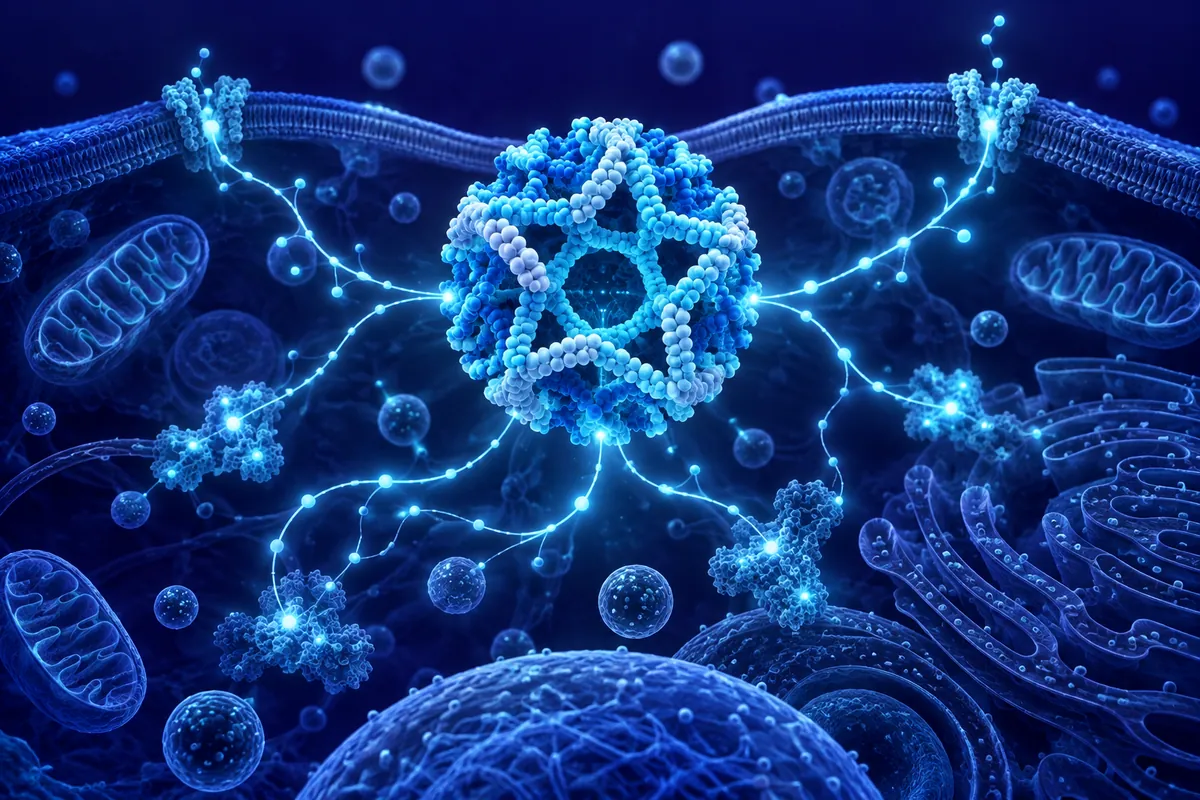
NAD+ touches over 500 enzymatic reactions. Burns fuel (glycolysis, TCA cycle, oxidative phosphorylation). And it vanishes with every passing decade.
A lot to cover.
What Is NAD+?
Arthur Harden boiled yeast extract in 1906. Something in the filtrate made fermentation go faster. Small molecule. Heat-stable. They called it a “cozymase.” We call it NAD+.
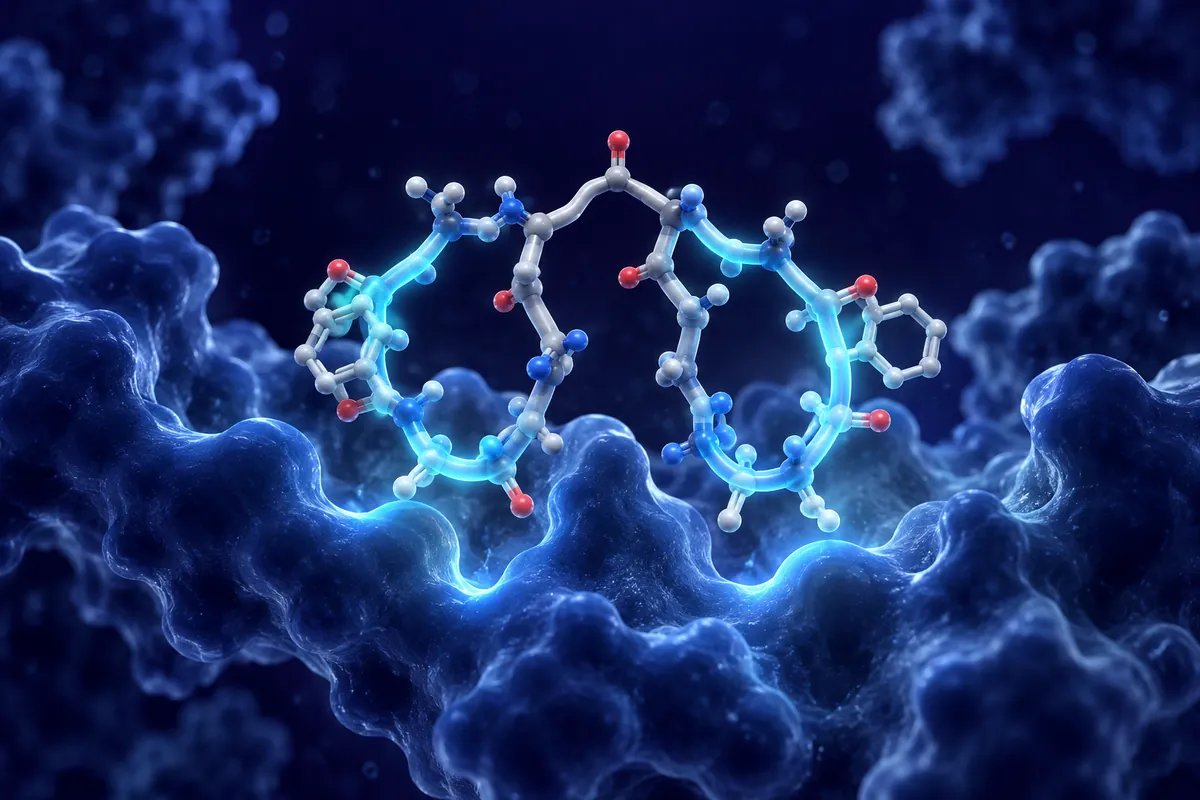
Two nucleotides linked through phosphate groups : NMN on one side, AMP on the other. Deceptively simple for a molecule that participates in hundreds of reactions.
- Molecular Formula: C₂₁H₂₇N₇O₁₄P₂
- Molecular Weight: 663.43 g/mol
- CAS Number: 53-84-9
Primary role: electron shuttle. Grabs hydride ions off metabolic substrates in glycolysis, TCA, and oxidative phosphorylation. Becomes NADH. The ratio between NAD⁺ and NADH tells cells what metabolic gear they’re running. High = active oxidation. Low = reduced state (Cantó et al., 2015; PMID: 25662603).
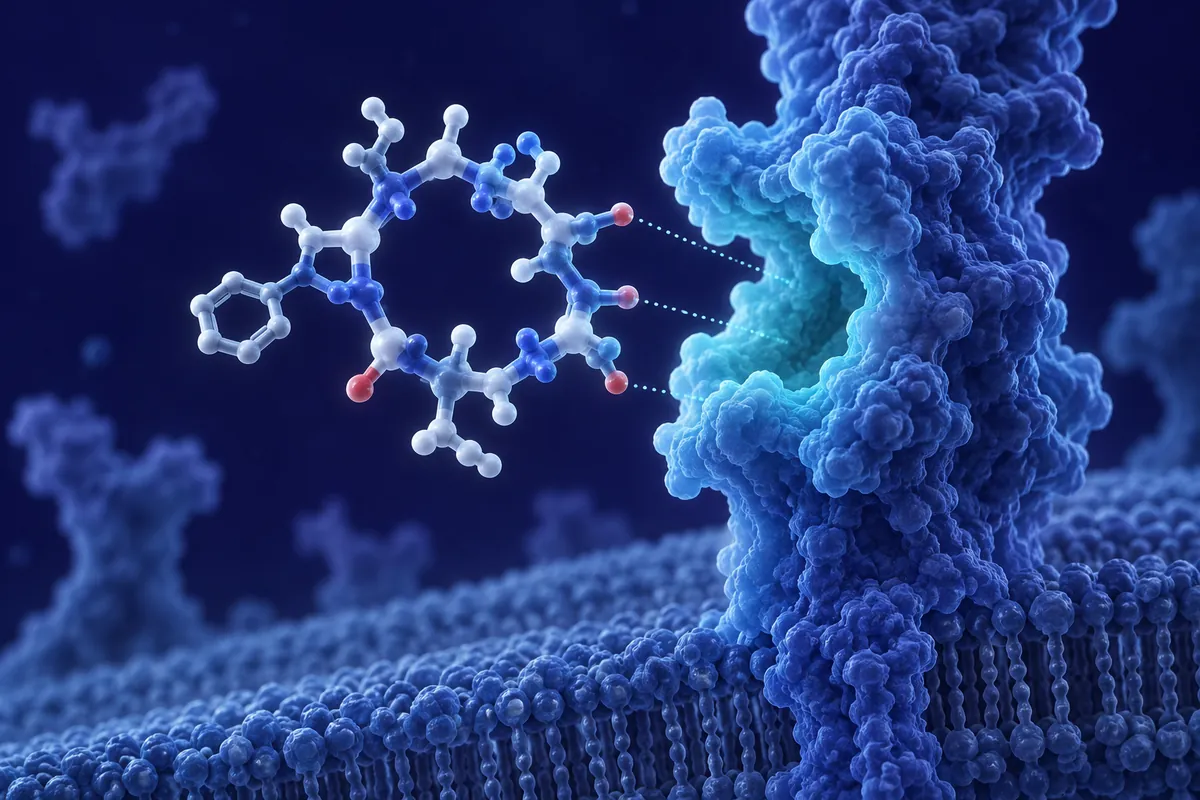
But the aging field doesn’t care about the electron shuttle role. It cares about what happens when NAD+ gets consumed. Three enzyme families : sirtuins, PARPs, CD38 : literally break NAD+ apart. They crack the nicotinamide-ADP-ribose bond and use the fragments for regulatory reactions (Imai & Guarente, 2014; PMID: 24786174).
This is the part people miss. NAD+ isn’t just an electron carrier. It’s expendable fuel for the cell’s highest-priority maintenance systems. And when levels drop with age, those systems starve.
The sirtuin family. SIRT1 through SIRT7. Deacylases that yank acetyl and acyl groups off proteins : but only when NAD+ is available to power the reaction. Pull NAD+ away and sirtuin activity collapses. That’s not metaphor; it’s enzymology.
| Sirtuin | Where | What It Does | Standout Data |
|---|---|---|---|
| SIRT1 | Nucleus/Cytoplasm | ||
| SIRT2 | Cytoplasm | Cell cycle control | Mitotic checkpoints, adipocyte biology |
| SIRT3 | Mitochondria | Mitochondrial deacetylation | Turns on SOD2, respiratory chain. |
| SIRT4 | Mitochondria | ADP-ribosylation | |
| SIRT5 | Mitochondria | Desuccinylation | Urea cycle, fatty acid oxidation |
| SIRT6 | Nucleus | Transgenic overexpression → males lived longer (Kanfi, 2012) | |
| SIRT7 | Nucleolus | rDNA transcription |
Here’s what makes this family so interesting for aging research. Four entirely different organisms. Not one pathway. A whole web of them : all gated by NAD+ availability.
PARPs: The NAD+ Budget Problem
PARP1 and PARP2 do 90% of PARP activity in mammalian cells. Crucial work. But incredibly expensive : measured in NAD+ molecules consumed.
Acute DNA damage can trigger PARP hyperactivation. When that happens? NAD+ reserves get torched. Rapidly. And every NAD+ molecule PARP burns is one the sirtuins can’t use.
Proof: PARP1 knockout mice. No PARP1 means no NAD+ drain from DNA repair. Chemical PARP inhibitors did the same thing. Block one NAD+ consumer, and the others feast.
This is the fundamental tension in NAD+ biology. PARPs, CD38, and sirtuins all compete for a limited NAD+ supply. A zero-sum game at the molecular level. Understanding who’s winning that competition at any given point in the aging process : that’s what drives the entire NAD+ repletion field (Mouchiroud et al., 2013; PMID: 23698361).
CD38 and the Age-Related NAD+ Collapse
CD38. Ectoenzyme. Chews through NAD+ and spits out cyclic ADP-ribose for calcium signaling. And its expression climbs : relentlessly : as organisms age. If you want a single culprit for age-related NAD+ loss, this is it.
The decline in numbers:
- ~50% of NAD+ gone by middle age (Yoshino et al., 2018; PMID: 29514064)
- Skin by 60: 50-80% depleted (Massudi et al., 2012; PMID: 22848760)
- Brain loses 10-25%. Liver about 30% (over-60 vs. under-45)
- Men drop faster, especially mid-life
Knockout experiment: remove CD38 entirely from mice. NAD+ stays elevated. SIRT1 cranks up. High-fat-diet metabolic damage? Protected (Barbosa et al., 2007; PMID: 17376880).
Why does CD38 increase with age? Blame inflammaging. Chronic low-grade inflammation. Fewer NAD+ molecules → more senescent cells → more inflammatory cytokines → higher CD38 expression → even less NAD+. A self-reinforcing spiral that accelerates with every year.
Mitochondria Can’t Run Without It
Every time the TCA cycle turns, it produces NADH. That NADH hands electrons to Complex I : the biggest, first complex in the electron transport chain. Kill that handoff and ATP production collapses. No NAD+ recycling, no energy. Full stop.
Three specific connections:
When Complex I is deficient, NADH piles up because it can’t pass electrons forward. Mitochondrial NAD+ crashes. SIRT3 goes dark. Tissue damage follows.
SIRT3 itself deacetylates subunits in both Complex I and Complex II. It’s the quality control enzyme for the respiratory chain. And it runs on NAD+. Low NAD+ means sloppy mitochondria.
Then there’s biogenesis : making entirely new mitochondria. SIRT1 deacetylates PGC-1α, which kicks off mitochondrial production. SIRT1 needs NAD+. So NAD+ levels control not just how well existing mitochondria work but how many new ones get built.
+.
Here’s where NAD+ goes from interesting chemistry to “maybe we can reverse aging.”
Worms
Give C. elegans NAD+ precursors and block PARPs. The worm sirtuin (sir-2.1) fires up. Mitochondria work better. The worms live longer. Simple experiment, clear result: busted NAD+ metabolism causes aging phenotypes. It’s not just correlated : fix the NAD+ and you fix the decline (Mouchiroud et al., 2013; PMID: 23698361).
Old Mice
Late-middle-age mice. NMN dissolved in drinking water at 500 mg/kg/day. Lipid profiles cleaned up. Mitochondria hummed again. The animals moved more. Organ after organ reversed its age-related slide.
One Gene, Longer Life
Extra SIRT6 copies? Male mice lived longer. Lower IGF-1. Just one sirtuin gene (Kanfi et al., 2012; PMID: 22367546). Target SIRT1 to the hypothalamus? Both sexes lived longer.
NMN vs. NR vs. Direct NAD+
The precursor question. Three molecules, three routes to the same destination.
| NMN | NR | Direct NAD+ | |
|---|---|---|---|
| MW | 334 g/mol | 255 g/mol | 663 g/mol |
| Conversion Steps | One (NMNAT) | Two (NRK → NMNAT) | Zero. Already NAD+ |
| Oral Route | Fast absorption, salvage pathway | Phosphorylated before conversion | Big molecule : parenteral routes studied |
Straightforward, right? Fewer steps should mean faster NAD+ elevation. Except a 2025 Science Advances paper complicated the picture. Both NMN and NR, when taken orally, get mostly broken down to plain nicotinamide (NAM) in the gut and liver first. Then re-synthesized into NAD+ through the Preiss-Handler pathway. The precursors themselves spiked in blood within 15 minutes : gone by 60. Actual NAD+ elevation was slower and more sustained (Yaku et al., 2025; DOI: 10.1126/sciadv.adr1538).
So much for the “direct conversion” narrative. The body routes things its own way.
Direct NAD+ 500mg administration bypasses all of that. It is the finished molecule. No enzymatic middlemen. The catch: 663 Da is nearly double the size of NMN, which complicates absorption. Parenteral delivery solves that, oral delivery doesn’t. Pick your trade-off based on protocol needs.
Safety and Practical Considerations
Generally favorable safety profile across preclinical models. NMN at 100-500 mg/kg/day in mice showed no significant adverse findings in long-term studies (Mills et al., 2016).
Watch for:
- NAD⁺/NADH ratio matters for protocol design. The oxidized-to-reduced balance influences multiple pathways simultaneously. Don’t ignore it
- NAD+ degrades with light, heat, and pH extremes. Store properly or your measurements are artifacts
Regulatory Status
NAD+ is a research compound available for laboratory and investigational use. Not FDA-approved as a standalone agent. NAD+ and its precursors (NMN, NR) are available through research suppliers for preclinical work.
Research Availability
From Loti Labs:
- NAD+ 500mg : $99.99
Conclusion
NAD+ vanishes as we age. CD38 drives the loss. Sirtuins and PARPs fight over what remains. Mitochondria stall.
But give aging animals NAD+ back? Mitochondria fire up. Physical function returns. That’s the preclinical promise : and it’s consistent across worms, mice, and every model organism tested so far.
Open questions remain. Delivery optimization. Tissue-specific kinetics. How much PARP capacity do you sacrifice for sirtuin gains? What’s the circadian angle? Big questions. But NAD+ left the “speculative” category years ago. This is bedrock aging biology now.
For laboratory and research use only. Not for human consumption.
References
- Imai S, Guarente L. NAD+ and sirtuins in aging and disease. Trends Cell Biol. 2014;24(8):464-471. PMID: 24786174
- Cantó C, Menzies KJ, Auwerx J. Cell Metab. 2015;22(1):31-53. PMID: 26118927
- Mouchiroud L, Houtkooper RH, Moullan N, et al. Cell. 2013;154(2):430-441. PMID: 23698361
- Mills KF, Yoshida S, Stein LR, et al. Long-term NMN administration mitigates age-associated physiological decline in mice. Cell Metab. 2016;24(6):795-806. PMID: 28068222
- Kanfi Y, Naiman S, Amir G, et al. Nature. 2012;483(7388):218-221. PMID: 22367546
- Satoh A, Brace CS, Rensing N, et al. Sirt1 extends life span and delays aging in mice through DMH and LH regulation. Cell Metab. 2013;18(3):416-430. PMID: 23746838
- Bai P, Cantó C, Oudart H, et al. Cell Metab. 2011;13(4):461-468. PMID: 21459330
- Barbosa MT, Soares SM, Novak CM, et al. CD38 is a key regulator of diet-induced body weight gain. Biochem J. 2007;403(Pt 3):573-581. PMID: 17376880
- Gibson BA, Kraus WL. New insights into poly(ADP-ribose) and PARPs. Nat Rev Mol Cell Biol. 2012;13(7):411-424. PMID: 22713970
- Yoshino J, Baur JA, Imai S. Cell Metab. 2018;27(3):513-528. PMID: 29514064
- Massudi H, Grant R, Braidy N, et al. Age-associated changes in oxidative stress and NAD+ metabolism in human tissue. PLoS One. 2012;7(7):e42357. PMID: 22848760
- Karamanlidis G, Lee CF, Garcia-Menendez L, et al. Complex I deficiency increases protein acetylation and accelerates heart failure. Cell Metab. 2013;18(2):239-250. PMID: 23931755
- Haigis MC, Sinclair DA. Mammalian sirtuins: biological insights and disease relevance. Annu Rev Pathol. 2010;5:253-295. PMID: 20078221
- Yaku K, et al. NR and NMN facilitate NAD+ synthesis via enterohepatic circulation. Sci Adv. 2025. DOI: 10.1126/sciadv.adr1538
This educational material discusses laboratory research concepts only. Loti Labs products are intended strictly for research and development use and are not for human consumption.