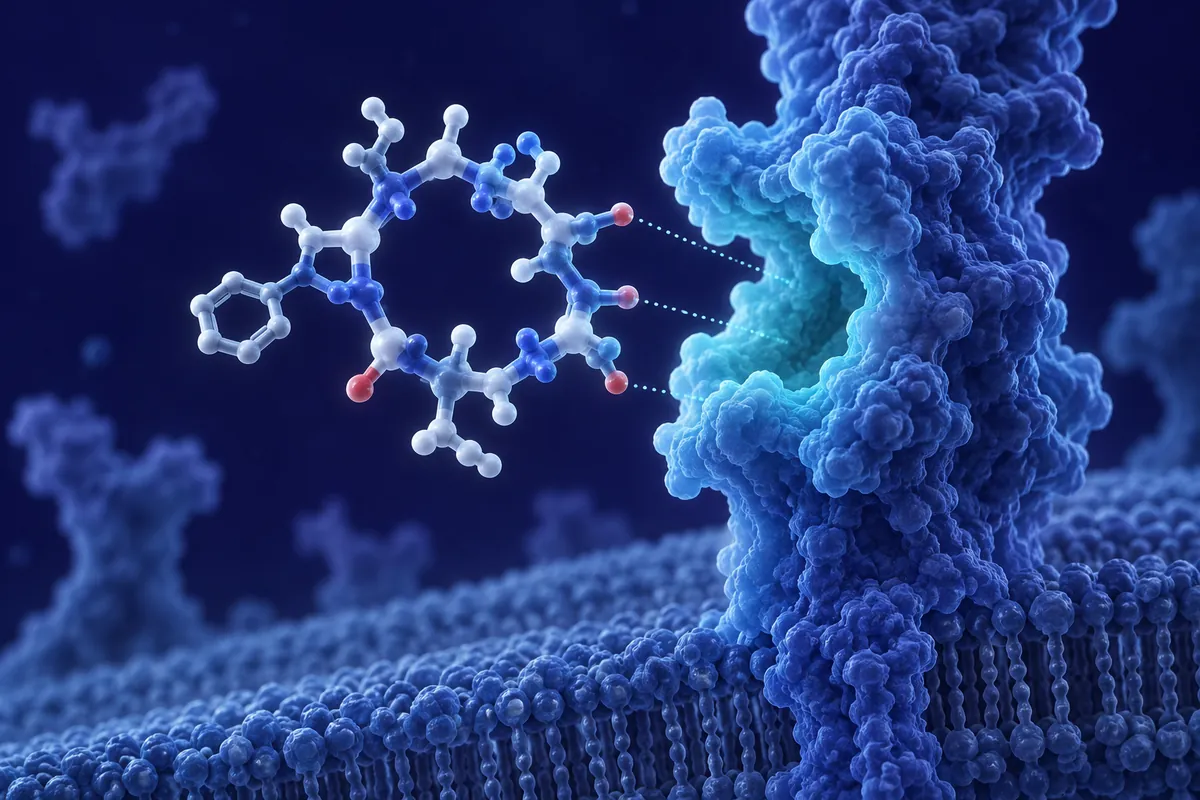
The global antimicrobial resistance (AMR) crisis is reshaping the priorities of microbiological and biochemical research. Each year, resistant pathogens claim hundreds of thousands of lives worldwide : a toll that the WHO projects will climb dramatically without decisive scientific intervention. Against this backdrop, researchers have intensified their study of host defense peptides (HDPs): small, evolutionarily ancient molecules that the innate immune system deploys as a first line of defense. Among them, LL-37 stands out as one of the most extensively investigated.
What Is LL-37?
Derived from the cleavage of the precursor protein hCAP18 : primarily by serine proteases such as proteinase 3 : LL-37 is a 37-amino acid, cationic, amphipathic α-helical peptide. The name reflects both its length and its N-terminal leucine-leucine sequence.
Expressed in neutrophils, epithelial cells, macrophages, and NK cells, LL-37 is found at barrier tissues throughout the body : skin, lung, gut, and reproductive mucosa. Its presence at these interfaces is no accident. What makes it compelling to study, however, is not just where it acts, but how it acts : across multiple, often simultaneous mechanisms.
Laboratory investigations have documented activity against Gram-positive and Gram-negative bacteria, enveloped viruses, fungi, and parasites. How does a single peptide accomplish this? The answer lies largely in its biophysical properties.
Membrane Disruption Mechanisms
LL-37’s cationic charge enables electrostatic attraction to negatively charged bacterial membranes : a feature largely absent in mammalian cell membranes, which are zwitterionic. Once bound, the peptide’s amphipathic helix inserts into the lipid bilayer. Several models have been proposed to explain the resulting disruption: the “carpet model,” in which peptide accumulation destabilizes the membrane surface; the “toroidal pore” model, where peptides and lipids together form transient pores; and detergent-like micellization at high concentrations. Research continues to refine which mechanism predominates under different experimental conditions, membrane compositions, and peptide concentrations.
Against Gram-negative species like Pseudomonas aeruginosa and Escherichia coli, LL-37 must first traverse the outer membrane : a challenge it navigates via interaction with lipopolysaccharide (LPS). Studies by Bals and colleagues, and later elaborated by Xhindoli et al. (2016) in Biochimica et Biophysica Acta, have detailed how LL-37 adopts a particularly helical conformation when interacting with LPS, which may facilitate its penetration. Against Gram-positive organisms, the absence of an outer membrane simplifies direct attack on the cytoplasmic membrane.
Antiviral Research Findings
The antiviral dimension of LL-37 research is equally active. In vitro studies have demonstrated activity against influenza A, HIV, respiratory syncytial virus (RSV), and herpes simplex viruses. The mechanisms here are somewhat distinct: rather than simple membrane lysis, LL-37 appears to interfere with viral entry by binding viral envelope proteins and disrupting interactions with host cell receptors.
Biofilm Disruption: A Critical Research Target
LL-37 disrupts biofilms through several mechanisms. Research by Overhage et al. This is a subtle but important distinction. A compound that disrupts biofilm formation at low concentrations may offer a fundamentally different research avenue than one that requires bactericidal concentrations.
More recent work has explored LL-37’s interaction with extracellular DNA (eDNA), a structural component of many biofilms. The peptide’s positive charge enables binding to eDNA, which may both destabilize the matrix and interfere with signaling that coordinates biofilm development. Whether this interaction can be exploited in engineered peptide derivatives remains an active area of study.
Perhaps the most nuanced : and scientifically rich : aspect of LL-37 research concerns its role as an immunomodulator. This dual identity complicates its study and makes it fascinating.
Resistance Profiles and Research Challenges
A central motivation for studying host defense peptides is the hypothesis that their multi-target mechanisms of action may make them inherently more difficult for pathogens to resist compared to single-target antibiotics. Is this borne out by the evidence? Partially. Staphylococcus aureus, for example, can use the DltABCD pathway to incorporate D-alanine into teichoic acids, reducing membrane electronegativity and thus LL-37 binding.
These resistance mechanisms are important objects of study in their own right. Understanding them may guide the design of synthetic peptide analogs that retain LL-37’s core activity while evading known countermeasures : a priority for peptide engineering research groups.
Synthetic Analogs and Future Research Directions
Native LL-37 presents several challenges as a research compound: susceptibility to proteolytic degradation, cytotoxicity at higher concentrations, and manufacturing complexity. This has spurred considerable interest in developing truncated or modified analogs.
The AMR crisis ensures that this line of inquiry will remain scientifically urgent.
For Research Purposes Only. LL-37 and related cathelicidin peptides discussed in this article are intended strictly for laboratory and preclinical research use. This content does not constitute medical advice, and these compounds are not approved for use in human applications. All research involving such peptides should be conducted in accordance with applicable institutional, ethical, and regulatory guidelines.
This educational material discusses laboratory research concepts only. Loti Labs products are intended strictly for research and development use and are not for human consumption.