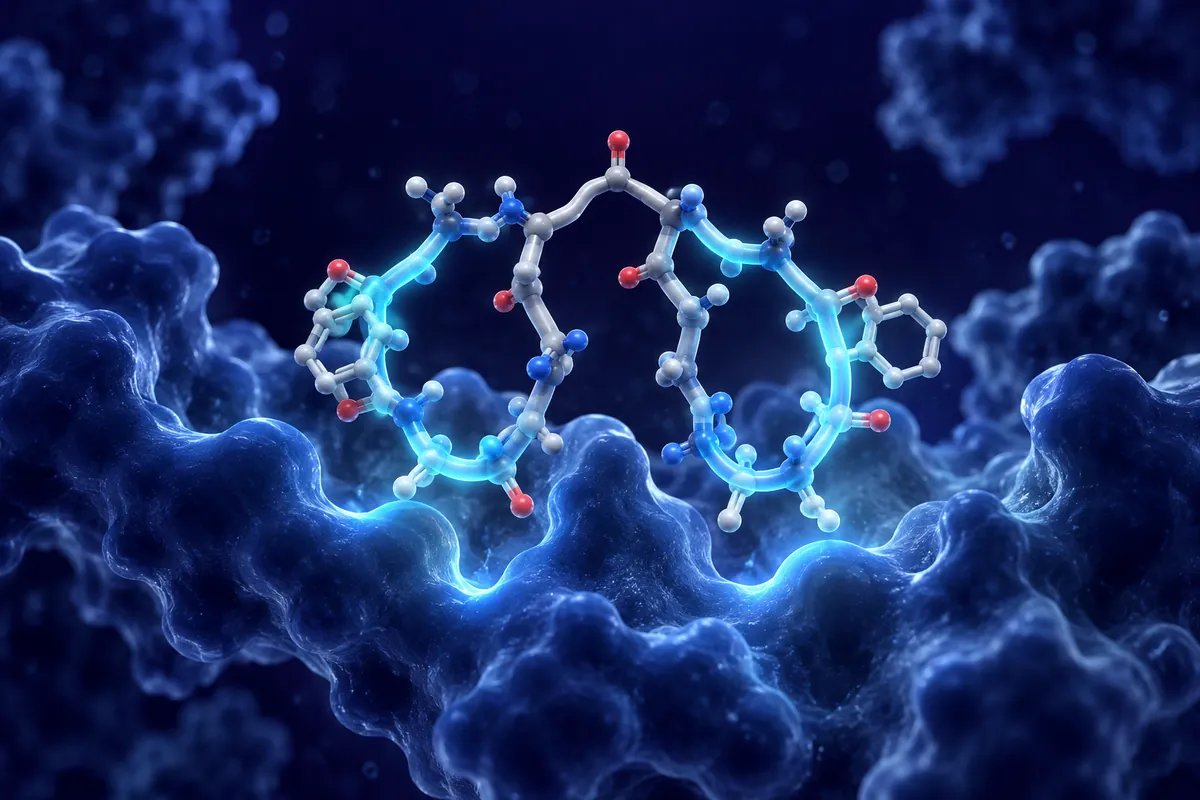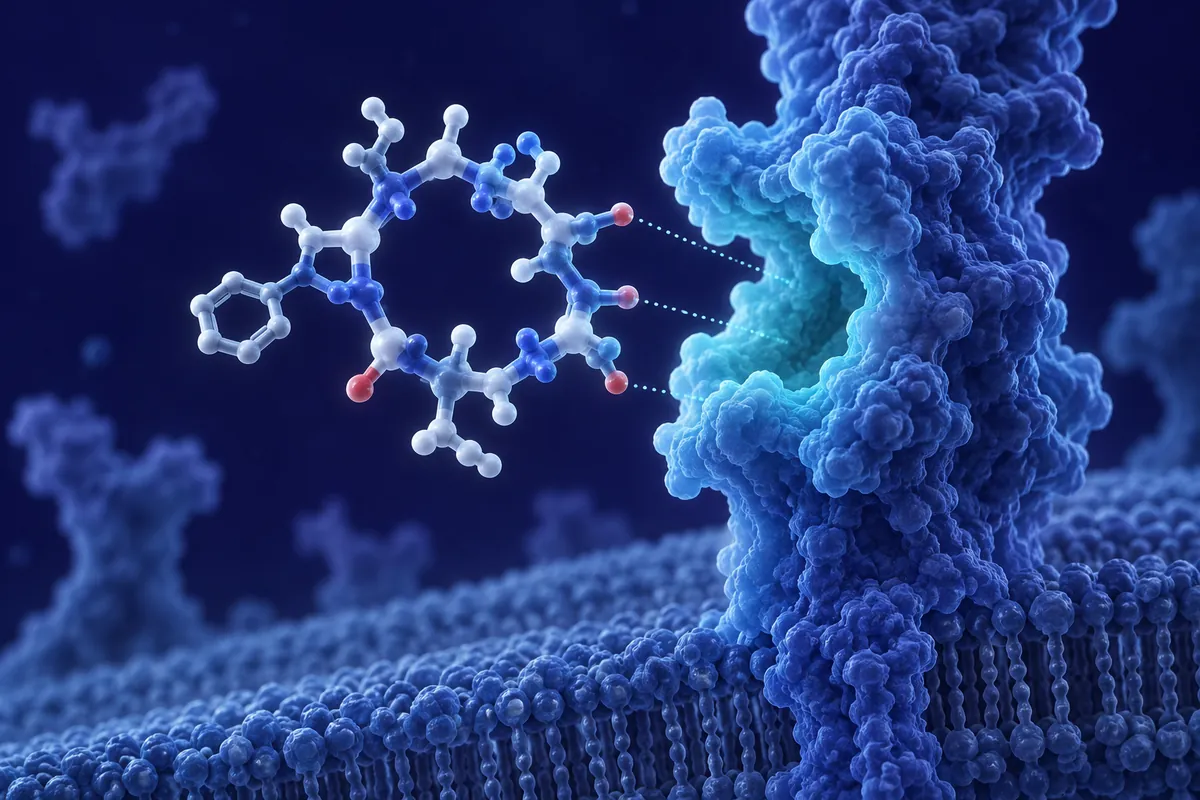
Few signaling molecules occupy as strategically important a position in reproductive endocrinology as kisspeptin. Encoded by the KISS1 gene and acting through its receptor KISS1R (formerly GPR54), kisspeptin sits at the very apex of the hypothalamic-pituitary-gonadal (HPG) axis : functioning as the master upstream regulator that ultimately governs gonadotropin release, sex steroid synthesis, and the broader rhythms of reproductive biology. For researchers exploring neuroendocrine signaling, kisspeptin is not merely a piece of the puzzle. It is, in many respects, the cornerstone that holds the entire structure together.
The KISS1 Gene and the Kisspeptin Family
The KISS1 gene was originally identified in the 1990s as a metastasis-suppressor gene in melanoma research : a context far removed from reproductive biology. Its peptide products, however, turned out to serve a far more fundamental physiological role. The gene encodes a precursor protein of 145 amino acids that undergoes proteolytic processing to yield several bioactive fragments: kisspeptin-54, kisspeptin-14, kisspeptin-13, and kisspeptin-10. All share the same C-terminal RF-amide motif essential for receptor binding.
Kisspeptin-10 is the shortest biologically active form and is commonly employed in research settings due to its structural simplicity. Kisspeptin-54 (also called metastin) represents the full-length processed peptide and demonstrates the highest affinity for KISS1R. Understanding which isoform is most relevant in a given experimental context remains an active line of inquiry.
KISS1R: The Receptor That Changed Reproductive Endocrinology
The significance of the kisspeptin system snapped into sharp focus following two landmark papers published in 2003. Seminara et al. and de Roux et al. independently reported that loss-of-function mutations in KISS1R caused idiopathic hypogonadotropic hypogonadism in both humans and mice : a condition characterized by absent or delayed puberty and infertility. If the receptor was silenced, the entire downstream HPG axis went quiet.
KISS1R is a Gαq/11-coupled G protein-coupled receptor expressed prominently on hypothalamic GnRH neurons. When kisspeptin binds, it triggers a robust and sustained secretion of gonadotropin-releasing hormone (GnRH). What makes this interaction so remarkable? GnRH neurons themselves do not express the receptor for most classical feedback signals. Kisspeptin neurons, by contrast, do : making kisspeptin the critical intermediary through which gonadal steroids communicate back to the brain.
Steroid Feedback Integration
Two primary kisspeptin neuron populations in the hypothalamus serve distinct functions in feedback regulation. Neurons in the arcuate nucleus (ARC) co-express kisspeptin, neurokinin B, and dynorphin : a trio known collectively as KNDy neurons. These cells are thought to be the primary mediators of negative feedback from circulating estradiol and testosterone. When gonadal steroid levels rise, KNDy neuron activity is suppressed, reducing GnRH pulsatility.
Neurons in the anteroventral periventricular nucleus (AVPV), found predominantly in female rodents, mediate a paradoxically positive feedback response to high estrogen. This mechanism underlies the preovulatory LH surge. The dual-population architecture of kisspeptin signaling provides a sophisticated, context-dependent regulatory system that researchers continue to dissect at the circuit and molecular levels.
Kisspeptin and Pulsatile GnRH Secretion
Reproduction in mammals depends not just on GnRH being present, but on it being secreted in precisely timed pulses. Continuous GnRH exposure actually desensitizes pituitary gonadotrophs : an observation that has important implications for research tool design. Pulsatile kisspeptin delivery, by contrast, faithfully mimics and drives endogenous GnRH pulsatility.
The KNDy neuron network in the arcuate nucleus is now widely accepted as the central “pulse generator” of the HPG axis. Neurokinin B acts as the accelerator, stimulating kisspeptin release; dynorphin acts as the brake, terminating each pulse. This self-sustaining oscillatory network produces the regular GnRH pulse intervals critical for downstream LH and FSH secretion. Elegant electrophysiological and calcium imaging studies have begun to reveal how these neurons coordinate their activity across time and space : work that would not have been possible without precise pharmacological tools targeting kisspeptin and its receptor.
Research Applications Across Reproductive Biology
Kisspeptin’s position at the top of the HPG axis makes it an exceptionally versatile research tool. By modulating kisspeptin signaling : either through receptor agonists, antagonists, or gene knockout models : investigators can interrogate virtually any downstream reproductive endpoint with mechanistic precision.
Puberty and Developmental Timing
When and how puberty is initiated at the neuroendocrine level remains an incompletely understood question. Evidence suggests that a rise in hypothalamic kisspeptin expression and increased KISS1R sensitivity in GnRH neurons is among the earliest detectable changes at puberty onset. Research in rodent models has demonstrated that central kisspeptin administration can advance pubertal timing, while KISS1 knockdown delays it. These findings position kisspeptin signaling as a core mechanism in developmental neuroendocrinology.
Seasonal Reproductive Rhythms
Seasonal breeders : sheep, hamsters, deer : provide another rich domain for kisspeptin research. In these species, hypothalamic kisspeptin expression fluctuates dramatically across photoperiod cycles, suggesting a direct link between melatonin signaling, kisspeptin neuron activity, and seasonal reproductive competence. Understanding this circuitry has implications for livestock reproductive biology and for basic research into how environmental signals are transduced into endocrine outputs.
Stress, Metabolism, and HPG Axis Suppression
The HPG axis is exquisitely sensitive to energetic and psychological stress. Chronic caloric restriction, for example, consistently suppresses kisspeptin expression in the hypothalamus before any detectable change in GnRH or LH is observed : placing kisspeptin signaling upstream of the metabolic gate on reproduction. Leptin, a key adipose-derived satiety hormone, appears to act in part through kisspeptin neurons, suggesting a molecular link between metabolic status and reproductive competence that warrants further mechanistic exploration.
Kisspeptin as a Neuroendocrine Research Tool
From an experimental design standpoint, kisspeptin offers properties that make it particularly tractable for in vivo neuroendocrine research. Peripheral kisspeptin administration reliably activates central GnRH neurons in a concentration-responsive manner, providing a clean, titratable stimulus for HPG axis activity. The robust LH response to kisspeptin challenge has been used as a functional readout of hypothalamic-pituitary integrity across numerous preclinical models.
Kisspeptin receptor antagonists such as peptide 234 (P234) and more recently developed small molecule KISS1R antagonists allow researchers to pharmacologically silence the kisspeptin input to GnRH neurons, effectively creating a reversible, pharmacological model of HPG axis suppression. Combined with genetic models : conditional KISS1R knockouts, Cre-driven KISS1 neuron ablations : these tools enable circuit-level dissection of reproductive neuroendocrinology that simply was not feasible a decade ago.
Current Research Frontiers and Outlook
The field continues to expand rapidly. Questions about sexual dimorphism in kisspeptin circuitry, species differences in KNDy neuron architecture, and the precise mechanisms by which kisspeptin neurons integrate diverse metabolic and hormonal signals remain active research fronts.
Beyond reproductive neuroendocrinology, kisspeptin’s original identity as a metastasis suppressor has not been forgotten. Its roles in cell migration, invasion, and possibly tumor microenvironment signaling continue to be explored in cancer biology. The molecular duality of kisspeptin : a master reproductive regulator that also influences oncogenic processes : makes it a uniquely multifaceted subject for fundamental peptide research.
As investigators develop increasingly refined tools for studying kisspeptin : from optogenetic activation of KISS1 neurons to single-cell transcriptomics of the arcuate nucleus : the precision with which the HPG axis can be interrogated will only grow. Kisspeptin sits at a rare intersection: molecularly tractable, physiologically central, and still yielding new surprises. That combination ensures its place at the forefront of neuroendocrine and reproductive biology research for years to come.
Disclaimer: This content is intended for research purposes only and is not meant to constitute medical advice.
This educational material discusses laboratory research concepts only. Loti Labs products are intended strictly for research and development use and are not for human consumption.