AI-Driven Peptide Discovery: AlphaFold, Generative Design Models & the Future of Peptide Research
The relationship between artificial intelligence and biological research has undergone a fundamental transformation in the past four years. What was once a field defined by painstakingly slow wet-lab iteration : synthesize a compound, test it, modify it, test it again : is now being reshaped by computational systems capable of predicting, designing, and virtually screening peptide candidates at a scale that no human team could match. The turning point was AlphaFold2. But the implications extend far beyond protein structure prediction. In 2026, the AI-driven peptide discovery pipeline is becoming a genuine research infrastructure : and understanding its capabilities and limitations is essential for any researcher working in this space.
AlphaFold2: The Structure Prediction Revolution and Its Relevance to Peptide Research
When DeepMind published AlphaFold2 in 2021 and subsequently released structure predictions for virtually the entire known proteome, the response from the scientific community was remarkable. Decades of structural biology : laborious X-ray crystallography, NMR spectroscopy, cryo-EM : had produced structures for a fraction of known proteins. AlphaFold2 predicted the rest, with accuracy that rivaled experimental methods for many targets.
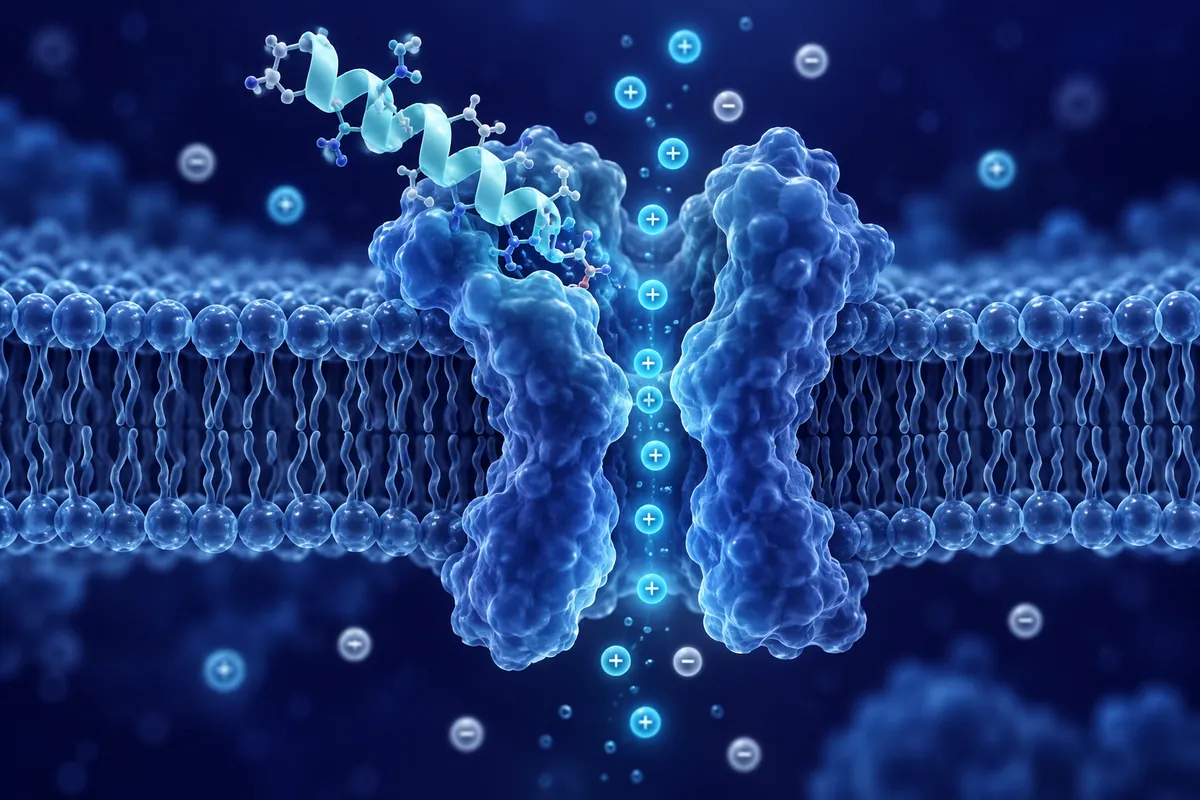
For peptide research, the implications are direct. Receptor binding studies require knowing the three-dimensional architecture of the target. Rational design of peptide ligands : short sequences engineered to fit a specific binding pocket : depends on understanding the shape, charge distribution, and conformational dynamics of that pocket. AlphaFold2’s freely available structure database has made this information accessible for targets that previously had no experimental structural data, opening thousands of receptor targets to structure-based peptide design that simply wasn’t possible before 2021.
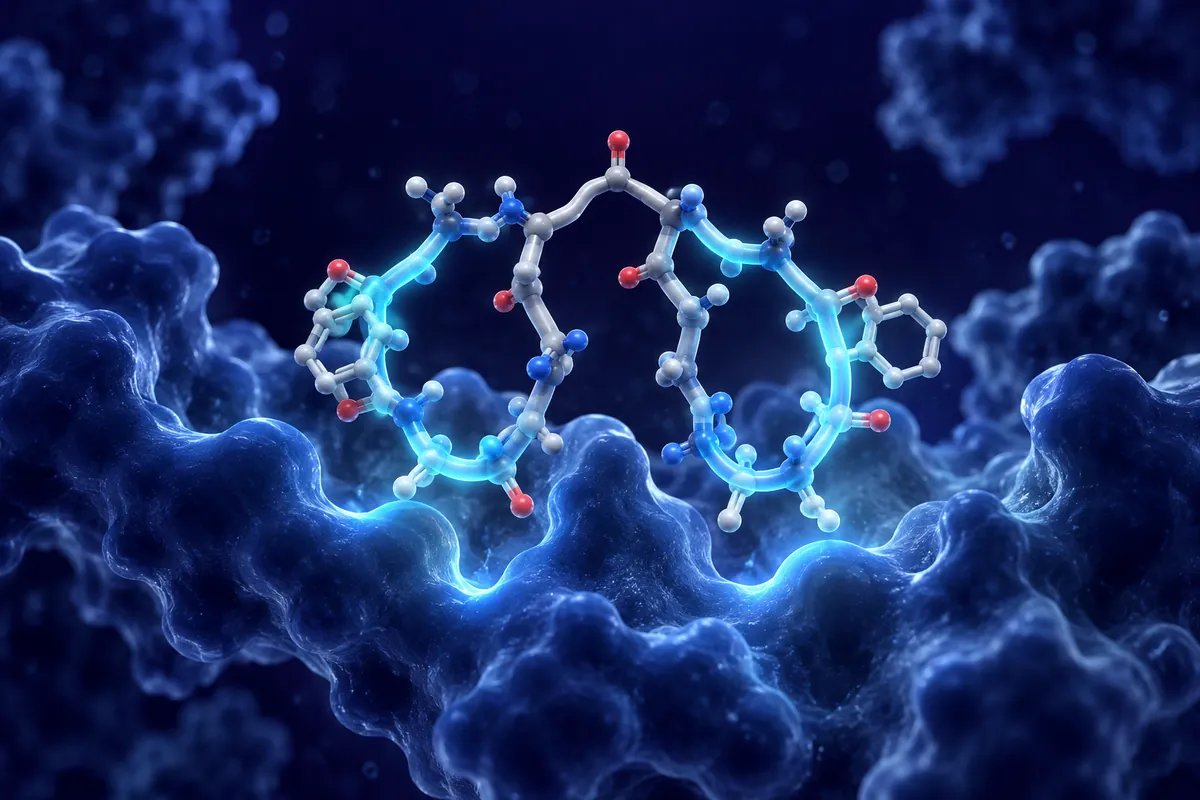
Virtual docking : computational placement of candidate peptide sequences into predicted binding sites to estimate binding affinity : has become dramatically more powerful as a result. Researchers can now generate ranked lists of peptide candidates against a novel target in silico before committing to any synthesis. The experimental burden is front-loaded into the computer, not the laboratory.
Generative Design Models: Inventing Peptides That Don’t Exist Yet
Structure prediction is powerful, but it operates on existing sequences. Generative AI models go further. Tools like RFdiffusion and ProteinMPNN : developed out of the Baker Lab at the University of Washington : can generate entirely novel peptide and protein sequences with specified structural or functional properties. They don’t retrieve sequences from a database. They invent them.
RFdiffusion applies a diffusion-based generative process to protein structure space, producing novel backbone architectures that can then be sequence-designed by models like ProteinMPNN. The workflow looks roughly like this: specify the desired binding geometry or structural scaffold → RFdiffusion generates candidate backbones → ProteinMPNN assigns amino acid sequences → AlphaFold2 validates predicted structure → virtual docking confirms binding pose. All computationally. All before a single peptide is synthesized.
The implications are significant. McLean et al. This is not incremental improvement over existing sequences. It is genuine molecular invention.
QSAR and Machine Learning: Predicting Activity from Sequence
Quantitative structure-activity relationship (QSAR) modeling is one of the oldest computational approaches in medicinal chemistry. Applied to peptides, QSAR models attempt to predict biological activity : potency, selectivity, metabolic stability, membrane permeability : from the sequence or structural features of candidate molecules. Machine learning has dramatically expanded what QSAR can do.
Training datasets sourced from large peptide and bioactivity databases : UniProt (now exceeding 550 million protein sequences), the Protein Data Bank (PDB), and ChEMBL, which catalogs bioactivity data for millions of compounds : provide the raw material for ML-driven QSAR models. These models can, in principle, learn the complex nonlinear relationships between sequence features and biological outcomes that classical statistical QSAR approaches struggle to capture.
Proteolytic stability prediction is a particularly active area. If a model can accurately predict which sequence regions are vulnerable to specific proteases : trypsin, chymotrypsin, brush-border peptidases : researchers can flag degradation-prone sites before synthesis and incorporate D-amino acid substitutions or cyclization strategies at the appropriate positions. This closes the loop between computational design and chemical modification strategy.
Still, honesty about limitations is essential. Peptide-receptor interactions are complex. Induced-fit binding, solvent effects, entropic contributions to affinity, and membrane context all introduce dynamics that current ML models do not fully capture. A model trained on one peptide-receptor class may generalize poorly to another. Virtual predictions must always be treated as hypotheses to be tested experimentally, not as final answers.
The Speed Advantage : and the Validation Requirement
The practical impact of AI-driven discovery on research timelines is substantial. Virtual screening of millions of peptide candidates against a target structure : a task that would take years of synthetic chemistry and bioassay work : can now be accomplished in hours on modern GPU infrastructure. The computational pre-screening dramatically narrows the experimental candidate pool. Instead of synthesizing and testing thousands of sequences, a research team might synthesize and test the top fifty predicted candidates. The hit rate improves because the screening is smarter.
But in silico is not in vitro, and in vitro is not in vivo. This cannot be stated too plainly. Predicted binding affinity does not equal actual activity. Stable folding in an AlphaFold2 prediction does not mean a peptide will fold correctly in aqueous solution or at physiological salt concentrations. Off-target effects invisible to a virtual screen may emerge in cell-based assays. Computational discovery is an accelerant for the research pipeline : a powerful filter that improves the quality of what reaches the bench : but it does not replace the bench.
The 2026 Landscape: Closed-Loop AI and Implications for Peptide Research
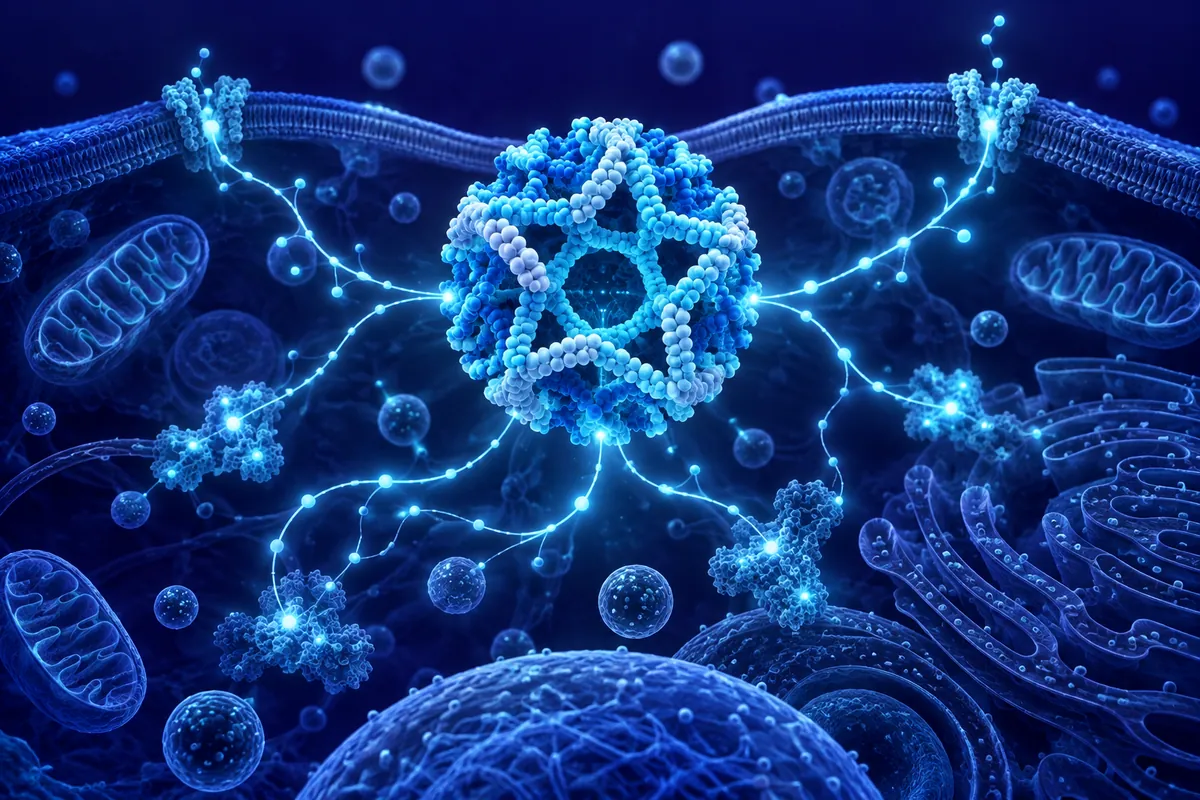
The most compelling development emerging in 2026 is the concept of the closed-loop AI discovery system. The workflow is iterative: a machine learning model designs peptide candidates → a small library is synthesized → experimental results (binding affinity, selectivity, stability) are generated → those results are fed back into the model as new training data → the model refines its predictions → the next synthesis round is better informed than the last. Each experimental cycle teaches the AI something that makes the subsequent design cycle more accurate.
This feedback architecture addresses one of the central weaknesses of purely in silico approaches: the gap between predicted and observed behavior. A closed-loop system learns the specific failure modes of its own predictions over time and compensates for them. Early implementations have demonstrated meaningfully improved hit rates in later synthesis rounds compared to first-round virtual screens : an encouraging signal that the approach is working.
For the broader research peptide field, the downstream effect of AI-accelerated discovery is already becoming visible: faster characterization of novel sequences, broader coverage of peptide structural space, and more rapid availability of research-grade compounds for laboratory investigation. The pace of discovery in the peptide space in 2026 is materially faster than it was five years ago, and AI-driven design is a significant reason why.
Conclusion
Artificial intelligence has not solved peptide discovery. What it has done : through AlphaFold2’s structure prediction revolution, generative design models like RFdiffusion and ProteinMPNN, and ML-driven QSAR systems trained on massive sequence and bioactivity databases : is fundamentally change the ratio of computational work to experimental work in the discovery pipeline. The hypothesis space is explored in silico. The bench work is focused where it matters most. Researchers who understand both the power and the current limitations of these tools are best positioned to use them effectively. In silico and in vitro remain complementary, not competing : and the most productive research programs in this space will be those that treat them as such.
For Research Purposes Only: The information presented in this article is intended solely for scientific research and educational purposes. These compounds are not approved for human use and should only be handled by qualified researchers in appropriate laboratory settings in compliance with all applicable regulations.
This educational material discusses laboratory research concepts only. Loti Labs products are intended strictly for research and development use and are not for human consumption.