For laboratory and research use only. Not for human consumption.
Here’s a problem that frustrated endocrine researchers for decades: native growth hormone-releasing hormone breaks down in minutes. Literally minutes. That’s why Theratechnologies Inc. in Montreal started tinkering with the molecule in the first place : and what they came up with was tesamorelin, a 44-amino acid GHRH analogue with one clever tweak that changes everything.
That tweak? A trans-3-hexenoic acid group bolted onto the N-terminal tyrosine. It sounds minor. It isn’t. That single lipophilic modification makes the compound resist the very enzymes that destroy native GHRH, and it tightens binding at the pituitary receptor.
What Is Tesamorelin? Chemical Identity & Structure
It carries the full 44-amino acid sequence of human GHRH (1-44). Same building blocks. One critical addition at the front end.
| Property | Value |
|---|---|
| Compound Name | Tesamorelin (TH9507) |
| Brand Name | Branded prescription formulation |
| CAS Number | 218949-48-5 |
| Molecular Formula | C221H366N72O67S |
| Molecular Weight | 5,135.86 Da |
| Amino Acid Length | 44 residues |
| Classification | GHRH receptor agonist |
| N-Terminal Modification | trans-3-Hexenoic acid |
| PubChem CID | 146681838 |
| Storage | 2-8°C (lyophilized powder) |
So why does that N-terminal modification matter so much? Two reasons. First, the trans-3-hexenoic acid group shields the peptide from DPP-IV and other aminopeptidases : the enzymes that shred native GHRH within minutes. Without the modification, endogenous GHRH (1-44) has a circulating half-life of maybe 5 to 7 minutes. That’s it. Gone. (PMID: 16052083). Tesamorelin survives long enough to do real work.
Development History
The compound started life as TH9507 : lab code, no brand name, just a promising molecule in Theratechnologies’ pipeline. The goal was straightforward: build a GHRH analogue that doesn’t fall apart the second it enters the bloodstream.
They succeeded. After Phase 2 and Phase 3 trials looking at how tesamorelin affected visceral fat stores, the FDA approved it in November 2010 under a branded prescription name. The compound keeps showing up in new contexts.
Mechanism of Action: How Tesamorelin Triggers GH Release
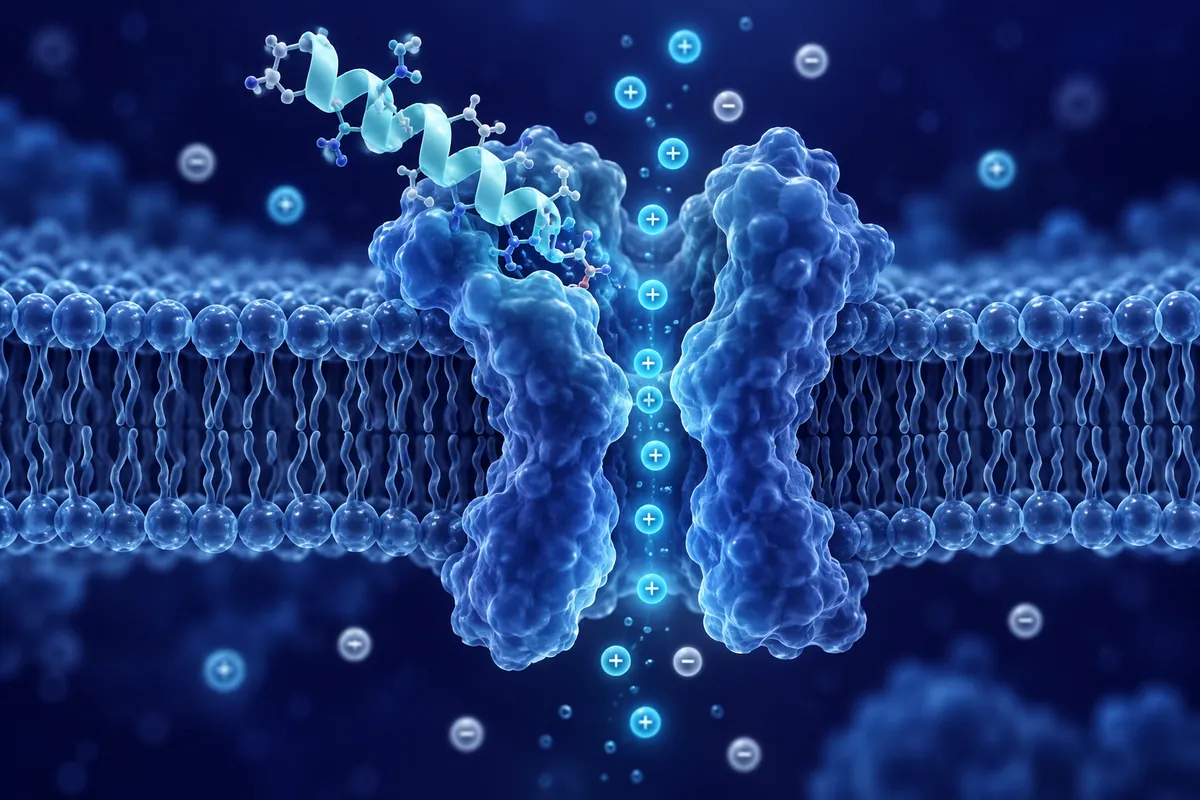
Big picture: tesamorelin binds the GHRH receptor on your pituitary. Done.
Pituitary GHRH Receptor Binding
Tesamorelin finds GHRH receptors on somatotroph cells sitting in the anterior pituitary and latches on. And here’s the kicker : that trans-3-hexenoic acid mod creates a tighter grip than native GHRH manages. Stronger binding. Stronger activation.
The Signaling Chain
Receptor engagement sets off a domino run:
- Gαs protein flips on : activating adenylyl cyclase
- cAMP floods in : adenylyl cyclase converts ATP to cyclic AMP, fast
- PKA fires up : all that cAMP wakes protein kinase A
- CREB gets tagged : phosphorylated, shipped to the nucleus
- GH dumps into blood : simultaneously, PKA cracks open calcium channels and pre-formed GH granules pour out via exocytosis
It preserves pulsatile release. Somatostatin still pumps the brakes between pulses. Feedback loops stay wired. You don’t get a flat-line dump of exogenous hormone : you get the real pattern, the one your pituitary was designed to produce. If you’re studying physiological GH secretion, this is a critical distinction. Not a minor footnote. Critical.
The IGF-1 Handoff
GH is actually a middleman. That falls on IGF-1. Researchers use IGF-1 elevation as their proof-of-concept marker for tesamorelin activity (PMID: 18057338). If IGF-1 isn’t moving, the compound isn’t working. Simple as that.
Published Research Findings
This isn’t a compound with a handful of pilot studies and some hand-waving. Tesamorelin has randomized controlled trial data. Multiple trials. Here’s what they found.
Visceral Fat: The Big One
Falutz et al. pooled data from two multicenter, double-blind, placebo-controlled Phase 3 studies : 816 subjects, 26 weeks (PMID: 23015655). The numbers were clear:
- Placebo groups: +5.0% : they gained visceral fat
- Between-group difference: P<0.001
- Trunk fat dropped too
A 20-point swing between drug and placebo. Different study, same story.
Liver Fat: This Is Where It Gets Really Interesting
Stanley et al. ran a 12-month randomized controlled study with 60 subjects who had excess abdominal adiposity (PMID: 24823457). What they found caught a lot of attention:
- Tesamorelin cut hepatic fat fraction by 37% relative to baseline
- Placebo group? Their liver fat went up 27%
- Absolute drop: −3.7 percentage points tesamorelin vs. +1.7 placebo
- More subjects in the tesamorelin arm met criteria for hepatic steatosis resolution
This one snuck up on people.
- All while visceral fat was going down
That caught the attention of sarcopenia researchers pretty quickly.
This is newer and still developing.
Published data also shows:
- Adiponectin: Went up.
Pharmacokinetics: What Researchers Need to Know
Numbers first:
| Parameter | Value |
|---|---|
| Bioavailability (SC) | ~4% (typical for large peptides) |
| Tmax | ~0.15 hours (~9 minutes) |
| Half-life | 26 min (tesamorelin); 38 min (GHRH 1-44 fragment) |
| Peak GH Response | |
| IGF-1 Elevation | Sustained over weeks of administration |
| Metabolism | Proteolytic cleavage to GHRH(1-44) and smaller fragments |
| Protein Binding |
Four percent bioavailability. That sounds terrible : and for a small molecule, it would be. But it’s normal for large peptides. The thing to wrap your head around: tesamorelin itself is gone from plasma in about 26 minutes. But the GH pulse it triggers lasts 2 to 4 hours. So the compound disappears fast, but its biological footprint doesn’t. That disconnect between pharmacokinetics and pharmacodynamics is something researchers absolutely must account for in protocol design (PMID: 36356032).
Tesamorelin vs. Other GHRH Analogues
If you’re running GH secretagogue experiments, you’ve probably looked at sermorelin, CJC-1295, and tesamorelin side by side. Here’s how they stack up:
| Property | Tesamorelin | Sermorelin | CJC-1295 (no DAC) | CJC-1295 (with DAC) |
|---|---|---|---|---|
| Amino Acids | 44 | 29 | 29 (modified) | 29 (modified) |
| GHRH Sequence | Full GHRH(1-44) | GHRH(1-29) | Modified GHRH(1-29) | Modified GHRH(1-29) |
| Key Modification | trans-3-hexenoic acid (N-term) | None (truncated native) | 4 amino acid substitutions | 4 substitutions + DAC |
| Half-life | ~26 min | ~10-20 min | ~30 min | ~8 days |
| GH Release Pattern | Pulsatile | Pulsatile | Pulsatile | Sustained/blunted pulsatility |
| DPP-IV Resistance | Minimal | High (amino acid subs) | High | |
| IGF-1 Elevation | Significant, sustained | Moderate | Moderate | Prolonged |
| Visceral Fat Data | Extensive Phase 3 data | Limited | Limited | Limited |
| Published Trials | Multiple Phase 2/3 RCTs | Moderate | Limited | Limited |
Against Sermorelin
Sermorelin is GHRH chopped to 29 amino acids. Still works : the truncated fragment keeps full receptor activity. Pulsatile release? Check. But there’s no N-terminal shield. DPP-IV enzymes tear it apart.
Against CJC-1295
Different philosophy here. CJC-1295 without DAC : Mod GRF 1-29 if you prefer the other name : swaps out four amino acids at positions 2, 8, 15, and 27. Those substitutions block DPP-IV from cutting the chain. Half-life: about 30 minutes. Comparable to tesamorelin. Keeps pulsatile release intact. And it stacks well with ghrelin agonists like ipamorelin : researchers like that combination for synergistic GH output.
Then there’s CJC-1295 with DAC. Totally different beast. The Drug Affinity Complex grabs serum albumin and hangs on, pushing the half-life to around 8 days. Sounds ideal until you realize it might flatten the natural GH pulse pattern. If your experiments need physiological rhythm, that trade-off could be a deal-breaker.
Combo Approaches
Why pick one when you can push from both sides? Plenty of researchers pair GHRH agonists with ghrelin receptor agonists for synergistic GH release. Two different receptor systems, one combined output. The CJC-1295/Ipamorelin blend is the classic pairing.
Safety Profile & Research Considerations
The pooled Phase 3 analysis (PMID: 23015655) gives a reasonably clear safety picture across hundreds of subjects:
- Most common finding.
- IGF-1 went up: Consistently. But it dropped back to baseline when administration stopped. Reversible
- Glucose: Some subgroups saw small fasting glucose increases, but HbA1c changes weren’t statistically significant in most analyses
- Fluid retention: Some peripheral edema and joint discomfort : expected with GH-mediated effects
- Liver enzymes: ALT levels didn’t differ between tesamorelin and placebo groups across studies. No acute liver injury cases reported (PMID: 18057338)
Visceral fat reaccumulates after discontinuation. That’s a real consideration for long-term study designs : and for interpreting what “sustained effect” actually means with this compound.
Regulatory Status
FDA approved November 2010. Brand name: marketed as a branded prescription formulation (later reformulated in a single-vial format).
For lab research, tesamorelin is available as lyophilized powder at ≥98% purity, confirmed by third-party HPLC and mass spectrometry.
Product Specifications
| Specification | Details |
|---|---|
| Product | Tesamorelin 10mg |
| Form | Lyophilized powder |
| Purity | ≥98% (HPLC verified) |
| Third-Party Testing | Mass spectrometry + HPLC |
| Storage | 2-8°C, protect from light |
| CAS Number | 218949-48-5 |
Related compounds for GH axis research: Sermorelin 2mg, CJC-1295 (Mod GRF 1-29) 2mg, CJC-1295 with DAC 2mg, CJC-1295/Ipamorelin Blend, and Ipamorelin 2mg.
Where Tesamorelin Research Is Heading
The compound isn’t sitting still. Multiple angles are being explored right now:
NAFLD is the big one. Stanley’s liver fat work blew a door open, and now researchers want to know if those results hold across broader populations. Fatty liver disease affects tens of millions of people and treatment options are limited.
Cognition is the wild card. But we’ll need the data before getting too excited.
Sarcopenia crept in through the back door.
Conclusion
Tesamorelin is the GHRH analogue with the receipts. A 37% relative cut in liver fat. And a mechanism that keeps pulsatile GH secretion intact instead of flooding the system with exogenous hormone.
Not many research peptides have this depth of controlled trial data behind them. Tesamorelin 10mg is available in high-purity lyophilized form for laboratory research.
References
- Falutz J, et al. J Clin Endocrinol Metab. 2007. PMID: 16052083
- Falutz J, et al. Multicenter study of tesamorelin for visceral adiposity. J Acquir Immune Defic Syndr. 2008. PMID: 18057338
- Falutz J, Mamputu JC, Potvin D, et al. Pooled analysis of two Phase 3 trials with safety extension data. Clin Infect Dis. 2012;54:1642-51. PMID: 23015655
- Stanley TL, et al. J Clin Endocrinol Metab. 2014. PMID: 24823457
- Adrian S, et al. Clin Infect Dis. 2019. PMC6766405
- NCT02572323. Phase II Trial of Tesamorelin for Cognition. ClinicalTrials.gov.
For laboratory and research use only. Not for human consumption. This article is intended for educational and informational purposes for qualified researchers.
This educational material discusses laboratory research concepts only. Loti Labs products are intended strictly for research and development use and are not for human consumption.