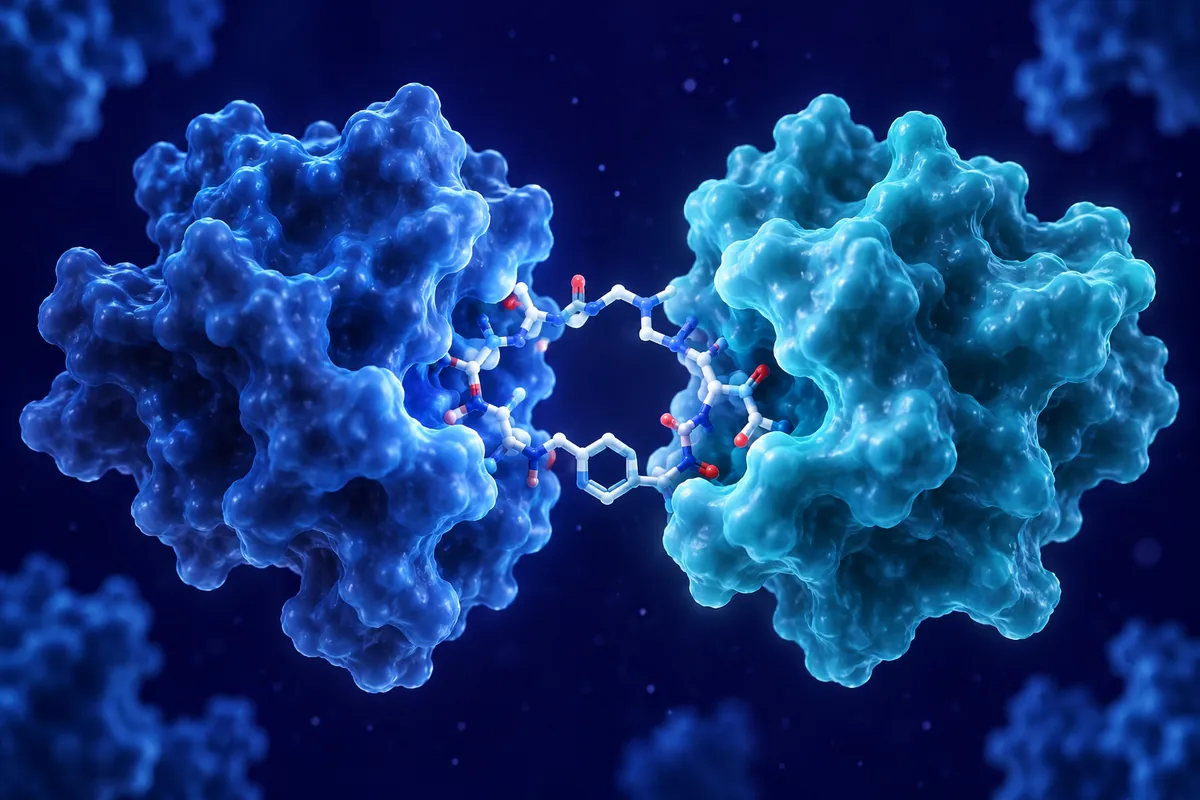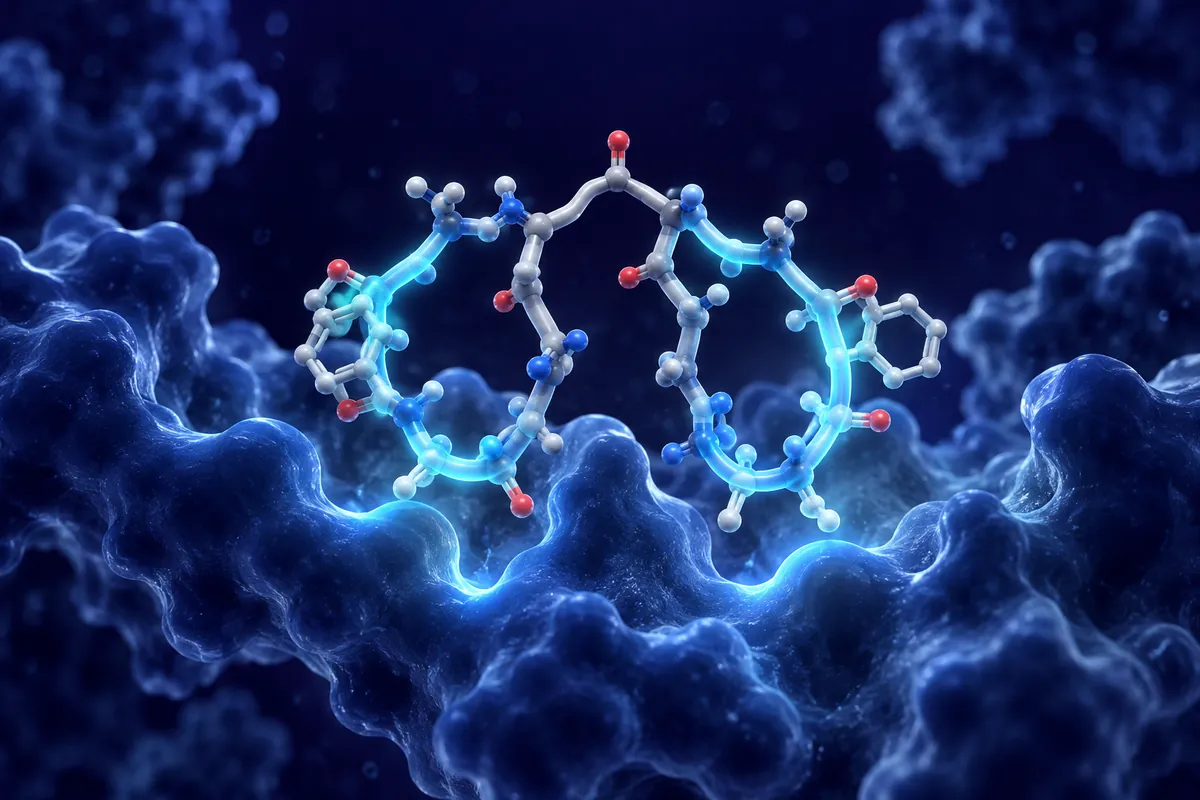
SLU-PP-332 did not come out of a screen for metabolic compounds. It came out of a chemist deciding to fix a molecule that almost worked. The starting point was GSK4716, a known agonist of two estrogen-related receptors that had basically no activity on the third one, ERRα. Burris and Walker’s team swapped its isopropyl-phenyl group for a naphthalene ring, and the new compound picked up about 50-fold more ERRα potency [1].
That naphthalene swap is SLU-PP-332. If you are designing a study around it, the “why it exists” matters, because the whole compound is tuned to hit a receptor earlier agonists kept missing.
What it actually is
Chemically it is small and simple: 4-hydroxy-N-[(E)-naphthalen-2-ylmethylideneamino]benzamide, formula C18H14N2O2, mass 290.3 g/mol, PubChem CID 5338394. No peptide bond anywhere in it. It is a synthetic small molecule, which already sets it apart from most of what gets filed next to it in the research-compound world.
The target is the estrogen-related receptor family: ERRα, ERRβ and ERRγ. These are orphan nuclear receptors that help run mitochondrial biogenesis, fatty acid oxidation and oxidative metabolism [1]. The “exercise mimetic” tag comes from the fact that aerobic training switches on a lot of the same ERR-driven gene program.
The binding numbers
The 2023 discovery paper is the one to read first. In a full-length ERR cell-based reporter assay, SLU-PP-332 gave an ERRα EC50 of 98 nM, ERRβ of 230 nM and ERRγ of 430 nM [1]. So it is a pan-agonist that leans hardest on ERRα, which was the whole design goal.
Those three numbers are worth copying into your notebook, because a lot of secondary write-ups describe SLU-PP-332 as “an ERRα agonist” full stop and leave out that it also drives the other two. If your readout depends on ERR subtype, that distinction is not a footnote.
The same group confirmed the mechanism points back to ERRα specifically. In their mouse work the exercise-type gene response was ERRα-dependent, and knocking that dependency out removed the effect [1].
What it does in cells
In the C2C12 myoblast line, SLU-PP-332 did two things the paper measured directly. It raised maximum mitochondrial respiration after 24 hours against vehicle-exposed cells, and it increased mitochondrial content based on MitoTracker staining [1]. Both results sit squarely in the ERR wheelhouse, since ERRα activation is tied to mitochondrial function in these cells. The induction of one ERR target gene, Ddit4, showed up in as little as one hour of exposure, which gives a fast, cheap readout if you want to confirm the compound is active before running a longer experiment [1].
One practical detail from the pharmacokinetics section: the compound reached roughly micromolar levels in mouse tissue and lower levels in plasma, which is why the authors called its properties “sufficient” to use it as an in vivo chemical tool [1]. Sufficient, not optimized. A later SAR study spelled out that several analogues beat SLU-PP-332 on solubility and metabolic stability while matching its activity [2]. So it is a good probe, not a finished drug candidate, and that gap is exactly what the follow-up chemistry is chasing.
Why the COA matters more here than usual
A lot of the search traffic for this compound is people looking for a test report or a certificate of analysis, and there is a good reason that instinct is correct.
SLU-PP-332 is new enough that the analytical community is still publishing how to identify it. Two separate 2026 studies worked out its in vitro metabolite fingerprint using human liver fractions, finding more than a dozen Phase I and Phase II products in one case and nine in another [3, 4]. When the metabolism of a compound is still being mapped in 2026, do not assume every vendor has a settled identity method for the parent compound either.
| Property | Value | Source |
|---|---|---|
| Chemical class | Non-peptide small molecule | PubChem CID 5338394 |
| Formula / mass | C18H14N2O2 / 290.3 g/mol | PubChem |
| ERRα EC50 | 98 nM | Billon 2023 [1] |
| ERRβ / ERRγ EC50 | 230 nM / 430 nM | Billon 2023 [1] |
| Parent scaffold | Optimized from GSK4716 | Billon 2023 [1] |
So verification is not boilerplate advice for this one. Identity confirmation by mass spectrometry and a purity figure from HPLC, tied to the exact lot in front of you, are the difference between studying SLU-PP-332 and studying an unknown. Our certificate of analysis explainer breaks down what those documents should contain.
Designing around it
A few things fall out of the literature. Run an ERRα-dependent readout if you want to connect your result to the published mechanism, because that is the arm the discovery paper validated [1]. Report your cell line and timepoint, since the C2C12 respiration effect was measured at 24 hours [1]. And if you are comparing SLU-PP-332 to a newer analogue, remember the newer ones were built to fix its solubility and stability [2], so those properties, not just potency, may drive what you see.
For a side-by-side with another metabolic compound, see our SLU-PP-332 vs O-304 comparison and the SLU-PP-332 vs 5-Amino-1MQ overview.
References
- Billon C, et al. ACS Chem Biol. 2023;18(4):756-771. PubMed 36988910
- Okda HE, et al. Int J Biol Macromol. 2026;355:151450. PubMed 41850449
- Avliyakulov NK, et al. Drug Test Anal. 2026;18(3):439-450. PubMed 41688415
- Möller T, et al. Rapid Commun Mass Spectrom. 2026;40(8):e70039. PubMed 41588687
Disclaimer: This content is intended for research purposes only and is not meant to constitute medical advice.
This educational material discusses laboratory research concepts only. Loti Labs products are intended strictly for research and development use and are not for human consumption.