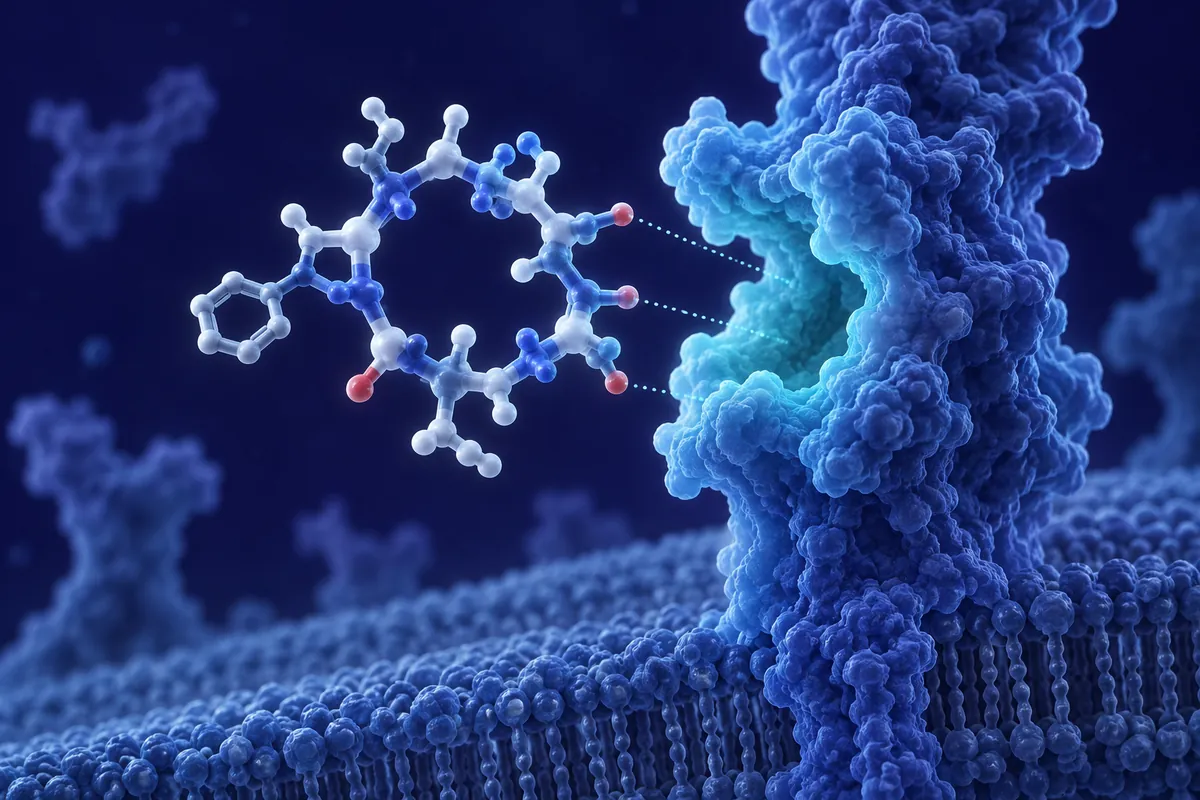
Peptide YY comes in two flavors, and the difference between them is a single enzymatic cut. The full-length form, PYY1-36, is promiscuous across several receptor subtypes. Trim two residues off the front and you get PYY3-36, a sharper tool that prefers one receptor and signals through a well-mapped gut-brain circuit. For researchers interested in how peripheral signals reach appetite-regulating neurons, PYY3-36 is close to a textbook case. Let’s walk through why.
One Enzyme, Two Peptides
PYY is released from L cells in the distal gut after a meal, in rough proportion to the calories present. It starts life as PYY1-36. Then dipeptidyl peptidase-4 (DPP-4), the same enzyme that chews on GLP-1 and oxyntomodulin, removes the N-terminal tyrosine-proline pair. The product is PYY3-36.
That small edit changes the pharmacology substantially. PYY1-36 binds and activates several members of the Y receptor family, including Y1, Y2, and Y5. PYY3-36, by contrast, is much more selective for the Y2 receptor. In other words, DPP-4 doesn’t just shorten the peptide, it refocuses it. The enzyme acts as a built-in selectivity filter, converting a broad-spectrum ligand into a Y2-preferring one.
Y2 Signaling and the Arcuate Circuit
The Y2 receptor is where the gut-brain story gets specific. Y2 is a presynaptic, mostly inhibitory Gi-coupled receptor, and it is expressed on neurons in the arcuate nucleus of the hypothalamus, a region that integrates peripheral energy signals. Within the arcuate sit two famous, opposing neuron populations: orexigenic NPY/AgRP neurons that promote feeding, and anorexigenic POMC neurons that oppose it.
Electrophysiology in rodent brain slices has shown that PYY3-36 acting at Y2 inhibits NPY neurons, and this effect is blocked by the Y2 antagonist BIIE0246, which is the clean pharmacological control you want to see. Interestingly, some work found PYY3-36 can inhibit both NPY and POMC neurons, which complicated the tidy early picture; the balance of evidence leans toward reduced NPY/AgRP activity being the dominant driver of the observed changes in feeding behavior in rodent models. That nuance matters, and it’s a good example of why single-pathway explanations deserve scrutiny.
Reading the Rodent Feeding Studies
Much of what we know mechanistically comes from controlled rodent experiments. Peripheral administration of PYY3-36 in rats reduced food intake in acute studies, and researchers mapped neuronal activation using Fos as a marker. Fos labeling lit up not just the arcuate nucleus but also hindbrain regions including the nucleus tractus solitarius and area postrema, which tells you the signal is reaching multiple nodes of the feeding-control network rather than acting at a single site.
A word of caution about this literature. Dose-response relationships for peripherally administered PYY3-36 in rodents turned out to be sensitive to experimental conditions, and early findings prompted vigorous methodological debate about reproducibility. None of that undercuts the receptor mechanism, but it does mean careful controls and attention to administration method are essential when designing new rodent work. Good science here lives or dies on the details.
Short Half-Life and the Engineering Response
Native PYY3-36 has a practical drawback as a research scaffold: a relatively short circulating half-life, partly because the same DPP-4 activity and renal clearance that shape the peptide family keep working on it. Its Y2 selectivity, while good, also isn’t perfectly clean against the other Y subtypes.
So structure-activity work has pursued longer-acting, more selective analogs. One well-characterized example, NNC0165-1273, was engineered for dramatically higher Y2 affinity over the other Y receptors, reportedly several hundred-fold selectivity, and attenuated NPY/AgRP neuron activity while reducing food intake in male mice. The engineering playbook mirrors what’s done across this peptide class: block the DPP-4 recognition site, add elements that extend circulation, and sharpen receptor selectivity so the molecule hits Y2 and little else.
The Broader Y Receptor Family
To appreciate why Y2 selectivity is the prize, it helps to see the family it belongs to. The neuropeptide Y receptor family in mammals includes Y1, Y2, Y4, and Y5, each with its own tissue distribution and its own behavioral correlates in rodent studies. Y1 and Y5 activity has generally been linked to increased feeding, while Y2 sits on the opposite side of the ledger. A ligand that hits several of these at once, as full-length PYY1-36 does, produces a muddy net effect because it’s pulling in competing directions simultaneously. That’s exactly why the DPP-4 truncation is so useful conceptually: by shifting preference toward Y2, it strips away much of the countervailing signaling and leaves a cleaner pharmacological message. Engineered analogs push that logic further still, chasing selectivity margins the native peptide never had. It’s a nice illustration of how receptor subtype selectivity, not just potency, defines whether a peptide makes a good research tool.
Why PYY3-36 Remains a Reference Point
As a research subject, PYY3-36 is valuable precisely because its biology is traceable end to end. You can follow a meal signal from gut secretion, through a specific enzymatic truncation, to a selective receptor, into a mapped hypothalamic and hindbrain circuit, and out to measurable feeding behavior in rodents. Few endogenous peptides let you connect that many dots with so little hand-waving.
The open questions are the interesting kind. How do simultaneous effects on NPY and POMC neurons net out under different conditions? What selectivity margin is actually needed for a clean Y2 tool compound? And how do half-life extensions change the circuit-level response? Those are cell-assay and rodent questions, and they keep PYY3-36 firmly in the mechanistic research literature where it has always been most useful.
Disclaimer: This content is intended for research purposes only and is not meant to constitute medical advice.
This educational material discusses laboratory research concepts only. Loti Labs products are intended strictly for research and development use and are not for human consumption.