
Premium USA-Made Research Compounds
Browse lab-tested peptides, research liquids, capsules and more.
Retatrutide: Triple GLP-1/GIP/GCGR Agonism, Metabolic Pathway Research & Pharmacodynamic Profiles
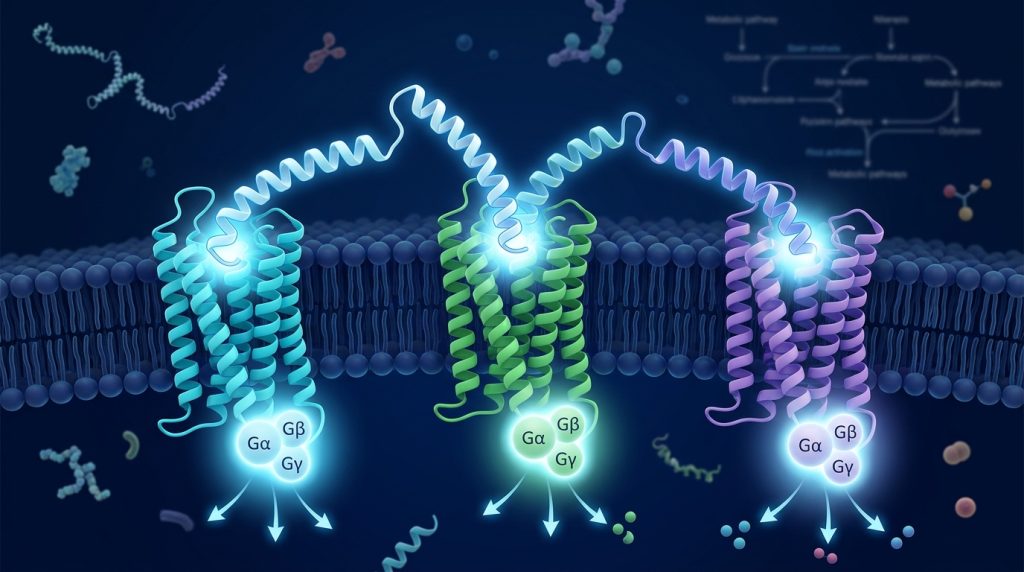
The metabolic peptide research landscape has rarely witnessed a compound as pharmacologically ambitious as retatrutide. Developed by Eli Lilly under the designation LY3437943, this molecule simultaneously engages three distinct receptor systems — the glucagon-like peptide-1 receptor (GLP-1R), the glucose-dependent insulinotropic polypeptide receptor (GIPR), and the glucagon receptor (GCGR). Each receptor operates through a different mechanism. Together, their coordinated activation produces a metabolic profile that, based on Phase II clinical data published in the New England Journal of Medicine in 2023, exceeds every previously studied compound of its class in magnitude of effect. For researchers studying energy homeostasis, adipose biology, and multi-receptor pharmacology, retatrutide represents a genuinely new chapter.
The Three-Receptor Rationale: Why Simultaneous Agonism?
Understanding retatrutide requires stepping back to ask a foundational question: why target three receptors at once? Semaglutide, the benchmark GLP-1R monoagonist, achieves approximately 15% body weight reduction in controlled research studies. Tirzepatide, a GLP-1R/GIPR dual agonist, reaches approximately 21%. Retatrutide’s Phase II data showed approximately 24% body weight reduction at 48 weeks. The incremental gains from adding each receptor are not coincidental — they reflect distinct, non-overlapping metabolic pathways being activated in parallel.
GLP-1R agonism is the most thoroughly characterized mechanism in this class. Activation enhances glucose-dependent insulin secretion from pancreatic beta cells, slows gastric emptying, and — critically for energy balance research — engages central nervous system pathways. The arcuate nucleus of the hypothalamus and the nucleus tractus solitarius (NTS) both express GLP-1R. Signaling through these regions suppresses appetite and modulates reward-based food intake circuitry. This is not simply peripheral satiety. It is centrally mediated behavioral modulation.
Looking for Premium Research Compounds?
GIPR agonism adds a second layer. Like GLP-1R, GIPR stimulates glucose-dependent insulin secretion, making GIP a potentiating signal in the postprandial insulin response. But GIPR research extends further. Expression has been identified in hippocampal neurons, suggesting potential roles in cognitive-metabolic signaling. Bone turnover studies have also incorporated GIPR agonism as a variable. Exactly how GIPR contributes to the enhanced efficacy of dual and triple agonists remains an active research question — one that retatrutide’s pharmacodynamic data continues to illuminate.
The Glucagon Receptor Paradox
The GCGR component is where retatrutide becomes truly interesting from a mechanistic standpoint. Glucagon is classically understood as a counter-regulatory hormone — it stimulates hepatic glucose production, raising blood glucose in opposition to insulin. Including a glucagon receptor agonist in a compound designed to study metabolic improvement seems, at first glance, contradictory. Researchers familiar with this apparent paradox know the answer lies in energy expenditure.
GCGR activation in adipose tissue — particularly brown adipose tissue (BAT) — stimulates thermogenic uncoupling via upregulation of uncoupling protein-1 (UCP-1). Brown adipose tissue dissipates energy as heat rather than storing it as triglyceride. Increased BAT activity elevates resting energy expenditure, meaning GCGR agonism drives caloric burn independent of behavioral effects on intake. This is a fundamentally different mechanism from appetite suppression. The question researchers are actively exploring is: can the hepatic glucose-raising effect of GCGR activation be offset — or even overridden — by simultaneous GLP-1R-mediated insulin enhancement and appetite suppression?
In diabetic research models, GCGR activation presents a variable that demands careful experimental design. Hepatic glucose output is a legitimate confounding factor. Retatrutide’s net glycemic profile in such models reflects the balance between GCGR-driven gluconeogenesis and the opposing insulin-sensitizing effects of GLP-1R and GIPR agonism. Understanding this balance is one of the more pressing questions the compound raises for preclinical and translational researchers.
Pharmacokinetic Architecture: Fatty Acid Acylation and Half-Life
Retatrutide’s pharmacokinetic profile reflects deliberate molecular engineering. The compound achieves an approximate half-life of six days, a significant extension over endogenous GLP-1 (which has a half-life measured in minutes). This extended half-life results from fatty acid acylation — a structural modification that promotes reversible albumin binding in the bloodstream. Albumin acts as a carrier, protecting the peptide from enzymatic degradation and renal clearance, allowing sustained receptor engagement between administrations.
This acylation strategy is not unique to retatrutide — semaglutide employs a similar approach — but the engineering challenge for a triple agonist is considerably more complex. The molecule must maintain functional activity at three distinct receptor binding sites while accommodating the acyl chain necessary for albumin interaction. The pharmacodynamic consequence of the extended half-life is a more stable receptor occupancy profile, which may reduce the oscillatory signaling seen with shorter-acting compounds. For research designs requiring consistent receptor activation over multi-week timeframes, this is a meaningful pharmacokinetic characteristic.
Research formulations available for laboratory investigation span a range of concentrations — 5mg, 10mg, 20mg, and 30mg vials — allowing investigators to design concentration-response studies across a spectrum of exposure levels. The 30mg concentration has drawn particular attention from the research community based on search traffic patterns, suggesting active interest in higher-concentration study designs.
Phase II Data: What the NEJM Findings Mean for Researchers
The Phase II data published in the New England Journal of Medicine in 2023 deserves careful reading. The approximately 24% mean body weight reduction at 48 weeks is a headline figure, but the distribution of response and the mechanistic implications matter equally to researchers. Weight reduction of this magnitude in a controlled research study had not previously been observed with any peptide compound in this class. Tirzepatide’s approximately 21% and semaglutide’s approximately 15% provide the reference points.
What drives the additional efficacy beyond tirzepatide? The GCGR-mediated increase in resting energy expenditure is the leading hypothesis. If dual agonism achieves approximately 21% through combined appetite suppression and insulin potentiation, then the additional ~3 percentage points may reflect thermogenic energy expenditure — BAT activation creating a caloric deficit that operates independently of intake. This is a mechanistic hypothesis that animal model studies are actively testing.
Researchers should also note the compound’s effects on lean mass preservation. Energy restriction models frequently produce disproportionate lean tissue loss alongside fat mass reduction. Preliminary data from retatrutide studies suggest the lean mass-sparing ratio may be favorable relative to net weight loss, though this remains an area requiring deeper investigation before firm conclusions can be drawn.
Comparison with Mono- and Dual Agonists: A Framework for Research Design
How should researchers position retatrutide relative to semaglutide and tirzepatide in their experimental frameworks? Each compound offers a distinct mechanistic profile. Semaglutide — GLP-1R only — isolates the GLP-1 signaling pathway cleanly, making it the appropriate control compound when studying GLP-1-specific biology. Tirzepatide — GLP-1R and GIPR — adds the GIPR variable while allowing researchers to study the interaction between these two incretin systems. Retatrutide adds the GCGR dimension, enabling studies that specifically interrogate the thermogenic and hepatic metabolic effects of glucagon receptor co-activation.
Side-by-side comparison designs using all three compounds within the same model system can provide insight into the marginal contribution of each receptor. Which proportion of the body composition effect is driven by appetite suppression versus insulin sensitization versus thermogenesis? Retatrutide’s profile makes this kind of mechanistic decomposition tractable in a way that mono-agonists alone cannot achieve.
The compound also invites questions about receptor desensitization and chronic activation dynamics. What happens to GCGR expression in adipose tissue under sustained agonist exposure? Does GIPR upregulation or downregulation influence the magnitude of response over multi-week protocols? These are questions that only a triple agonist with retatrutide’s pharmacokinetic stability can properly frame in a laboratory setting.
Conclusion
Retatrutide (LY3437943) stands as arguably the most pharmacologically complex metabolic peptide currently being studied. Its simultaneous engagement of GLP-1R, GIPR, and GCGR creates a multi-pathway energy balance profile that — based on Phase II evidence — produces effects beyond what any single or dual agonist has demonstrated in controlled research. The glucagon receptor paradox at the heart of its design is not a flaw but a deliberate mechanism: GCGR-driven thermogenesis offsets the classical glycemia-raising effects of glucagon while adding an energy expenditure dimension that appetite suppression alone cannot match. For researchers investigating the full architecture of metabolic regulation, retatrutide offers a uniquely powerful experimental tool — and a model compound for understanding how receptor polypharmacology might reshape the future of metabolic biology research.
For Research Purposes Only: The information presented in this article is intended solely for scientific research and educational purposes. These compounds are not approved for human use and should only be handled by qualified researchers in appropriate laboratory settings in compliance with all applicable regulations.
Continue Your Research
Explore our complete catalog of premium research compounds.
