
Premium USA-Made Research Compounds
Browse lab-tested peptides, research liquids, capsules and more.
Peptide Reconstitution & Storage: Research Protocols for BPC-157, TB-500 & Lyophilized Peptides
Peptide research demands precision — not just in experimental design, but in every step that precedes it. How a lyophilized peptide is reconstituted, what solvent is selected, at what temperature it is stored, and how quickly it is used all directly influence the integrity of the compound and, by extension, the reproducibility of results. For researchers working with peptides such as BPC-157 and TB-500, understanding the chemistry behind reconstitution and storage is not optional. It is the foundation of sound science.
This guide addresses the technical considerations that define best practices in peptide handling — from the physics of freeze-drying to the concentration calculations that underpin in vitro study design.
Why Lyophilization? The Science Behind Freeze-Drying
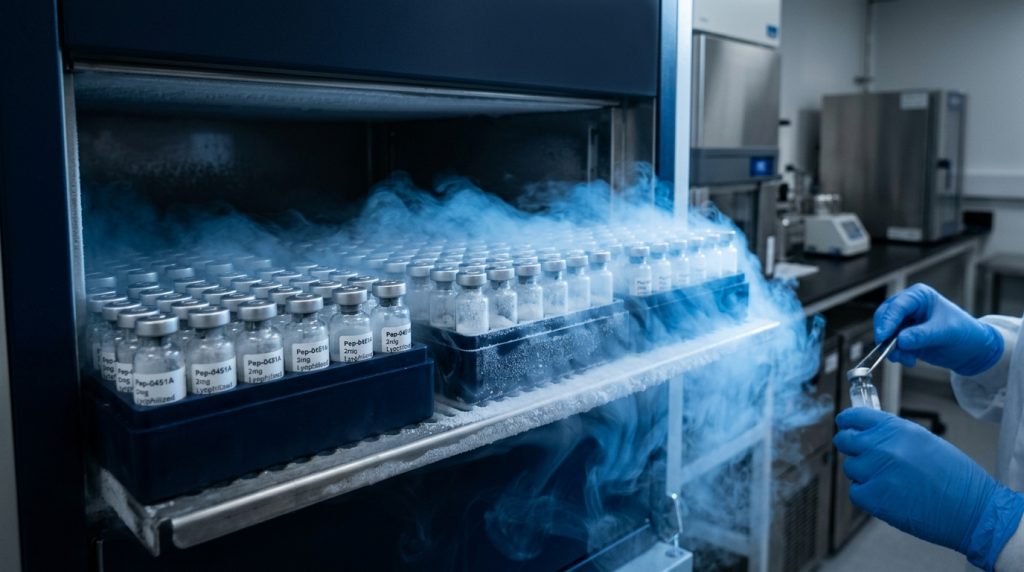
Research-grade peptides are almost universally supplied in lyophilized (freeze-dried) form. The reason is stability. In aqueous solution, peptides are vulnerable to a cascade of degradation mechanisms: hydrolysis of peptide bonds, oxidation of susceptible residues (particularly methionine and cysteine), deamidation at asparagine and glutamine, and aggregation driven by hydrophobic interactions.
Looking for Premium Research Compounds?
Lyophilization removes water from the peptide matrix through sublimation under vacuum, essentially pausing chemical reactivity. The result is a dry, powder-like cake that retains the native secondary structure of the peptide far more reliably than any refrigerated liquid formulation. What drives this stability at the molecular level? The absence of water eliminates the aqueous medium that facilitates most degradation pathways. Properly lyophilized and stored peptides can maintain >95% purity for years under appropriate conditions.
Long-term storage for lyophilized peptides is best conducted at −20°C for general use. For archival storage exceeding one year, −80°C is the standard in most research settings. Both temperature regimes dramatically slow the Maillard reaction and other slow-degradation chemistries that proceed even in dry solids. One rule applies universally: avoid freeze-thaw cycling. Each cycle introduces mechanical stress and transient moisture exposure that incrementally degrades the compound. Aliquot accordingly.
Solvent Selection: Bacteriostatic Water vs. Sterile Water
Once a researcher is ready to reconstitute, solvent choice is the most consequential variable. Two solvents dominate peptide research protocols: bacteriostatic water (BW) and sterile water for injection (SWFI).
Bacteriostatic water contains 0.9% benzyl alcohol as a preservative. This antimicrobial agent inhibits bacterial proliferation within the reconstituted solution, extending multi-use stability significantly — typically to 28 days when refrigerated at 2–8°C. For peptides that will be sampled repeatedly across a research timeline, bacteriostatic water is the solvent of choice. It is particularly well-suited to BPC-157, which demonstrates good stability in this medium and maintains its structural integrity across the multi-week window commonly used in rodent studies.
Sterile water, by contrast, contains no preservative. It is appropriate for single-use reconstitution scenarios: prepare, use, discard. For experiments where benzyl alcohol might confound results — certain cell culture assays, for instance — sterile water eliminates that variable. The tradeoff is that reconstituted peptide in sterile water should be used promptly and not stored.
A third option, acetic acid (0.1–1% in sterile water), is employed for peptides that are poorly soluble at neutral pH or that require an acidic milieu for initial dissolution. Researchers should always verify the isoelectric point and solubility characteristics of the specific peptide before committing to a solvent system.
Compound-Specific Reconstitution: BPC-157 and TB-500
Not all peptides behave identically in solution. Two commonly studied examples illustrate the need for compound-specific protocols.
BPC-157 (Body Protection Compound-157) is a 15-amino-acid peptide derived from the gastric protein BPC. It is pH-sensitive — reconstitution into solutions outside its stability window can promote degradation. Bacteriostatic water at neutral to slightly acidic pH represents a stable reconstitution medium. Once reconstituted, BPC-157 solutions should be stored at 2–8°C and used within 28 days. Critically, researchers should protect reconstituted BPC-157 from UV and fluorescent light exposure, as photooxidation can compromise aromatic residues. Amber vials or foil wrapping are standard laboratory precautions.
TB-500 is a synthetic analogue of Thymosin Beta-4, a 43-amino-acid peptide involved in actin polymerization dynamics. Its larger molecular weight introduces some handling nuances. TB-500 can be more resistant to quick dissolution — gentle swirling or inversion is appropriate to encourage complete reconstitution. Importantly, vortexing should be avoided. High-shear mechanical agitation introduces air-water interfaces that promote protein aggregation and foaming, both of which compromise peptide integrity. Once reconstituted, TB-500 performs well in bacteriostatic water stored at 2–8°C under the same 28-day guidance.
For both compounds, allowing the vial to equilibrate to room temperature before reconstitution reduces thermal shock and promotes uniform dissolution.
Research Concentration Calculations: Molarity, mg/mL, and μg/μL
Researchers frequently need to calculate working concentrations from a known lyophilized mass. This is the practical equivalent of what many online search queries frame as a concentration calculator — in the research context, the goal is preparing precise in vitro or in vivo working concentrations from a known lyophilized mass.
The starting point is straightforward. If a vial contains 5 mg of lyophilized peptide and the researcher adds 2 mL of bacteriostatic water, the resulting stock concentration is 2.5 mg/mL, or equivalently 2,500 μg/mL (2.5 μg/μL). Serial dilutions from this stock allow researchers to prepare working concentrations for cell culture (often in the nanomolar to micromolar range) or animal study protocols.
Converting between mass-based and molar concentrations requires the peptide’s molecular weight. BPC-157 has a molecular weight of approximately 1,419 Da (1.419 kDa). A 2.5 mg/mL solution therefore corresponds to approximately 1.76 mM — a straightforward calculation: (2.5 mg/mL) ÷ (1.419 g/mol) × 1,000 = ~1,762 μmol/L. TB-500’s molecular weight is approximately 4,963 Da, so the same mass concentration yields a substantially lower molarity.
Why does this matter for reproducibility? Reporting concentrations in molar terms allows cross-study comparison regardless of peptide source or lot — a crucial detail when attempting to replicate findings from the literature. Always document the molecular weight used in calculations in experimental records.
Degradation Mechanisms Researchers Should Monitor
Understanding why peptides degrade helps researchers design storage and handling protocols that actively counteract degradation pathways. Several mechanisms deserve attention:
Hydrolysis is the primary aqueous degradation route — water molecules cleave peptide bonds, particularly at aspartate-X sequences. Lower temperatures slow this dramatically, which is why even reconstituted peptides are refrigerated rather than held at room temperature.
Oxidation targets methionine and cysteine residues. Exposure to dissolved oxygen, light (via photosensitization), and peroxides all drive oxidative modification. Flushing vials with inert gas (nitrogen or argon) prior to sealing, minimizing headspace, and storing away from light all reduce this risk. BPC-157 does not contain methionine or cysteine, which contributes to its relative oxidative stability; TB-500 contains a cysteine residue and warrants more careful handling in this regard.
Aggregation is particularly relevant at higher concentrations or following freeze-thaw cycling. Aggregated peptide is both biochemically inactive and potentially problematic in cellular assays. Visual inspection (cloudiness or particulate formation) is a basic but useful check; researchers working with sensitive assays may wish to perform dynamic light scattering or analytical HPLC to confirm solution integrity.
Adsorption to container surfaces is an often-overlooked source of effective concentration loss, especially at low working concentrations. Low-binding polypropylene tubes and compatible transfer equipment reduce this effect.
Conclusion
Rigorous peptide handling is inseparable from rigorous peptide research. Lyophilization preserves structural integrity during storage; proper solvent selection determines stability once reconstituted; careful temperature management and protection from light slow the degradation reactions that erode compound quality over time. For researchers working with BPC-157, TB-500, and the broader class of synthetic peptides, internalizing these principles is the difference between reproducible data and confounded results. The science begins long before the experiment does.
For Research Purposes Only: The information presented in this article is intended solely for scientific research and educational purposes. These compounds are not approved for human use and should only be handled by qualified researchers in appropriate laboratory settings in compliance with all applicable regulations.
Continue Your Research
Explore our complete catalog of premium research compounds.
