
Premium USA-Made Research Compounds
Browse lab-tested peptides, research liquids, capsules and more.
Peptide Reconstitution Calculator & Dosage Volume Reference Guide
In the high-precision world of biochemical research, the transition from a lyophilized powder to a viable liquid solution is a critical juncture where mathematical errors can compromise entire study cohorts. Accurate reconstitution is not merely a preliminary step; it is the foundation of experimental integrity. For researchers at Loti Labs, understanding the Peptide Reconstitution Calculator logic is essential to avoid the “mg/mcg confusion trap,” a common pitfall where a simple decimal error leads to a tenfold variance in the intended concentration ratio.
⚠️ Research Use Only This guide is for laboratory and research purposes only. All calculations and procedures described are intended for in vitro or animal model research use only under qualified supervision. All peptide materials mentioned are strictly not for human use. Precise measurements are required to prevent experimental failure or degradation of sensitive amino acid sequences.
The stakes are high: using an Insulin Syringe (U-100) requires a granular understanding of tick marks and units, as even a minor misread of the milliliter (mL) graduations can result in an incorrect subcutaneous or systemic dose in animal models. This guide provides the definitive reference for converting milligram (mg) mass into microgram (mcg) dosages, ensuring that your diluent selection—whether Bacteriostatic Water (BAC) or Sterile Water—supports the long-term stability and isoelectric point (pI) requirements of your specific research peptide.
Looking for Premium Research Compounds?
How to Use the Peptide Reconstitution Calculator
- Enter your vial size in milligrams (mg). This is printed on the vial label (common sizes: 2mg, 5mg, 10mg).
- Enter the exact volume of bacteriostatic water (mL) you will add. Use 1mL for high-concentration protocols or 2mL for standard research doses.
- Enter your target research dose in micrograms (mcg). Refer to the peptide-specific reference table below for typical ranges.
- Read the calculator output: concentration (mcg/mL), dose volume (mL), and U-100 syringe units. The syringe units tell you exactly where to draw to on the needle.
- Verify manually using the formula: Concentration (mcg/mL) = (Vial mg × 1,000) ÷ BAC water mL. Then: Dose Volume (mL) = Target mcg ÷ Concentration. Then: U-100 Units = Volume (mL) × 100.
✅ Peptide Reconstitution Calculator
Dose Volume: 0.10 mL
Draw to (U-100 syringe): 10 units
Draw to (U-40 syringe): 4 units
For laboratory research purposes only. Verify all calculations manually before use.
The Core Reconstitution Formula
To master peptide dosing, a researcher must internalize three primary equations. These formulas allow for the conversion of solid mass into a liquid concentration ratio that can be accurately measured using standard laboratory equipment.
Step 1: Determining Peptide Concentration (mcg/mL)
The first step is to determine how many micrograms of the research peptide are present in every milliliter (mL) of diluent. Since most vials are labeled in milligrams (mg), you must first convert to micrograms (mcg) by multiplying by 1,000.
Formula: Total Peptide Amount (mcg) ÷ Volume of Diluent (mL) = Concentration (mcg/mL)
Step 2: Calculating Dose Volume (mL)
Once the concentration is known, you determine the specific volume required to achieve the desired research dose.
Formula: Desired Dose (mcg) ÷ Concentration (mcg/mL) = Dose Volume (mL)
Step 3: Converting Volume to Syringe Units
In most research settings, a U-100 insulin syringe is used. On these syringes, 100 units equals exactly 1.0 mL. Therefore, each individual unit represents 0.01 mL.
Formula: Dose Volume (mL) × 100 = Units on U-100 Syringe
✅ Quick Reference Worked Example: You have a 5mg vial of a peptide and add 2mL of Bacteriostatic Water (BAC).
1. 5,000mcg ÷ 2mL = 2,500mcg/mL.
2. If your target dose is 250mcg: 250mcg ÷ 2,500mcg/mL = 0.1mL.
3. 0.1mL × 100 = 10 Units on a U-100 syringe.
The Dilution Equation: C1V1 = C2V2
The standard laboratory dilution equation — C1V1 = C2V2 — is the formal chemistry framework underlying all peptide reconstitution calculations. Here, C1 is the initial concentration, V1 is the initial volume, C2 is the final desired concentration, and V2 is the final total volume.
Applied to peptide reconstitution: If a 5mg vial contains a lyophilized stock (C1 = effectively infinite concentration solid), adding 2mL BAC water (V2) creates a solution at C2 = 2,500mcg/mL. The equation also governs serial dilutions: if your 2,500mcg/mL stock is too concentrated for precise micro-dosing, dilute 0.1mL of stock with 0.9mL fresh BAC water to yield 250mcg/mL (a 10× dilution).
Per the American Chemical Society (ACS) dilution standards, the minimum recommended working volume for bench reconstitutions is 100–200 µL. Below this threshold, relative pipetting errors and vial-wall adhesion losses become significant as a percentage of total mass — particularly for peptides with high surface adhesion such as IGF-1 LR3 and GHK-Cu.
💡 Minimum Volume Rule Always reconstitute with at least 0.5mL of diluent regardless of vial size. For 2mg vials intended for micro-dosing, use 1mL minimum. Below 100–200µL, relative measurement error from vial-wall peptide adhesion can exceed 10% of total mass — compromising research accuracy significantly.

Peptide Reconstitution Calculator Reference Tables
The following tables serve as a high-precision Peptide Reconstitution Calculator reference for common laboratory vial sizes and diluent volumes. These figures assume the use of a U-100 insulin syringe.
Table 1: Reconstitution Concentration Quick-Reference
| Vial Size (mg) | BAC Water Added (mL) | Resulting Concentration (mcg/mL) | 250mcg Dose (Units) | 500mcg Dose (Units) |
|---|---|---|---|---|
| 2mg | 1mL | 2,000 mcg/mL | 12.5 Units | 25 Units |
| 2mg | 2mL | 1,000 mcg/mL | 25 Units | 50 Units |
| 5mg | 1mL | 5,000 mcg/mL | 5 Units | 10 Units |
| 5mg | 2mL | 2,500 mcg/mL | 10 Units | 20 Units |
| 5mg | 3mL | 1,666 mcg/mL | 15 Units | 30 Units |
| 10mg | 1mL | 10,000 mcg/mL | 2.5 Units | 5 Units |
| 10mg | 2mL | 5,000 mcg/mL | 5 Units | 10 Units |
| 10mg | 3mL | 3,333 mcg/mL | 7.5 Units | 15 Units |
| 10mg | 5mL | 2,000 mcg/mL | 12.5 Units | 25 Units |
| 15mg | 2mL | 7,500 mcg/mL | 3.3 Units | 6.6 Units |
| 15mg | 3mL | 5,000 mcg/mL | 5 Units | 10 Units |
| 20mg | 2mL | 10,000 mcg/mL | 2.5 Units | 5 Units |
| 20mg | 4mL | 5,000 mcg/mL | 5 Units | 10 Units |
| 20mg | 5mL | 4,000 mcg/mL | 6.25 Units | 12.5 Units |
Table 2: U-100 Syringe Units Conversion Chart
| Concentration (mcg/mL) | Target Dose (mcg) | Volume (mL) | Units on U-100 Syringe |
|---|---|---|---|
| 1,000 | 100 | 0.10 | 10 Units |
| 1,000 | 250 | 0.25 | 25 Units |
| 1,000 | 500 | 0.50 | 50 Units |
| 2,000 | 100 | 0.05 | 5 Units |
| 2,000 | 200 | 0.10 | 10 Units |
| 2,000 | 500 | 0.25 | 25 Units |
| 2,500 | 125 | 0.05 | 5 Units |
| 2,500 | 250 | 0.10 | 10 Units |
| 2,500 | 500 | 0.20 | 20 Units |
| 3,000 | 300 | 0.10 | 10 Units |
| 3,000 | 600 | 0.20 | 20 Units |
| 4,000 | 200 | 0.05 | 5 Units |
| 4,000 | 400 | 0.10 | 10 Units |
| 4,000 | 1000 | 0.25 | 25 Units |
| 5,000 | 250 | 0.05 | 5 Units |
| 5,000 | 500 | 0.10 | 10 Units |
| 5,000 | 1000 | 0.20 | 20 Units |
| 10,000 | 500 | 0.05 | 5 Units |
| 10,000 | 1000 | 0.10 | 10 Units |
| 10,000 | 2000 | 0.20 | 20 Units |

How to Read an Insulin Syringe for Peptide Research
Visualizing the concentration ratio requires a physical mastery of the Insulin Syringe (U-100). Because research doses are often in the low microgram (mcg) range, even a one-unit discrepancy can result in a significant percentage error in the final protocol.
U-100 vs U-40 Syringes — Which to Use
In North American laboratories, the U-100 syringe is the industry standard. This designation means the syringe is calibrated for a solution containing 100 units per 1 milliliter (mL). U-40 syringes, which are more common in veterinary medicine for specific insulin types, contain only 40 units per mL. Using a Peptide Reconstitution Calculator designed for U-100 on a U-40 syringe will lead to a 2.5x overdose. Researchers should always verify the syringe barrel markings before proceeding.
Understanding Tick Marks and Unit Markings
The tick marks on a syringe barrel represent specific volumes. On a 1mL U-100 syringe, major lines usually represent 10 units (0.1mL), while smaller tick marks represent 2 units (0.02mL). On a 0.5mL or 0.3mL syringe, the resolution is higher, often with tick marks representing single units (0.01mL). For ultra-precise research, the smaller barrel sizes (0.3mL) are preferred to minimize the margin of error when drawing small volumes.
U-20 and U-30 Syringes for Micro-Dosing
For research protocols requiring doses below 50mcg or volumes below 0.05mL, U-20 and U-30 insulin syringes offer finer gradations than standard U-100 syringes:
- U-20 syringe: 20 units = 1mL. Each unit = 0.05mL. Useful for extremely dilute solutions or very small doses.
- U-30 syringe (30U/0.3mL): 30 units total capacity. Each unit = 0.01mL (same as U-100). Common for micro-dosing GLP-1 analogs in rodent studies.
- U-40 syringe: 40 units = 1mL. Each unit = 0.025mL. Common in veterinary research contexts. Requires recalculating: Units on U-40 = Volume (mL) × 40.
Critical: Always verify the syringe type before drawing — a U-40 syringe used with U-100 dose calculations will deliver 2.5× the intended volume.
Choosing the Right Syringe Size (1mL, 0.5mL, 0.3mL)
Selecting the appropriate syringe is a function of the total volume to be administered. If the reconstitution calculation results in a volume of 0.15mL, a 0.3mL syringe provides the best visual clarity for the 15-unit mark. Conversely, using a 1mL syringe for a 5-unit (0.05mL) draw increases the likelihood of degradation due to the larger air-to-liquid surface area and plunger inaccuracy.
💡 Pro Tip Most peptide researchers use U-100 insulin syringes. On a U-100 syringe, 100 units = 1mL. Each unit mark = 0.01mL. If your target dose volume is 0.1mL, you draw to the 10-unit mark. Always ensure the "dead space" in the needle is accounted for by consistent drawing techniques.
Choosing the Right Diluent
The choice of diluent is dictated by the chemical properties of the lyophilized powder, specifically its isoelectric point (pI) and its susceptibility to bacterial degradation. Selecting the wrong solvent can cause the peptide to precipitate out of solution or lose bioactivity within hours.
The FDA's guidance on sterile water for injection (21 CFR 1.3) classifies sterile water as a single-dose vehicle — it contains no antimicrobial agent and must not be used for multi-dose preparations. The 0.9% benzyl alcohol in bacteriostatic water is classified by the ACS as a Category B antimicrobial preservative that inhibits gram-positive and gram-negative bacterial growth at ambient research storage temperatures (2–25°C).
Bacteriostatic Water (BAC) — The Standard Choice
Bacteriostatic Water (BAC) is Sterile Water containing 0.9% benzyl alcohol. The alcohol acts as an antimicrobial agent, inhibiting the growth of most bacteria. This is the gold standard for multi-dose vials, as it allows the reconstituted solution to remain viable for up to 28 days when refrigerated. However, some fragile sequences can be denatured by the benzyl alcohol if not introduced carefully.
Sterile Water — Single-Use Only
Sterile Water lacks a preservative. Once the seal is broken and it is added to the lyophilized powder, there is no protection against microbial proliferation. This diluent is typically reserved for single-injection studies or peptide synthesis and laboratory methods where preservatives might interfere with analytical results (e.g., mass spectrometry).
0.1% Acetic Acid — For Fragile Sequences (IGF-1 LR3, GH)
Certain peptides, particularly those with high molecular weights or specific isoelectric points like IGF-1 LR3 or certain Growth Hormone variants, are notoriously difficult to dissolve in neutral water. A 0.1% Acetic Acid solution provides a slightly acidic environment that prevents the peptide from "clumping" or sticking to the glass walls of the vial, ensuring a uniform concentration ratio.
DMSO — Co-solvent for Lipophilic Peptides
For highly lipophilic (fat-soluble) research compounds, Bacteriostatic Water may not be sufficient for full dissolution. In these cases, a small percentage of DMSO (Dimethyl Sulfoxide) is used as a co-solvent to break the hydrophobic bonds before the primary diluent is added. This is critical for maintaining the peptide in a subcutaneous-ready liquid state.
Why Peptides Are Sold as Lyophilized Powder
Peptides are commercially supplied as lyophilized (freeze-dried) powder because liquid-phase peptide solutions degrade rapidly through hydrolysis, oxidation, and microbial contamination at ambient temperatures. Lyophilization removes water content to below 1%, halting these degradation pathways and extending shelf life to 2–5 years when stored properly at -20°C.
The lyophilization process: the peptide solution is frozen at ultra-low temperatures, then water is removed via sublimation under vacuum — transitioning directly from solid ice to vapor, bypassing the liquid phase. This preserves the peptide's primary amino acid sequence and disulfide bond architecture without thermal denaturing. The result is a fragile, porous "puck" or powder in the vial that reconstitutes rapidly when diluent is added.
Understanding lyophilization physics explains several reconstitution rules: the peptide puck may appear smaller than expected (highly porous, low density), the powder may stick to vial walls (electrostatic charge from lyophilization), and reconstitution volume appears not to change significantly (the powder displacement volume is negligible at research scale). For a deeper examination of synthesis and laboratory methods, see peptide synthesis and laboratory methods.
Sonication for Poorly Soluble Peptides
For highly hydrophobic peptides that resist dissolution in standard aqueous diluents, sonication — applying ultrasonic energy via a bath or probe sonicator — can accelerate dissolution by disrupting peptide aggregation. Apply in short 5–10 second bursts at low amplitude to avoid thermal degradation. Ensure the vial is sealed and immersed only partially in the water bath. Never sonicate peptides that are already reconstituted and stored — use only for initial dissolution of stubborn lyophilized powder. Peptides that typically require sonication assistance include high-MW fragments (>5kDa), heavily hydrophobic sequences, and some cyclic peptides.
Step-by-Step Reconstitution Technique
The physical act of reconstitution is as much about chemistry as it is about mechanical handling. Peptide molecules are chains of amino acids held together by fragile peptide bonds; mechanical stress can cause permanent degradation.
Equipment and Sterile Preparation
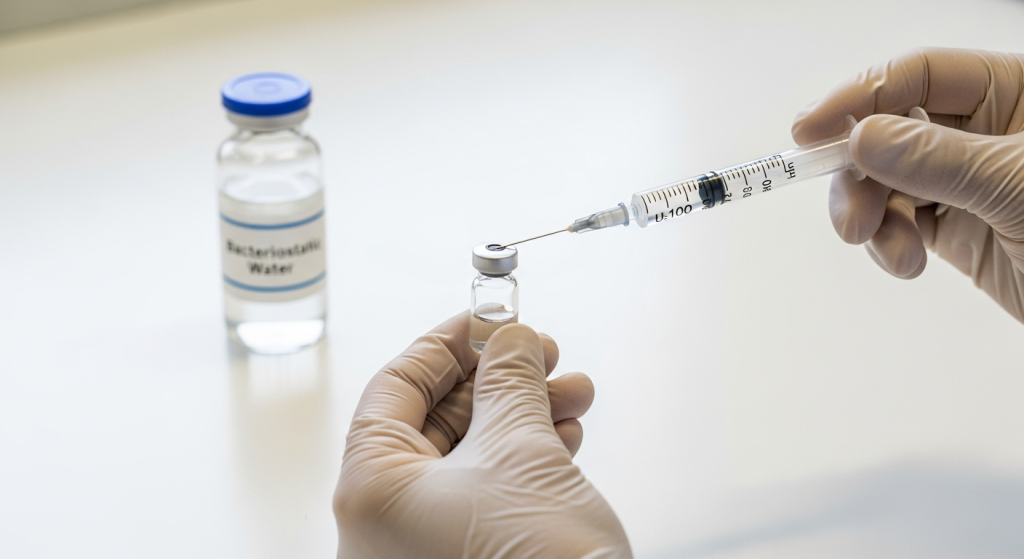
Before beginning, ensure a sterile field. This includes a laminar flow hood if available, or at minimum, a clean environment wiped with 70% isopropyl alcohol (IPA). Both the peptide vial stopper and the diluent vial must be swabbed. When evaluating your research peptide supplier, ensure they provide vials with secure, vacuum-sealed flip-tops to maintain the integrity of the lyophilized powder.
Before any needle insertion, sanitize the rubber stopper with a 70% isopropyl alcohol (IPA) swab and allow it to air-dry for 30 seconds. This is the single most critical contamination-prevention step. Use a fresh swab for every insertion event, even mid-vial use.
Vacuum Equalization Technique
Quality lyophilized powder is often sealed under a vacuum. When you insert the needle to add the diluent, the vacuum may pull the liquid in too rapidly. To prevent this, researchers should draw a volume of air into the syringe equal to the amount of diluent being used, then carefully manage the pressure as the liquid enters the vial.
Dropwise Addition and Swirling (Never Shake)
Aim the needle toward the side of the glass vial. Allow the Bacteriostatic Water to dribble down the glass wall rather than directly onto the powder. Once the diluent is added, gently rotate or swirl the vial between your palms. Never shake the vial. Shaking creates shear forces that can break the peptide chains, leading to experimental failure.
Visual Inspection and Clarity Check
A successful reconstitution should result in a perfectly clear solution. If the solution is cloudy, contains "floaters," or shows signs of precipitation, it may indicate that the pH has reached the isoelectric point (pI) or that the peptide has denatured. In such cases, the batch should be discarded to avoid inconsistent research data.
Common Research Peptide Dosing Reference
Different classes of research compounds require different reconstitution strategies. Below is a guide for the most common peptide stacking research protocols.
GLP-1 Receptor Agonists (Semaglutide, Tirzepatide, Retatrutide)
GLP-1 receptor agonists are among the most frequently researched peptides in 2026. For a complete comparison of their molecular profiles and research applications, see the GLP-1 receptor agonist reconstitution comparison guide.
These peptides are often studied in higher milligram (mg) amounts. Due to their relatively stable nature, they are excellent candidates for Bacteriostatic Water. When performing GLP-1 receptor agonist reconstitution, researchers often use a 2mL volume to allow for easier microgram (mcg) measurements of the escalating dose protocols used in weight loss and metabolic studies.
Growth Hormone Peptides (CJC-1295, Ipamorelin, GHRP-2)
GH secretagogues are highly sensitive to temperature and agitation. They require immediate refrigeration after reconstitution. Because the doses are often small (e.g., 100mcg), using a higher volume of diluent (2-3mL) helps in measuring the 5-unit or 10-unit draws accurately on a U-100 insulin syringe.
Tissue Repair Peptides (BPC-157, TB-500)
BPC-157 and TB-500 are frequently used in peptide stacking research protocols. BPC-157 is notably stable, while TB-500 is more fragile. Often, these are reconstituted in the same laboratory session to study their synergistic effects on musculoskeletal repair in animal models. Refer to our guide on peptide stacking research protocols for specific ratios.
Table 3: Research Peptide Quick-Reference
| Peptide | Vial Sizes | Typical Research Dose (mcg) | Recommended Diluent | Reconstitution Notes |
|---|---|---|---|---|
| Semaglutide | 2mg, 5mg | 250 - 2,400 | BAC Water | Stable; 28-day shelf life |
| Tirzepatide | 5mg, 10mg | 2,500 - 15,000 | BAC Water | Requires gentle swirling |
| BPC-157 | 5mg, 10mg | 250 - 500 | BAC Water / Sterile | Highly stable sequence |
| TB-500 | 2mg, 5mg | 2,000 - 5,000 | BAC Water | Fragile; do not shake |
| CJC-1295 (No DAC) | 2mg, 5mg | 100 - 300 | BAC Water | Store at 2-8°C strictly |
| Ipamorelin | 2mg, 5mg | 100 - 500 | BAC Water | Sensitive to UV light |
| IGF-1 LR3 | 1mg | 20 - 50 | 0.1% Acetic Acid | Prevents vial wall adhesion |
| Melanotan II | 10mg | 250 - 500 | BAC Water | High concentration possible |
| PT-141 | 10mg | 1,000 - 2,000 | BAC Water | Stable at room temp briefly |
| AOD-9604 | 2mg, 5mg | 300 - 500 | BAC Water | May require slight warming |
| Semax | 5mg, 10mg | 100 - 500 | Sterile Water / BAC | Often studied intranasally |
| Selank | 5mg | 100 - 500 | Sterile Water / BAC | Keep away from heat |
| Tesamorelin | 2mg, 10mg | 1,000 - 2,000 | Sterile Water | Often single-use research |
| Epitalon | 10mg, 50mg | 1,000 - 10,000 | BAC Water | Stable in solution |
| GHK-Cu | 50mg | 1,000 - 2,000 | BAC Water | Blue tint is normal |
Worked Dosage Calculation Examples
To ensure total accuracy, follow these five common research scenarios. Using a peptide reconstitution calculator effectively requires practicing these manual steps.
1. Semaglutide 5mg vial, 2mL BAC, 250mcg dose
- Convert mg to mcg: 5mg × 1,000 = 5,000mcg.
- Find concentration: 5,000mcg ÷ 2mL = 2,500mcg/mL.
- Find volume: 250mcg ÷ 2,500mcg/mL = 0.1mL.
- Result: 10 Units on a U-100 syringe.
2. BPC-157 5mg vial, 1mL BAC, 500mcg dose
- Convert mg to mcg: 5mg × 1,000 = 5,000mcg.
- Find concentration: 5,000mcg ÷ 1mL = 5,000mcg/mL.
- Find volume: 500mcg ÷ 5,000mcg/mL = 0.1mL.
- Result: 10 Units on a U-100 syringe.
3. Ipamorelin 2mg vial, 1mL BAC, 100mcg dose
- Convert mg to mcg: 2mg × 1,000 = 2,000mcg.
- Find concentration: 2,000mcg ÷ 1mL = 2,000mcg/mL.
- Find volume: 100mcg ÷ 2,000mcg/mL = 0.05mL.
- Result: 5 Units on a U-100 syringe.
4. Retatrutide 10mg vial, 2mL BAC, 500mcg dose
- Convert mg to mcg: 10mg × 1,000 = 10,000mcg.
- Find concentration: 10,000mcg ÷ 2mL = 5,000mcg/mL.
- Find volume: 500mcg ÷ 5,000mcg/mL = 0.1mL.
- Result: 10 Units on a U-100 syringe.
5. Semax 5mg vial, 1.5mL BAC, 300mcg dose
- Convert mg to mcg: 5mg × 1,000 = 5,000mcg.
- Find concentration: 5,000mcg ÷ 1.5mL = 3,333mcg/mL.
- Find volume: 300mcg ÷ 3,333mcg/mL = 0.09mL.
- Result: 9 Units on a U-100 syringe.
Bodyweight-Based Dosing and Blended Vial Calculations
Calculating mcg/kg for Weight-Adjusted Dosing Protocols
Many 2026 research protocols specify doses in micrograms per kilogram of body weight (mcg/kg) rather than a fixed dose. This is especially common in GLP-1 receptor agonist studies and growth hormone secretagogue research. To convert a mcg/kg dose to a syringe volume:
- Calculate total dose: Body Weight (kg) × Protocol Dose (mcg/kg) = Total Target Dose (mcg)
- Apply standard formula: Total Target Dose ÷ Concentration (mcg/mL) = Volume (mL)
- Convert to U-100 units: Volume (mL) × 100 = Units to draw
Example: A 75kg research subject, protocol dose 3mcg/kg Ipamorelin. Total dose = 75 × 3 = 225mcg. Concentration (2mg vial + 1mL BAC) = 2,000mcg/mL. Volume = 225 ÷ 2,000 = 0.1125mL = 11.25 units on U-100.
Reconstituting Blended Peptide Vials (Combination Formulations)
Combination vials — such as CJC-1295/Ipamorelin (5mg/5mg) or BPC-157/TB-500 blends — are increasingly common in research formulations. Each component maintains its individual potency per unit volume, but the reconstitution math applies to each peptide independently:
- A CJC-1295/Ipamorelin 5mg/5mg blend reconstituted with 2mL BAC water yields 2,500mcg/mL of each peptide.
- A 300mcg CJC-1295 dose = 0.12mL = 12 units (simultaneously delivering 300mcg Ipamorelin).
- Verify blend concentration on the Certificate of Analysis (COA) from your supplier — HPLC should confirm individual peptide peaks.
When evaluating your research peptide supplier, always request COA/HPLC documentation for blend formulations to confirm accurate per-peptide dosing.
IU vs. mg Conversion for Peptide Research
Some peptides — particularly growth hormone (GH), human chorionic gonadotropin (hCG), and EPO — are measured in International Units (IU) rather than milligrams. IU values are potency-based and not directly convertible by a universal formula. For reference: recombinant human GH is typically standardized at approximately 3 IU per 1mg. Always verify the IU/mg ratio on the product Certificate of Analysis.
NAD+ and Large-Scale Vial Calculations
NAD+ precursors such as NMN and NR, along with NAD+ itself, are often available in vials of 500mg to 1,000mg — orders of magnitude larger than typical research peptide vials. Apply identical reconstitution math at scale: a 500mg (500,000mcg) vial reconstituted with 10mL BAC water yields a concentration of 50,000mcg/mL (50mg/mL). A 100mg dose = 0.002mL = 0.2 units on a U-100 syringe — an impractically small volume. In such cases, diluting to a lower working concentration (e.g., 10mg/mL by using 50mL diluent) simplifies dosing accuracy.
Post-Reconstitution Storage and Stability
The transition from lyophilized powder to solution drastically reduces the shelf-life of any research compound. In the lyophilized state, peptides are often stable at room temperature for weeks; once reconstituted, the clock starts on molecular degradation.
Refrigeration Protocol (2–8°C)
Most reconstituted peptides must be stored between 2°C and 8°C (36°F to 46°F). This slows down the kinetic energy of the molecules and inhibits the enzymatic pathways that lead to degradation. Avoid storing vials in the refrigerator door, as the temperature fluctuates every time the door is opened. A stable, interior shelf is required for laboratory standards.
Avoiding Freeze-Thaw Degradation
While some researchers attempt to freeze reconstituted peptides to extend their life, this is generally discouraged. The formation of ice crystals can physically shear the peptide chains. If freezing is necessary for long-term storage, the solution should be aliquoted so that each sample is only thawed once. Repeated freeze-thaw cycles are a primary cause of experimental inconsistency.
Shelf Life of Reconstituted Peptides (28-day BAC rule, USP <797>)
According to USP <797> guidelines, multi-dose vials containing Bacteriostatic Water have a "Beyond Use Date" (BUD) of 28 days after the initial reconstitution or first puncture. After 28 days, the benzyl alcohol concentration may no longer be sufficient to prevent bacterial growth. From a biochemical standpoint, some fragile peptides (like IGF-1) may degrade even faster, losing potency within 7–14 days regardless of the antimicrobial presence.
Aliquoting for Multi-Dose Research Protocols
For large-scale studies involving many animal models, researchers may reconstitute a 20mg vial and aliquot the volume into smaller, sterile vials. This limits the number of times a single vial stopper is punctured, maintaining the integrity of the seal and preventing coreing (where small pieces of the rubber stopper fall into the liquid).
In 2026, a notable shift in peptide research tool preference has emerged: mobile-first, visual calculator applications — particularly those that render a syringe graphic showing the exact tick mark — have become the dominant format for researcher onboarding. The Loti Labs reconstitution reference tables and the interactive calculator above are designed to address both the computational and visual verification needs documented in 2026 research community feedback. Additionally, the 2026 U.S. Pharmacopeia update to <USP 797> has reinforced the 28-day beyond-use dating (BUD) for compounded GLP-1 analog solutions using BAC water, while some academic pharmacology labs are adopting 14-day BUDs for fragile GLP-1 fragments. Always confirm the applicable BUD with your research institution's standard operating procedures.
Net Peptide Content (NPC) and TFA Salt Mass Errors
A frequently overlooked error in research peptide dosing is the assumption that the labeled vial weight represents 100% pure active peptide. In reality, lyophilized peptides contain:
- Counter-ions (TFA salts): Peptides synthesized via Fmoc SPPS are purified using trifluoroacetic acid (TFA), leaving TFA counter-ion salts that contribute to total mass. A vial labeled "5mg" may contain only 80–90% active peptide by mass.
- Water and residual solvents: Even after lyophilization, trace moisture (1–5% by weight) remains.
- Net Peptide Content (NPC): The true active fraction, expressed as a percentage on the COA. An NPC of 85% means a "5mg" vial contains approximately 4.25mg of active peptide.
NPC-corrected concentration formula: Effective Concentration (mcg/mL) = (Vial Weight mg × NPC%) × 1,000 ÷ Diluent (mL). Example: 5mg vial, 85% NPC, 2mL BAC water = (5 × 0.85 × 1,000) ÷ 2 = 2,125mcg/mL actual active concentration vs. 2,500mcg/mL labeled. Always check the NPC column on your supplier's Certificate of Analysis (COA) when running quantitative research protocols.
Digital Tracking and Research Documentation
In 2026, laboratory-grade research protocols increasingly incorporate digital peptide tracking to maintain accurate reconstitution logs. Apps such as PepCalc and PepTracker — as well as simple spreadsheet templates — allow researchers to document:
- Vial batch number and supplier COA reference
- Reconstitution date and diluent volume used
- Running dose log: date, dose (mcg), volume drawn (mL), units, remaining volume estimate
- Calculated remaining doses based on starting concentration and cumulative draws
- Beyond-use date (BUD) — typically 28 days post-reconstitution for BAC water
Proper documentation is particularly important for multi-peptide research stacks. When running peptide stacking research protocols, tracking each vial's remaining concentration ensures consistent dosing across study sessions and prevents inadvertent concentration drift from partial draws.
💡 Documentation Standard Log each draw immediately after dosing: Date | Peptide | Dose (mcg) | Volume drawn (mL) | Syringe units | Remaining vial volume estimate. Store this log alongside the batch COA from your supplier. This practice aligns with standard laboratory notebook protocols and the 2026 USP <797> documentation recommendations for compounded research preparations.
Safe Sharps Disposal Protocols
Used insulin syringes and needles constitute regulated medical sharps waste in most jurisdictions. Follow these disposal standards:
- Use an FDA-cleared sharps disposal container (puncture-resistant, leak-proof, labeled).
- Never re-cap needles by hand — use the one-hand scoop technique or a one-touch re-capper if capping is necessary.
- Never place loose needles in household trash or recycling bins.
- When the container is three-quarters full, seal it and contact your local household hazardous waste (HHW) program, mail-back service, or retail drop-off (pharmacies, fire stations).
- Peptide vials (glass ampules): treat as pharmaceutical waste — dispose via authorized pharmaceutical waste collection, not standard trash.
Common Reconstitution Calculation Errors and How to Avoid Them
Even seasoned researchers can succumb to "calculator fatigue." Errors in peptide dosing are rarely due to poor math skills and more often due to a lack of a double-verification protocol.
The mg/mcg Decimal Error
The most dangerous error is forgetting to multiply the vial size (mg) by 1,000 to reach micrograms. If a researcher assumes 5mg is 500mcg, they will under-dose the experiment by 10x. If they assume it is 50,000mcg, they will over-dose by 10x. Always write out the full number: 5mg = 5,000mcg.
Using Wrong Concentration After Partial Draw
If a researcher adds 1mL to a 5mg vial but later adds another 1mL of diluent because the volume was too low, the concentration ratio has changed. Every time diluent is added, the calculator must be reset. It is a best practice to record the concentration (mcg/mL) on the vial label immediately after reconstitution.
Air Bubble Displacement Error
In subcutaneous research models, air bubbles in the syringe barrel can displace up to 2-3 units of volume. In a 10-unit dose, a 2-unit air bubble represents a 20% error margin. Ensuring all air is flicked to the top of the syringe and expelled back into the vial is critical for precision.
Misreading U-100 Syringe Graduations
As mentioned in the tick marks section, not all syringes have the same increments. A researcher used to 0.5mL syringes (where every mark is 1 unit) may misread a 1.0mL syringe (where every mark is 2 units), leading to a 50% dosing error. For more on ensuring you are using high-quality materials, see our guide on evaluating your research peptide supplier.
Frequently Asked Questions — Peptide Reconstitution Calculator
- How do I calculate the concentration if I use more than 1mL of water?
- Simply divide the total milligrams (multiplied by 1,000) by the total milliliters of diluent. For example, 10mg in 2mL is 10,000 / 2 = 5,000mcg/mL.
- What is the most common vial size for research peptides?
- Most peptides come in 2mg, 5mg, or 10mg vials, though some like GHK-Cu or Epitalon come in much larger 50mg sizes.
- Can I use a regular calculator for these dosages?
- Yes, as long as you follow the formula: (Vial mg * 1000) / Diluent mL = Concentration. Then: Dose / Concentration = Volume (mL).
- Why does my 5mg vial look like it has less powder than my 2mg vial?
- The amount of lyophilized powder (puck) is often determined by the "bulking agents" (like mannitol) used during peptide synthesis and laboratory methods. The physical size of the powder puck does not always correlate with the weight of the active peptide.
- Does the volume of the powder add to the volume of the liquid?
- In most cases, the displacement volume of 2-10mg of peptide is negligible and does not significantly change the final 1mL or 2mL volume.
- What happens if I put too much BAC water in the vial?
- The peptide will simply be more diluted. You will need to draw a larger volume into the Insulin Syringe (U-100) to get the same microgram (mcg) dose.
- How do I convert 0.25mg to mcg?
- 0.25mg is equal to 250mcg (0.25 * 1000 = 250).
- If my syringe is 0.5mL, is 10 units still the same as a 1.0mL syringe?
- Yes, on any U-100 syringe, 10 units is always 0.1mL, regardless of the total barrel size.
- What are "units" in peptide research?
- Units are a measurement of volume on an insulin syringe, where 100 units = 1mL. They are not a measurement of the peptide's mass.
- How many mcg are in one unit?
- This depends on your concentration ratio. If you have 5,000mcg in 1mL (100 units), then 1 unit = 50mcg.
- What if my syringe doesn't say U-100?
- Stop the procedure. You must know the calibration (U-40, U-100, etc.) to calculate the volume accurately.
- Is a 31-gauge needle okay for reconstitution?
- 31-gauge needles are very thin. While they are fine for subcutaneous draws, they may be slow for drawing the initial diluent. A 25-gauge needle is often used to add water to the vial, while 31-gauge is used for the research doses.
- Can I use the same needle to reconstitute multiple vials?
- To maintain sterility and prevent cross-contamination, use a fresh needle for every vial entry.
- Why is Bacteriostatic Water preferred over Sterile Water?
- Bacteriostatic Water (BAC) contains benzyl alcohol, which prevents bacterial growth for up to 28 days, making it safer for multi-dose research protocols.
- Can I use saline (0.9% Sodium Chloride) for reconstitution?
- Saline can be used, but it does not have antimicrobial properties. It may also alter the isoelectric point (pI) and cause some peptides to precipitate.
- What is the pH of Bacteriostatic Water?
- It is typically slightly acidic, around 4.5 to 7.0, which helps stabilize many peptide sequences.
- How do I know if a peptide is lipophilic?
- Check the COA or the peptide synthesis and laboratory methods data. Lipophilic peptides often won't dissolve in BAC water and will require DMSO.
- Can I mix two peptides in the same syringe?
- While common in some peptide stacking research protocols, it can lead to interactions or pH shifts that cause one peptide to degrade. It is generally safer to draw them separately.
- How long can reconstituted peptides stay at room temperature?
- Most will begin degradation within hours. Some stable ones may last a few days, but refrigeration is always recommended.
- What should I do if I dropped my reconstituted vial?
- Inspect it for "floaters" or cloudiness. The impact can cause degradation in very fragile peptides. If it remains clear, it is likely still viable.
- Why do some peptides come in 10mg vials instead of 5mg?
- It usually depends on the GLP-1 receptor agonist reconstitution requirements or the typical dose used in the study. Higher-dose studies use larger vials for efficiency.
- How long does a 5mg vial of BPC-157 last once reconstituted?
- If using Bacteriostatic Water and refrigerated, it remains stable for roughly 28 days.
- Does the color of the flip-top matter?
- No, flip-top colors are not standardized across the industry. Always read the label for the milligram (mg) amount.
- What is "lyophilized powder" exactly?
- It is peptide that has been freeze-dried to remove all solvent, leaving behind a stable solid that resists degradation during shipping.
- Can I use 0.1% Acetic Acid for all peptides?
- No, only for those that are insoluble in BAC water. The acidity can damage some sensitive sequences.
- How do I know if my peptide is still active?
- The only way to be certain is through HPLC testing or observing the expected biological markers in your research model. Visual clarity is only a baseline indicator.
- Where can I find more technical stack designs?
- You can find detailed experimental setups in our guide on peptide stacking research protocols.
- How do you calculate peptides?
- To calculate a peptide dose, use the three-step formula: (1) Convert vial mass to micrograms: mg × 1,000 = mcg. (2) Calculate concentration: total mcg ÷ mL of diluent added. (3) Determine injection volume: desired dose (mcg) ÷ concentration (mcg/mL) = mL to draw. Multiply mL by 100 for U-100 syringe units. Example: 5mg ÷ 2mL = 2,500mcg/mL; for a 250mcg dose, draw 0.1mL (10 units).
- How much water do you mix with peptides?
- For most research peptides in 2mg–10mg vials, use 1mL to 3mL of bacteriostatic water. The amount you choose determines the concentration — more water lowers concentration and requires larger injection volumes per dose. 2mL is the standard starting point for 5mg vials, yielding 2,500mcg/mL which allows convenient unit calculations on a U-100 syringe.
- Are peptides steroids?
- No. Peptides are short chains of amino acids (typically 2–50 residues) that function as signaling molecules, growth factors, or hormonal precursors. Steroids are a structurally distinct class of lipid-derived compounds with a four-ring carbon skeleton that directly alter gene transcription. The reconstitution and storage chemistry of peptides is entirely different from that of steroids.
- What happens if I use too much bacteriostatic water?
- Excess BAC water lowers the concentration but does not damage the peptide. If you add 4mL instead of 2mL to a 5mg vial, concentration drops to 1,250mcg/mL instead of 2,500mcg/mL. A 250mcg dose then requires 0.2mL (20 units) instead of 10 units — double the injection volume. This is a calibration inconvenience, not a chemical problem. Always note how much water you actually added so your dose calculations remain accurate.
- Can I reconstitute with sterile water instead of bacteriostatic water?
- Yes, sterile water is a valid diluent for single-use or same-session reconstitutions. It lacks the 0.9% benzyl alcohol found in BAC water, meaning it provides zero antimicrobial protection beyond the initial sterile fill. Reconstituted peptide solutions using sterile water should be used within hours of reconstitution and not stored in multi-day research protocols. For multi-dose vials expected to last 14–28 days, bacteriostatic water is the correct choice per USP <797> guidelines.
- How do you determine peptide content?
- Peptide content (concentration) is determined by dividing the total milligrams of lyophilized powder by the milliliters of diluent added, then multiplying by 1,000 to convert to mcg/mL. For example, a 5mg vial in 2mL BAC water = 5 ÷ 2 × 1,000 = 2,500mcg/mL. For verified potency, a Certificate of Analysis (COA) from HPLC testing confirms the actual peptide content matches the labeled amount.
- What are the side effects of peptides in research models?
- In preclinical research contexts, reported effects vary by peptide class. GLP-1 receptor agonists (semaglutide, tirzepatide) commonly show dose-dependent nausea and reduced gastric motility in animal models. Growth hormone secretagogues may show transient water retention and mild hypoglycemia. Tissue repair peptides (BPC-157, TB-500) show a favorable preclinical safety profile with minimal reported adverse effects at standard research doses. All effects described are from in vitro and animal model data only — not from human clinical use.
- Where can a researcher find injection-administration protocols?
- In vivo subcutaneous administration of research peptides in animal research models must follow institutional protocols. Researchers should refer to their facility's IACUC-approved standard operating procedures (SOPs) and ensure all administration is performed by trained research personnel under appropriate institutional oversight. This guide does not provide human-use administration instructions.
- Does the amount of water change the peptide dosage?
- No. Adding more bacteriostatic water only dilutes the concentration — the total mass of peptide in the vial remains identical. If you add 4mL instead of 2mL to a 5mg vial, concentration drops from 2,500mcg/mL to 1,250mcg/mL. A 250mcg dose now requires 0.2mL (20 units) instead of 0.1mL (10 units). The peptide dose is the same; only the injection volume changes. Always document how much water you added to avoid incorrect dose calculations.
- How many mL is 100 units on an insulin syringe?
- On a standard U-100 insulin syringe, 100 units = exactly 1mL. This means each unit mark on a U-100 syringe equals 0.01mL. Common conversions: 10 units = 0.1mL; 20 units = 0.2mL; 50 units = 0.5mL. On a U-40 syringe, 100 units = 2.5mL (each unit = 0.025mL). Always confirm your syringe type before converting units to volume.
- Why are peptides sold as powder (lyophilized)?
- Peptides are sold as lyophilized powder because liquid peptide solutions degrade rapidly through hydrolysis, oxidation, and bacterial contamination. The freeze-drying process removes water below 1% by weight, halting all major degradation pathways. Lyophilized peptides remain stable for 2–5 years when stored at -20°C, compared to days or weeks for liquid solutions. Powder format also allows precise mass-based dosing and is more stable during international shipping.
- Can you reconstitute peptides with normal saline?
- Normal saline (0.9% sodium chloride solution) will dissolve most hydrophilic peptides but contains no antimicrobial preservative — making it strictly a single-use diluent. Reconstituted peptide solutions using normal saline must be used within the same session and cannot be stored. Additionally, the ionic strength of saline can affect the solubility of some peptides near their isoelectric point (pI). For multi-dose research protocols, bacteriostatic water with 0.9% benzyl alcohol is the correct choice.
- How long are reconstituted peptides stable at room temperature?
- Most reconstituted peptides degrade significantly within 4–24 hours at room temperature (20–25°C). Enzymatic degradation by ambient proteases, oxidation, and deamidation of asparagine/glutamine residues accelerate dramatically above 8°C. Reconstituted peptide solutions must be refrigerated at 2–8°C immediately after preparation and returned to the refrigerator within 30 minutes of any dose draw. For protocols requiring bench stability, keep the vial on ice during extended sessions.
- What happens if you shake peptides during reconstitution?
- Vigorous shaking creates air bubbles at the peptide-solvent interface, inducing surface denaturation — where peptide molecules unfold and aggregate at the air-liquid boundary. This is an irreversible process that permanently destroys active peptide mass. The resulting solution appears foamy or cloudy. Shear stress from vigorous mixing also mechanically disrupts weaker peptide-peptide interactions. Always use gentle, slow vial rotation or swirling for 30–60 seconds instead of shaking.
- What is the ISO 8537:2016 standard for insulin syringes?
- ISO 8537:2016 is the international standard specifying accuracy requirements for sterile single-use insulin syringes with integral needle. It mandates that U-100 syringe graduations are accurate to ±2% of stated volume, that needle gauge is consistent with labeling (typically 27–31G for insulin syringes), and that the dead space volume (retained in the needle hub) is clearly specified. For research applications requiring sub-unit precision, a low dead space (LDS) or needle-free syringe may be appropriate to minimize volume retention below the piston face.
Continue Your Research
Explore our complete catalog of premium research compounds.

