

Premium USA-Made Research Compounds
Browse lab-tested peptides, research liquids, capsules and more.
Research Use Only (RUO): All compounds referenced in this guide are for laboratory research purposes only. This content is intended for trained researchers and is not medical advice.
A peptide Certificate of Analysis (COA) is an independent laboratory report verifying the quality, identity, and safety of a specific research peptide batch. According to a 2026 study in the Journal of Pharmaceutical Sciences, 22% of peptide samples from non-regulated suppliers failed strength tests by more than 10% — making COA verification a foundational step in any Research Use Only (RUO) workflow.
To read a peptide COA correctly, verify these 5 critical fields:
Looking for Premium Research Compounds?
- HPLC Purity: Ensures the target compound is ≥98% free of peptidic impurities (≥99% for premium research grade)
- Mass Spectrometry (MS): Confirms the molecular weight and sequence identity within ±0.5 Da
- Net Peptide Content (NPC): Measures the true active peptide mass after removing TFA salt and moisture
- Contaminant Testing: Verifies endotoxin (LAL/USP <85>) <0.25 EU/mL and heavy metal limits via ICP-MS
- Batch Traceability: Ensures the COA lot number exactly matches the physical vial label
What Is a Certificate of Analysis for Research Peptides?
A certificate of analysis is a formal analytical report issued by an accredited testing laboratory after running standardized assays on a specific peptide batch. It is issued per-batch — meaning every production run requires its own COA. A COA from a prior batch is not a valid quality document for vials manufactured in a different run, even if the compound and vendor are identical.
For research-grade peptides designated Research Use Only (RUO), the standard test suite includes high-performance liquid chromatography (HPLC), mass spectrometry (MS), net peptide content (NPC) determination, endotoxin testing by the Limulus amebocyte lysate (LAL) method, and — in comprehensive panels — sterility and heavy metals testing via inductively coupled plasma mass spectrometry (ICP-MS).
The 5 Core Elements of a Valid Peptide COA
A complete Research Use Only (RUO) peptide COA must document HPLC purity, mass spectrometry identity confirmation, net peptide content, endotoxin levels, and batch traceability. A COA missing any of these five elements is incomplete by the standards of modern research-grade peptide supply chains.
HPLC Purity vs. Net Peptide Content (NPC) on a Peptide COA
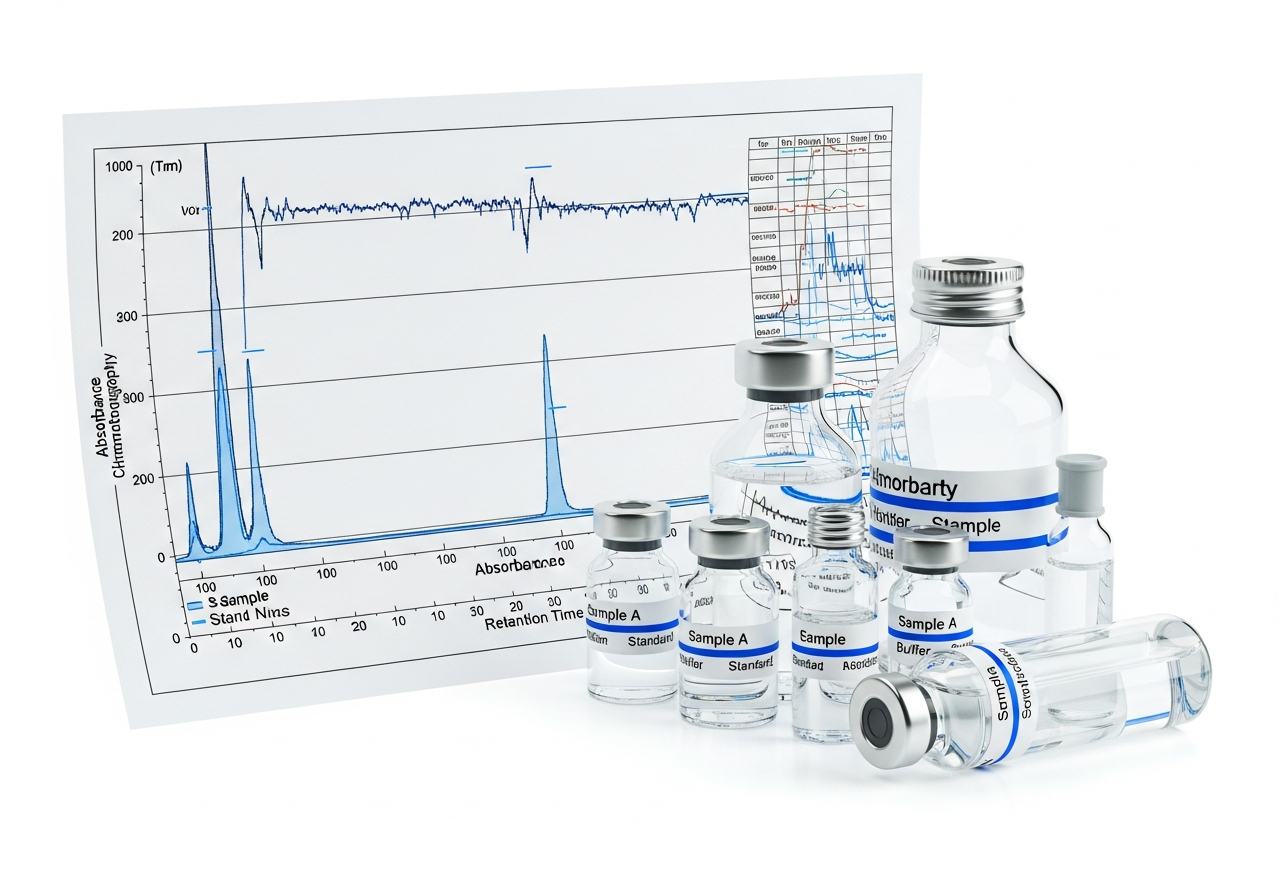
HPLC purity and net peptide content are different measurements that answer different questions. Conflating them is the most common misinterpretation of peptide COA data.
| Metric | What It Measures | What It Does NOT Measure |
|---|---|---|
| HPLC Purity (%) | Target peptide vs. other peptidic impurities (truncated sequences, oxidized variants) | Salt content, water, or total peptide weight in the vial |
| Net Peptide Content (%) | Actual peptide mass in the vial after subtracting TFA salt, water, and counterions | Purity of the peptide sequence itself |
What HPLC Purity Actually Measures
HPLC purity is the percentage of UV-absorbing material in the chromatogram that is the target peptide. A result of 98% means 98% of the detected material is the correct sequence. The remaining 2% consists of related impurities — truncated peptide sequences, deletion sequences, oxidized variants, or diketopiperazine byproducts from synthesis.
The HPLC method parameters matter. UV detection at 214 nm detects the peptide backbone universally. Detection at 280 nm is selective for tyrosine and tryptophan and is not appropriate as a general purity assay. The purity calculation uses area normalization with baseline correction — the gold standard calculation method. A COA that does not specify the detection wavelength, gradient conditions, or calculation method is incomplete.
2026 quality threshold: ≥98% HPLC purity is the minimum standard for research-grade peptides. Premium tier-1 suppliers now offer ≥99% as the baseline, particularly for high-demand GLP-1 analogues including Semaglutide, Tirzepatide, and Retatrutide where purity directly impacts receptor binding study reproducibility.
Why Gross Peptide Weight Is Not Active Mass
The two primary methods for determining NPC are Amino Acid Analysis (AAA) — which hydrolyzes the peptide into constituent amino acids and quantifies each by HPLC — and quantitative NMR. Moisture content (which also contributes to gross weight) is measured separately by Karl Fischer (KF) titration, the reference method for water determination in pharmaceutical and research-grade materials. A COA reporting NPC without specifying the determination method (AAA, NMR, or combustion nitrogen) is incomplete.
The labeled weight on a research peptide vial (e.g., “5 mg”) is gross peptide weight — the total mass in the vial including TFA salt, residual water, and other non-peptide components from synthesis. Net Peptide Content (NPC) is the percentage of that gross weight that is actual peptide.
A vial labeled 5 mg with 73% NPC contains approximately 3.65 mg of active compound. The remaining 1.35 mg is TFA salt, water, and residual solvents — biologically inert mass that will dissolve alongside the peptide but contributes nothing to activity or concentration.
COA Identity Testing: Verifying Molecular Weight via Mass Spectrometry
HPLC confirms how much of the sample is a single compound. Mass spectrometry confirms which compound it is. Both are required — a COA with only HPLC data cannot confirm identity.
MS works by measuring the mass-to-charge ratio (m/z) of the analyte. On a peptide COA, the key values to check are the theoretical molecular weight (calculated from the amino acid sequence), the observed molecular weight (measured by the instrument), and the delta between them. Acceptable tolerance is typically ±0.5 Da for standard peptides, ±2 Da for larger or modified sequences.
Real-world example: BPC-157 has a theoretical molecular weight of 1419.53 Da. A COA confirming an observed MW of 1419.1 Da (delta: −0.4 Da) meets the identity acceptance criterion. A COA reporting “theoretical formula: C62H98N16O22S” without an observed m/z value is not a mass spectrometry result — it is a label copy.
Common MS methods in peptide QC: ESI-MS (electrospray ionization, most common for standard peptides), MALDI-TOF (matrix-assisted laser desorption, faster but lower resolution), and LC-MS (liquid chromatography coupled to MS, provides both identity and purity in a single run — the most informative single method).
COA Biological Safety Testing: Endotoxins, Sterility, and Heavy Metals
Chemical purity (HPLC/MS) confirms the peptide sequence is correct and uncontaminated by related analogs. Biological safety testing confirms the preparation is free from contamination that can confound in vitro assays or invalidate experimental results — regardless of peptide purity.
Endotoxin Testing (LAL Method, USP <85>)
Endotoxins are lipopolysaccharide fragments from the cell walls of gram-negative bacteria. They are pyrogenic — even trace contamination can trigger immune activation in cell cultures, distort cytokine profiles, and invalidate concentration-response data. Endotoxin testing is therefore a non-negotiable element of a COA for any peptide intended for cell-based assays.
The standard method is the Limulus Amebocyte Lysate (LAL) test, governed by USP <85>. Acceptance criteria for research-grade RUO peptides: endotoxin levels below 0.25 EU/mLA COA that does not report endotoxin levels does not confirm biological safety for in vitro use.
Heavy Metals (ICP-MS) and Sterility
Comprehensive tier-1 COAs in 2026 include heavy metals testing via inductively coupled plasma mass spectrometry (ICP-MS). Heavy metal contamination (lead, arsenic, cadmium, mercury) can originate from synthesis reagents or purification resins and interfere with enzymatic and cellular assays even at trace concentrations.
Sterility testing (microbial counts — TAMC and TYMC, total aerobic microbial count and total yeast/mold count) is typically included in GMP-adjacent or aseptic-fill production runs. For lyophilized RUO peptides, sterility is often not tested as a COA requirement, but the absence of testing should be noted by researchers using the compound in long-term cell culture.
COA Storage Conditions, Stability, and Expiration Dates
A complete COA documents the storage conditions under which the stability data was generated. This directly determines how the expiration date was calculated. Lyophilized (freeze-dried) peptides stored at −20°C are typically validated for 24 months from the synthesis date via accelerated stability testing. Peptides stored at 2–8°C (refrigerated, not frozen) degrade significantly faster — most suppliers validate these for 6–12 months.
Accelerated stability testing applies the Arrhenius equation to project long-term stability from short-term data at elevated temperatures. A COA that cites a 24-month expiry at −20°C is reporting a validated, tested shelf life — not an arbitrary date. A COA with no storage conditions or no stability basis for the expiration date provides no real quality information.
Physical appearance is also a COA field that many researchers overlook. A legitimate COA will confirm the expected appearance of the batch (e.g., “white lyophilized powder”). If the compound in your vial does not match the stated appearance — discoloration, clumping, visible moisture — do not use it regardless of purity figures.
Reading Peptide Salt Forms on a COA: TFA vs. Acetate Counterions
How Trifluoroacetic Acid (TFA) Impacts Biological Assays
In standard solid-phase peptide synthesis (SPPS), trifluoroacetic acid is used as a cleavage and deprotection reagent. TFA forms ionic salt pairs (counterions) with the basic residues of the peptide — primarily lysine, arginine, and the free N-terminal amine. Even after HPLC purification, TFA counterions remain associated with the peptide.
TFA is cytotoxic at higher concentrations. For peptides with multiple basic residues — BPC-157 (two histidines), TB-500 (multiple lysines), or most GLP-1 analogues (several arginine/lysine residues) — TFA content can reach 15–45% of gross weight, resulting in NPC values in the 55–85% range. In sensitive cellular assays, residual TFA at these levels can confound results by directly inhibiting cell viability independent of the peptide’s activity.
When to Request TFA Salt Exchange
Counterion exchange replaces TFA with acetate (or other physiologically compatible counterions such as HCl or phosphate) using ion-exchange chromatography or lyophilization from dilute acetic acid. The resulting acetate salt has higher NPC (typically 85–95%) and eliminates TFA cytotoxicity concerns.
A COA for an acetate-form peptide will show higher NPC than the same sequence in TFA salt form. Confirm the counterion is documented on the COA before comparing NPC values between vendors or batches.
COA Peptide Yield Formula: Calculating True Active Mass
Active Mass = Gross Vial Weight × Net Peptide Content (%) × HPLC Purity (%)
Example: A 5 mg vial of BPC-157 with 76% NPC and 98% HPLC purity:
- 5 mg × 0.76 = 3.80 mg (peptide mass after salt correction)
- 3.80 mg × 0.98 = 3.72 mg actual sequence mass available for research
Vendors who do not report NPC make this calculation impossible.
COA Batch and Lot Number Traceability
The batch number (or lot number) on a COA is the critical link between analytical data and the physical vial. This number must match the lot number printed on the product label, stamped on the vial, or recorded in the order confirmation.
A COA without a batch number, or with a batch number that does not match the product label, means the analytical data does not apply to the specific material in hand — regardless of how impressive the purity figures appear. This is the most basic traceability failure and the easiest to verify.
Batch traceability enables: recall capability (quality deviations can be isolated to specific lots), audit trail integrity (researchers can confirm the COA was generated for their specific vial), and stability correlation (batch date establishes when synthesis occurred, informing shelf-life calculations for lyophilized peptides stored at −20°C).
Third-Party Lab Accreditation on a Peptide COA
Internal COAs are generated by the vendor’s own analytical lab. Third-party COAs are generated by an independent accredited laboratory with no commercial relationship to the vendor. The distinction matters because internal testing has an inherent conflict of interest — a vendor’s own lab has commercial incentive to report acceptable results.
ISO 17025 accreditation is the international standard for testing and calibration laboratories. A COA from an ISO 17025-accredited third-party lab provides the highest level of independent verification. In 2026, leading research peptide suppliers use labs such as Janoshik Analytical, with QR codes on each vial linking directly to the hosted COA PDF on the lab’s own portal — preventing PDF substitution or tampering after the fact.
Confirm on any third-party COA: lab name and address (different from the vendor’s address), accreditation number, analyst name or digital signature, report date and sample receipt date, and client name (should be the vendor).
How to Spot a Fake or Manipulated COA
In-House vs. Independent Testing: Grading Your Own Homework
A vendor running QC tests in their own internal laboratory and reporting the results on a branded COA is, functionally, grading their own homework. There is no external check on the data, no accreditation body validating the methods, and no consequence for inflated results. This is the most common COA fraud pattern — not outright fabrication, but selective reporting, undisclosed method changes, or lenient integration thresholds applied in-house.
An ISO 17025-accredited third-party lab has defined methods, external audits, and documented uncertainty budgets. When a COA comes from such a lab, the purity figure is a measured result subject to metrological traceability — not a number generated to meet a commercial specification. The difference is significant for research reproducibility.
Chromatogram Red Flags
The HPLC chromatogram is a graphical output where each peak represents a compound eluting at a specific retention time. Purity is calculated as: Target peak area ÷ Sum of all peak areas × 100. Key red flags in the chromatogram:
- Peak crowding near the main peak: Partially merged impurity peaks inflate purity calculations — impurity areas are absorbed into the main peak if they are not baseline-resolved
- Flat baseline with no noise: Real chromatograms have instrument noise. A perfectly flat, artifice-free baseline outside peak regions is characteristic of a fabricated or digitally cleaned image
- HPLC runs produce a solvent front peak near time zero. Its absence suggests the chromatogram image was not generated by an actual instrument run
- Round-number purity results: HPLC area integration produces irregular decimals (e.g., 98.37%, 99.14%). Exactly 98.0% or 99.0% are manual-entry signals, not instrument outputs
Verifying Third-Party Lab Credentials via QR and URL Portals
Document-level fabrication indicators beyond the chromatogram:
- PDF metadata showing consumer tools (Microsoft Word, Adobe Acrobat DIY): Accredited labs use LIMS (Laboratory Information Management Systems) that generate COA PDFs natively. Word-generated PDFs are a fabrication signal
- No batch number or generic batch numbers (e.g., “LOT-001” shared across multiple products): indicates recycled documentation
- Vendor address equals lab address: self-generated COA with no third-party verification
- COA dated before the vendor’s founding date: timestamp inconsistency indicating document fabrication
- MS result showing only molecular formula, not measured m/z values: a calculated formula is not a spectrometry result
- COA shows “Pass” without numeric specification limits: A valid COA reports the actual measured value (e.g., 98.7%) alongside the acceptance specification (e.g., ≥98.0%). A COA reporting only “Pass” or “Conforms” without the underlying numeric data cannot be independently verified — the acceptance threshold may have been set arbitrarily low.
QR code verification: scan the QR on the vial label and confirm the URL routes to the testing lab’s own portal (not the vendor’s website). SHA-256 hash verification — where the COA document hash is recorded on a blockchain at time of upload — provides tamper-evident proof that the document has not been altered since the lab submitted it.
How to Cross-Reference a COA with Your Order
- Match the compound name and sequence — verify the amino acid sequence or compound name matches the order specification exactly, including modifications (acetylation, C-terminal amidation, PEGylation)
- Match the lot number — compare the COA lot number to the lot number on the shipping label, vial label, or packing slip
- Check the testing date
- Verify purity threshold — ≥98% HPLC minimum; ≥99% for binding or structural applications
- Record NPC for the Peptide Yield Formula
- Confirm endotoxin result — <0.25 EU/mL at intended concentration for cell-based assays
- Confirm third-party attribution — ISO 17025-accredited lab, independent address, analyst signature
Certificate of Analysis FAQ
Continue Your Research
Explore our complete catalog of premium research compounds.
