
Premium USA-Made Research Compounds
Browse lab-tested peptides, research liquids, capsules and more.
Comprehensive Peptide Storage Guide: Lyophilized and Reconstituted Compounds
In the field of laboratory research and biochemistry, maintaining the integrity of experimental compounds is paramount to ensuring reproducible data. This peptide storage guide serves as a definitive resource for scientists and laboratory technicians managing various peptide sequences, from short-chain ligands like BPC-157 to complex fatty-acid conjugated analogues found in semaglutide vs tirzepatide vs retatrutide comparison studies. Peptides are inherently fragile molecules, susceptible to enzymatic degradation, chemical hydrolysis, and physical denaturation; therefore, implementing a standardized storage protocol is not merely a recommendation but a foundational requirement for high-fidelity research.
Successful long-term preservation of research peptides relies on mitigating four primary environmental stressors: temperature fluctuations, moisture (humidity), light exposure, and physical agitation. While lyophilized (freeze-dried) powders offer the greatest stability, the transition to a liquid state for administration or assay use introduces a new set of variables that can drastically shorten the half-life of the compound. By following this peptide storage guide, researchers can maximize the shelf-life of their reagents and minimize the risk of using degraded materials that could compromise experimental outcomes or biological assays.
Looking for Premium Research Compounds?
| Peptide State | Temperature | Duration | Light Sensitivity | Humidity Sensitivity | Notes |
|---|---|---|---|---|---|
| Lyophilized (Powder) | -20°C to -80°C | 24+ Months | High (Store in dark) | Critical (Use desiccant) | Most stable form; avoid frost-free freezers. |
| Lyophilized (Powder) | 4°C (Refrigeration) | 3–6 Months | High (Store in dark) | High | Acceptable for short-term use/frequent access. |
| Reconstituted (BAC Water) | 4°C (Refrigeration) | 20–30 Days | Very High | N/A (Liquid) | Benzyl alcohol preserves sterility; stability varies by pH. |
| Reconstituted (Sterile Water) | 4°C (Refrigeration) | <24 Hours | Very High | N/A (Liquid) | Lacks antimicrobial; risk of rapid bacterial growth. |
- Lyophilized (Powder) — Long-Term: -20°C to -80°C (-4°F to -112°F) for up to 24+ months. Use manual-defrost freezer with desiccant.
- Lyophilized (Powder) — Short-Term/Transit: Room temperature (under 25°C / 77°F) up to 30 days if sealed and dry; refrigerator (4°C / 39°F) for 3–6 months.
- Reconstituted in BAC Water: 4°C (39°F) refrigerator interior shelf for 20–30 days maximum. Never freeze after mixing.
- Reconstituted in Sterile Water: 4°C (39°F) for <24 hours only — no bacteriostat protection.
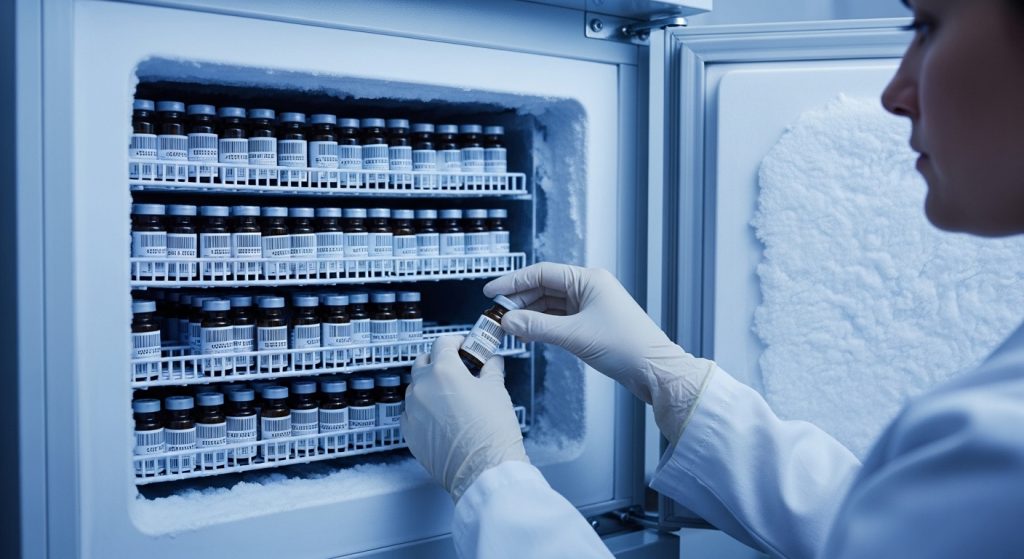
Store lyophilized (dry powder) peptides in a manual-defrost freezer at -20°C (-4°F) for up to 24 months, or at 4°C (39°F) for 3–6 months. Once reconstituted into liquid form, keep the solution refrigerated at 2–8°C (36–46°F) and use within 20–30 days (with bacteriostatic water). Never freeze a reconstituted peptide.
What Is Peptide Stability and Why Storage Conditions Matter
The stability of a peptide refers to its ability to maintain its intended primary, secondary, and tertiary structures under specific environmental conditions. When a peptide loses stability, its biological activity—its ability to bind to receptors or catalyze reactions—diminishes or disappears entirely. For researchers, understanding these pathways is critical to following an effective peptide storage guide. Degradation is rarely a single event; it is usually a cumulative process driven by thermodynamics and chemical kinetics.
Chemical Degradation Pathways: Hydrolysis, Oxidation, Aggregation
The chemical integrity of a peptide is under constant threat from the environment. There are four primary pathways through which peptides degrade in a laboratory setting:
- Hydrolysis: This is the cleavage of the peptide bond (the amide bond connecting amino acids) through the addition of water. Hydrolysis is significantly accelerated by elevated temperatures and extreme pH levels. Even trace amounts of moisture in a lyophilized vial can trigger hydrolysis over several months.
- Oxidation: Peptides containing specific residues—namely Methionine (Met), Cysteine (Cys), and Tryptophan (Trp)—are highly susceptible to oxidation. Methionine can be converted to methionine sulfoxide, while Cysteine can form unwanted intra- or inter-molecular disulfide bridges. Tryptophan degradation often leads to a yellowing of the solution or powder, indicating the formation of kynurenine derivatives.
- Aggregation: This is a physical degradation pathway where peptide molecules clump together. This “hydrophobic collapse” or “fibrillation” is often irreversible. Once aggregated, the peptide can no longer interact with its biological target. Aggregation is frequently caused by physical agitation (vortexing) or rapid temperature changes.
- Deamidation: This involves the removal of an amide group from Asparagine (Asn) or Glutamine (Gln) residues, often converting them into Aspartic acid or Glutamic acid. This change in charge and structure can completely neutralize a peptide’s efficacy.
Ionic Strength Effects: The ionic strength of the reconstitution solvent affects peptide stability. High ionic strength buffers can accelerate aggregation in hydrophobic sequences by weakening electrostatic repulsion between molecules. Most research peptides perform optimally at physiological ionic strength (approximately 150 mM NaCl equivalent).
Analytical Verification of Degradation (2026 Standard): Visual inspection detects only late-stage degradation. Early chemical changes — partial hydrolysis, deamidation, oxidation (+16 Da mass shift) — are invisible to the naked eye. In 2026 laboratory practice, High-Performance Liquid Chromatography (HPLC) and mass spectrometry are the definitive methods to confirm peptide purity and detect truncated fragments. Modern cryopreservation protocols also incorporate lyoprotectants such as trehalose (0.1–1% w/v added before lyophilization) and inert gas blanketing (argon or nitrogen headspace flushing of vials before sealing) to minimize oxidative degradation during long-term frozen storage.
Amino Acid Vulnerability Profiles by Research Compound
Different peptides require different levels of care based on their amino acid sequence. This peptide storage guide highlights specific vulnerabilities for common research compounds:
- BPC-157: Composed of 15 amino acids (Gly-Glu-Pro-Pro-Pro-Gly-Lys-Pro-Ala-Asp-Asp-Ala-Gly-Leu-Val), this peptide is relatively robust because it lacks Cysteine and Methionine. However, it contains multiple Aspartic acid residues, making it sensitive to deamidation if stored at improper pH levels. For further details, see BPC-157 and TB-500 research protocols.
- GHK-Cu: This copper-binding tripeptide is uniquely sensitive to UV light. The copper-nitrogen bond can be destabilized by photon energy, leading to the dissociation of the metal ion and loss of therapeutic potential. See GHK-Cu copper peptide studies for more.
- Retatrutide/Tirzepatide: These are complex GLP-1 analogues featuring fatty acid conjugates. These “tails” increase the peptide’s hydrophobicity, which significantly increases the risk of aggregation. These compounds should never be vortexed and require strict temperature control. Reference the semaglutide vs tirzepatide vs retatrutide comparison for structural differences.
- Deliquescence-prone residues (Asp, Glu, Lys, Arg, His): Peptides with high concentrations of charged, hygroscopic residues are especially susceptible to deliquescence — absorbing atmospheric moisture to form a liquid state. This destroys the lyophilized cake structure and massively accelerates hydrolysis. Peptides containing these residue clusters require the strictest moisture-barrier conditions (sealed vials, molecular sieve desiccants, <10% RH environments).
- IGF-1 LR3 and TB-500: These larger proteins/peptides rely on specific disulfide bridge configurations. Any exposure to reducing agents or excessive heat can break these bonds, rendering the protein biologically inert.

How to Store Lyophilized Peptides (Powder Form)
Lyophilization, or freeze-drying, is the industry standard for peptide preservation. By removing water through sublimation, the chemical reactions that cause degradation (like hydrolysis) are slowed to a near-halt. However, the powder remains hygroscopic, meaning it will aggressively pull moisture from the air if not handled according to a strict peptide storage guide.
Long-Term Freezer Storage: -20°C vs -80°C Protocols
For most research applications, a standard laboratory freezer set to -20°C is sufficient for 24 months of storage. For more sensitive sequences or ultra-long-term preservation (5+ years), -80°C (ultra-low temperature freezer) is preferred.
Advanced Preservation Techniques: For critical research stocks where maximum shelf-life is required, vacuum sealing or nitrogen/argon gas flushing of the vial headspace before sealing provides an additional layer of oxidation protection. Commercially, most Loti Labs lyophilized peptides are packaged under inert gas to minimize oxidative degradation from the point of manufacture. Researchers can replicate this by using a nitrogen flush before re-sealing any storage container.
The Frost-Free Problem: One of the most common mistakes in a peptide storage guide is the use of a “frost-free” or “auto-defrost” freezer. These units function by periodically warming the internal coils to melt ice buildup. These temperature “spikes” can cause repeated micro-thawing and refreezing of the peptide powder, which encourages the formation of moisture crystals and degradation. Always use a manual-defrost freezer for peptide storage.
The Microcondensation Risk: Room-Temperature Equilibration Protocol
The single most dangerous moment for a lyophilized peptide is when the vial is opened immediately after being removed from the freezer. Because the vial is significantly colder than the surrounding air, moisture from the atmosphere will instantly condense on the powder (microcondensation). This introduces water at a molecular level, triggering hydrolysis.
The Equilibration Protocol:
- Remove the vial from the freezer.
- Place it on the lab bench, still sealed, for 30–60 minutes.
- Wait until the vial has reached room temperature (equilibrated).
- Wipe the exterior of the vial with 70% ethanol to remove any external condensation before opening.
Light Protection: UV Degradation of Photoactive Peptides
Peptides containing aromatic amino acids such as Tryptophan (Trp), Tyrosine (Tyr), and Phenylalanine (Phe) are highly susceptible to photo-oxidation — a specific degradation mechanism where photon energy from UV radiation (200–300 nm wavelength) excites electrons in aromatic ring structures, generating reactive oxygen species (ROS) and initiating chain-reaction oxidative damage. This photo-oxidation process leads to chain cleavage, free radical generation, and in the case of Tryptophan, the distinctive yellowing that indicates formation of kynurenine derivatives. Research laboratories should use amber-tinted vials whenever possible. If clear vials are used, they must be stored in a light-proof box (e.g., a cardboard vial organizer) inside the freezer or refrigerator.

Reconstitution Handling: Aseptic Technique and Avoiding Shear Stress
Proper reconstitution technique is as critical as storage conditions. A peptide storage guide that covers temperature without covering handling mechanics is incomplete. The moment of reconstitution is when most preventable damage occurs.
Correct Mixing Technique: Swirl, Never Shake
- Inject diluent down the vial wall: Insert the single-use access component at the vial wall angle and allow the solvent to run slowly down the glass side — never spray it directly onto the lyophilized cake. Direct impact creates shear stress and foam.
- Gentle swirl only: Rotate the vial in a slow circular motion until the powder dissolves. This typically takes 1–3 minutes for most peptides. Never shake, vortex, or tap the vial on a hard surface.
- Why foaming is dangerous: Foam introduces oxygen at the air-liquid interface and generates mechanical shear stress at bubble surfaces. Both catalyze oxidation and hydrophobic aggregation. If foaming occurs, let the vial sit undisturbed for 5 minutes before proceeding.
- Allow full dissolution: Some hydrophobic peptides (AOD-9604, IGF-1 LR3) require 5–10 minutes of gentle rotation. Attempting to force dissolution accelerates aggregation.
Aseptic Handling Protocol
- Wipe the rubber stopper with a 70% isopropyl alcohol swab and allow to dry for 30 seconds before single-use access component insertion.
- Use a sterile, single-use calibrated transfer tool for each draw. Never reuse single-use access components that have contacted the vial stopper.
- Perform reconstitution in a clean area — preferably a laminar flow hood or at minimum a freshly wiped bench surface away from air vents.
- 0.2 µm membrane filtration: For research requiring sterility-verified preparations, filter reconstituted solutions through a 0.2 µm calibrated transfer tool-tip membrane filter before aliquoting. This removes bacterial contamination, fungal spores, and particulate matter. Use low-protein-binding PVDF or PES membranes to minimize peptide adsorption losses.
- Sonication for stubborn peptides: When hydrophobic peptides resist dissolution after 10+ minutes of gentle swirling, brief sonication in a bath sonicator (30 seconds at 25°C, low intensity) can break surface tension without causing shear denaturation. Avoid probe sonicators which generate excessive heat and cavitation.
- Buffer pH selection (target pH 5–7): Reconstituting in buffers within the pH 5–7 range minimizes both acid-catalyzed and base-catalyzed hydrolysis. For most peptides, pH 6.5–7.0 (close to physiological) is optimal. Extremes beyond pH 4 or pH 8 accelerate degradation dramatically.
- Unopened bacteriostatic water is stable at room temperature indefinitely until punctured. Once the vial is punctured, store upright in the refrigerator and use within 30 days.
Reconstituted Peptide Storage: The 30-Day Rule Explained
Once a peptide is dissolved in a solvent, its “stability clock” accelerates significantly. In a liquid state, the molecules are mobile and constantly interacting with the solvent, dissolved oxygen, and the walls of the container. A peptide storage guide for reconstituted compounds focuses on slowing these interactions through temperature and pH control.
Refrigerator Storage: 2°C to 8°C Guidelines
Reconstituted peptides should almost always be stored in a refrigerator (2°C to 8°C). This temperature range is cold enough to suppress the kinetic energy of the molecules (slowing degradation) but warm enough to prevent the solution from freezing.
Placement Matters: Never store peptide vials in the refrigerator door. The door is the warmest part of the unit and experiences the most frequent temperature fluctuations. Store vials in the center or back of a shelf, where the temperature is most stable.
Dedicated Peptide Freezer vs. Regular Refrigerator: What You Need
A common practical question for researchers setting up their first peptide storage system is whether standard household appliances are adequate.
- Regular refrigerator (2–8°C / 36–46°F): Entirely adequate for reconstituted peptides and short-term lyophilized storage (under 3 months). Use the interior back shelf, never the door. Most lab-grade research uses a standard refrigerator without issue for liquid storage.
- Standard chest/upright freezer (-20°C / -4°F): Suitable for the majority of lyophilized peptides for 12–24 months. The critical requirement is manual defrost — auto-defrost household freezers cycle to above 0°C multiple times daily, creating cumulative micro-damage. If only a frost-free unit is available, add an additional sealed insulated container to buffer thermal swings.
- Ultra-low temperature (ULT) freezer (-80°C / -112°F): Required for cysteine-rich sequences, sub-milligram quantities, or storage exceeding 2 years. Standard in academic and commercial research labs. Not necessary for most biohacker home-lab applications.
- USP <797> guidance: Current USP sterile compounding guidelines specify 2–8°C for reconstituted sterile preparations and -20°C or below for long-term lyophilized compound preservation — consistent with manufacturer protocols.
Bacteriostatic Water and the 20–30 Day Stability Window
The choice of diluent is a critical component of any peptide storage guide.
- Bacteriostatic Water: Contains 0.9% benzyl alcohol, which acts as a preservative by inhibiting the growth of bacteria. Most research peptides remain stable for 20 to 30 days when reconstituted with BAC water and refrigerated.
- Sterile Water (Plain): Contains no preservative. If a peptide is reconstituted with plain sterile water, it must be used immediately or within 24 hours, as bacterial contamination will degrade the peptide and compromise the research.
Why Freezing Reconstituted Peptides Damages Research Compounds
A frequent question in any peptide storage guide is whether one can freeze a peptide after it has been mixed with water. In general, the answer is no.
Freezing a liquid peptide causes the formation of ice crystals. These crystals exert physical “shear stress” on the peptide chains, potentially snapping the delicate bonds. Furthermore, as the water freezes, the concentration of salts and the pH of the remaining liquid can shift dramatically (by as much as 2 pH units), which can denature the compound. Finally, benzyl alcohol in BAC water can precipitate out of solution at sub-zero temperatures, forming shards that further damage the peptide structure. The only exception is the aliquoting method described below.
Aliquoting Strategy: Minimizing Freeze-Thaw Cycles
If a large volume of peptide is required for a long-term study, but the researcher wants to avoid the 30-day degradation limit of a single vial, the aliquoting strategy is the gold standard in any peptide storage guide.
Aliquoting involves dividing a newly reconstituted peptide into multiple single-use containers. This allows the researcher to thaw only what is needed for a single session, preventing the rest of the batch from undergoing harmful freeze-thaw cycles. Every time a peptide is frozen and thawed, it loses roughly 5% to 15% of its biological activity due to the stressors mentioned in the previous section. By the third freeze-thaw cycle, many peptides are significantly degraded.
The Aliquoting Protocol:
- Reconstitute the lyophilized powder with the required volume of diluent.
- Immediately divide the solution into sterile 0.5 mL microcentrifuge tubes or “PCR” tubes.
- Flash-freeze the tubes using dry ice or liquid nitrogen if available (this minimizes ice crystal size).
- Store the aliquots at -80°C (ideal) or -20°C (acceptable).
- Label each tube with the compound name, concentration, and date of reconstitution.
Traveling and Transporting Research Peptides: Cold Chain Protocols
A peptide storage guide for active researchers must address transport logistics. Moving peptides between facilities, shipping to collaborators, or traveling to field research sites all require maintaining the cold chain.
Transporting Lyophilized Peptides
- Short-distance travel (same day): Lyophilized powders tolerate room temperature for the duration of typical transit (days to weeks) if the vial is sealed and protected from light and moisture. Standard shipping containers without refrigeration are acceptable for most peptide powders.
- Long-distance shipping: Place vials in individual sealed zip-lock bags with a silica gel desiccant sachet. Use an insulated shipping container to minimize temperature excursions above 25°C.
- Documentation: Include a copy of the Certificate of Analysis (COA) and maintain temperature logs for GLP-compliant research.
Transporting Reconstituted Peptides
- Use a validated cold pack system: Reconstituted peptides require continuous 2–8°C maintenance. Use a Phase Change Material (PCM) cold pack rated for 4°C — not standard ice packs, which can drop to 0°C and risk freezing.
- Minimize time outside refrigeration: Even at ambient temperature, reconstituted peptide stability degrades measurably within hours. Total time outside 2–8°C should not exceed 4 hours for sensitive compounds.
- Upright orientation: Keep vials upright to minimize stopper contact with solution (silicone contamination risk).
The Equilibration Protocol: Bringing Frozen Vials to Working Temperature
Whether you are dealing with a lyophilized vial or a frozen aliquot, the process of returning it to working temperature must be gradual. This peptide storage guide emphasizes patience over speed to protect the molecular integrity of the compound.
Step-by-Step Equilibration:
- Removal: Take the vial/aliquot from the freezer.
- Environment: Place it on a clean laboratory bench at room temperature. Do NOT use a warm water bath, a heat lamp, or a microwave. Heat is a primary catalyst for denaturation.
- Duration: Wait 30–60 minutes. For larger volumes, a longer duration may be required.
- Inspection: Once the vial has reached room temperature, inspect it. For lyophilized powder, check for any “clumping” which might indicate moisture ingress. For aliquots, ensure the solution is clear and free of particles.
- Opening: Only open the vial after it is no longer cold to the touch.
Compound-Specific Storage Notes for Common Research Peptides
Because every sequence is unique, a universal peptide storage guide must include specific notes for the most common research molecules.
- BPC-157: Remarkably stable. Can last up to 2 years at -20°C as a powder. Once reconstituted in BAC water, it is stable for 30 days at 4°C. Avoid high-heat environments, as BPC-157 is susceptible to thermal degradation at temperatures exceeding 40°C. Read more on BPC-157 storage.
- TB-500 (Thymosin Beta-4): This peptide binds to actin and is very sensitive to heat-induced conformational changes. While it is stable as a powder, it should be kept at 4°C even during active use periods once in liquid form.
- GHK-Cu: As a copper chelate, GHK-Cu is particularly prone to oxidation if exposed to air. Ensure the vial cap is tight and the compound is stored in complete darkness. Explore GHK-Cu research.
- GLP-1 Analogues (Semaglutide/Tirzepatide/Retatrutide): These peptides are very large and heavy. They are extremely sensitive to mechanical stress. NEVER vortex these compounds; instead, gently swirl the vial to reconstitute. They should be stored at -20°C long-term as powders. See comparison guide.
- IGF-1 LR3: Highly fragile due to its complex disulfide structure. It is often reconstituted in 0.1% acetic acid or 10mM HCl to maintain a low pH, which helps prevent aggregation and maintains stability.
- AOD-9604: This hydrophobic peptide can be difficult to dissolve. If it does not go into solution with BAC water, a small amount of 0.1% acetic acid may be required. It must be stored at -20°C as a lyophilized powder.
- Ipamorelin and CJC-1295: These are standard research peptides that follow the general “30-day rule” for refrigerated liquid storage and the “24-month rule” for frozen powder storage.
7 Critical Peptide Storage Mistakes to Avoid
- Using a Frost-Free Freezer: As mentioned, the heating cycles destroy peptides over time. Always use a manual defrost unit.
- Storing in the Fridge Door: Constant opening and closing lead to temperature spikes. Use the back of the fridge.
- Opening Vials While Cold: This is the #1 cause of moisture contamination. Always equilibrate to room temperature first.
- Using Sterile Water for Multi-Day Use: Without benzyl alcohol, the solution becomes a breeding ground for bacteria within hours.
- Vortexing Peptides: High-speed mixing creates “shear force” that can break peptide bonds and cause hydrophobic aggregation. Always swirl gently.
- Storing in Pre-loaded calibrated transfer tools: calibrated transfer tools are not airtight and are made of plastics that can leach chemicals or adsorb the peptide. Only draw the peptide into a calibrated transfer tool immediately before use.
- Unlabeled Vials: Lyophilized powders look identical. Never rely on memory; always label with the name, date, and concentration.
Peptide Storage Checklist: Before, During, and After Reconstitution
Phase 1: Before Reconstitution (Lyophilized)
- [ ] Is the freezer set to at least -20°C and set to manual defrost?
- [ ] Are the vials in an airtight secondary container with silica desiccant?
- [ ] Are the vials protected from light (amber glass or light-proof box)?
- [ ] Has the vial been equilibrated to room temperature for 45 minutes before opening?
Phase 2: During Reconstitution
- [ ] Has the vial stopper been cleaned with an alcohol swab?
- [ ] Is the correct diluent (BAC water vs. Sterile water) being used?
- [ ] Is the diluent being added slowly down the side of the glass (not directly onto the powder)?
- [ ] Am I swirling gently rather than shaking or vortexing?
Phase 3: After Reconstitution (Liquid)
- [ ] Is the vial stored in the back of the refrigerator (2°C to 8°C)?
- [ ] Is the vial labeled with the “Discard Date” (30 days from now)?
- [ ] If freezing, have I divided the solution into single-use aliquots?
- [ ] Is the solution clear? (Discard if cloudy or containing particles).
Frequently Asked Questions
Q: Do all peptides need to be refrigerated?
A: Yes, in a research setting, all peptides should be refrigerated (for liquid) or frozen (for powder). While some peptides like BPC-157 are more stable than others, refrigeration is the only way to ensure standardized results and prevent degradation over time.
Q: How long can a lyophilized peptide stay at room temperature?
A: Most lyophilized peptides are stable at room temperature for 1–4 weeks during shipping. However, for long-term storage, they should be moved to a freezer as soon as possible to prevent slow degradation.
Q: Can I freeze a peptide after it has been mixed with bacteriostatic water?
A: It is generally discouraged unless you are performing a one-time “aliquoting” procedure. Repeatedly freezing and thawing liquid peptides causes physical damage to the molecules through ice crystal formation and pH shifts.
Q: Exactly how long does BAC water keep a peptide stable?
A: Bacteriostatic water keeps a solution sterile for about 28–30 days. The chemical stability of the peptide itself may vary, but 30 days is the standard safety window for most research compounds in a peptide storage guide.
Q: What happens if I left my peptide out of the fridge overnight?
A: If the peptide was lyophilized, it is likely fine. If it was reconstituted, one night at room temperature may cause a minor loss of potency (1-5%), but it is usually still viable for research. If it was left in direct sunlight or a hot car, it should likely be discarded.
Q: What is the best container for peptide storage?
A: Type I borosilicate glass vials are the gold standard. They are chemically inert and resistant to thermal shock. For aliquoting, use high-quality polypropylene microcentrifuge tubes.
Q: How do I know if my peptide has degraded?
A: Look for physical changes: cloudiness, “clumping” of the powder that doesn’t dissolve, or a change in color. However, chemical degradation (like deamidation) is invisible to the naked eye, which is why following a peptide storage guide protocol is so vital.
Q: Do I really need a desiccant?
A: Yes. Moisture is the “silent killer” of lyophilized peptides. A small silica gel packet in your storage bag can extend the shelf life of your peptides by months by absorbing any ambient humidity.
Q: Can BPC-157 be stored at room temperature?
A: While BPC-157 is exceptionally stable compared to other peptides, room temperature storage (lyophilized) should not exceed 30 days for maximum potency. Reconstituted BPC-157 must always be refrigerated.
Q: How many freeze-thaw cycles can a peptide survive?
A: Most peptides can survive one freeze-thaw cycle (the initial aliquot). By the second or third cycle, the cumulative damage from ice crystals and pH changes will significantly degrade the compound’s effectiveness.
Q: Why must peptides be stored in the dark?
A: UV light provides energy that can break chemical bonds, particularly in peptides containing aromatic rings (Trp, Tyr, Phe). This leads to the formation of free radicals and irreversible degradation.
Q: Can lyophilized peptides be stored at room temperature?
A: Yes, for short periods. Most lyophilized peptides tolerate ambient room temperature (20–25°C / 68–77°F) for the standard 1–4 week transit and shipping window without significant degradation, provided the vial seal is intact and exposure to light and moisture is avoided. For storage beyond 30 days, placement in a -20°C manual-defrost freezer is required to prevent progressive deamidation and backbone hydrolysis.
Q: Does unopened bacteriostatic water need to be refrigerated?
A: No. Sealed, commercially produced bacteriostatic water (0.9% benzyl alcohol) is stable at room temperature until the vial is first punctured. Refrigeration of the unopened vial is unnecessary. Once the rubber stopper is penetrated, store upright in the refrigerator (2–8°C) and discard within 28–30 days.
Q: Why is foaming bad when reconstituting peptides?
A: Foam creates an air-liquid interface where two simultaneous damage mechanisms occur: (1) dissolved oxygen at bubble surfaces catalyzes oxidation of Met, Cys, and Trp residues, and (2) surface tension at bubble boundaries generates mechanical shear stress that disrupts non-covalent bonds, promoting hydrophobic aggregation. To prevent foaming, inject diluent slowly down the vial wall and swirl gently. If foam appears, allow the vial to rest undisturbed for 5 minutes before use.
Q: Can peptides be stored in a regular refrigerator?
A: Yes. A standard household or lab refrigerator set to 2–8°C (36–46°F) is appropriate for reconstituted peptides (up to 30 days with BAC water) and short-term lyophilized storage (3–6 months). The critical rule: always use the interior back shelf, never the door compartment, where temperature fluctuates by ±3–5°C with each opening.
Q: How should peptides be stored long-term?
A: Long-term storage (over 6 months) requires a dedicated manual-defrost freezer at -20°C to -80°C (-4°F to -112°F). Store lyophilized peptides in sealed amber glass vials with a silica gel desiccant sachet inside a secondary airtight container. For cysteine-rich or methionine-containing sequences, -80°C storage with nitrogen-flushed vials is the gold standard.
Q: Should peptides always be stored in a freezer?
A: Not always — it depends on the form. Lyophilized (powder) peptides benefit from freezer storage (-20°C) for long-term preservation, but short-term lyophilized storage at 4°C is acceptable for 3–6 months. Reconstituted (liquid) peptides must never be frozen — ice crystal formation causes permanent shear damage. Liquid peptides belong in the refrigerator (2–8°C), not the freezer.
Q: Can I transport peptides without refrigeration?
A: Lyophilized peptide powders can be transported at room temperature safely for days to weeks if the vial is sealed, protected from light, and kept below 25°C (77°F). No refrigeration is required for powder transport. Reconstituted liquid peptides require a Phase Change Material (PCM) cold pack rated for 4°C and should not exceed 4 hours outside the 2–8°C range during transit.
Q: What is the difference between BAC water and sterile water in storage?
A: BAC water contains benzyl alcohol, which prevents bacterial growth for up to 30 days. Sterile water has no preservative; once the vial is punctured, bacteria can grow rapidly, making it unsuitable for storage beyond 24 hours.
Continue Your Research
Explore our complete catalog of premium research compounds.
