
Premium USA-Made Research Compounds
Browse lab-tested peptides, research liquids, capsules and more.
Mitochondria have long been described as the cell’s power plants — but that framing undersells them. Over the past two decades, researchers have recognized that mitochondria are active signaling organelles, capable of producing small peptides that communicate with the rest of the cell and even with distant tissues. Humanin is one of the most studied of these mitochondria-derived peptides (MDPs), and the research surrounding it has grown into something genuinely remarkable.
What follows is a research-focused overview of what science currently knows — and where investigational work is heading. All content is intended strictly for research use only.
What Is Humanin?
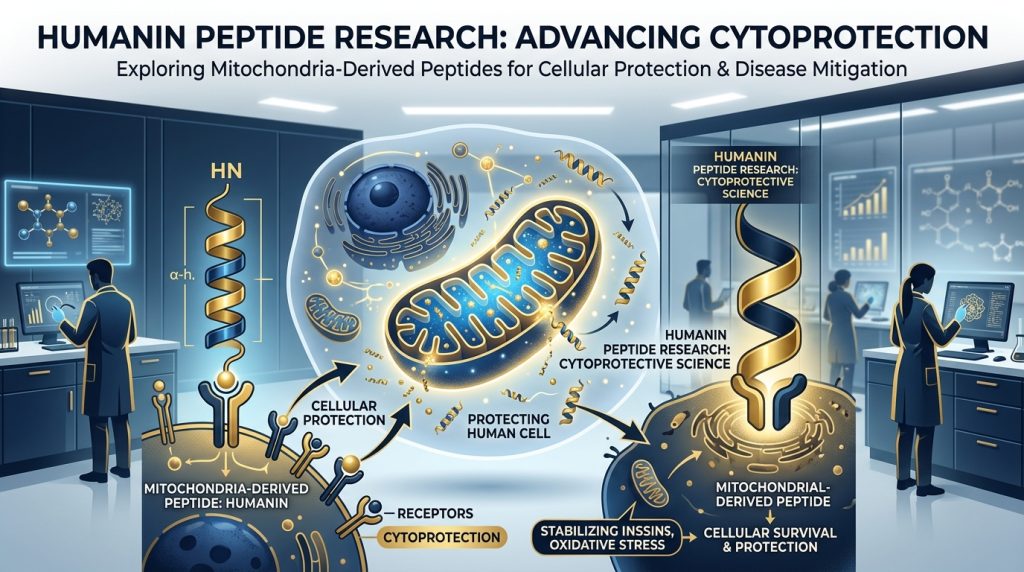
Humanin is a small peptide — 21 amino acids in length — that sits at a fascinating intersection of mitochondrial biology and cellular survival signaling. It is not synthesized through the conventional nuclear genome pathway. Instead, it is encoded within the mitochondrial genome itself, specifically within the 16S ribosomal RNA gene of mitochondrial DNA. This alone makes it unusual. Most bioactive peptides trace back to nuclear-encoded genes; humanin is one of a growing class of exceptions.
Discovery and Molecular Identity
The discovery of humanin came in 2001, from the laboratory of Ikuo Nishimoto and colleagues. The team was screening for genes that could protect neurons against Alzheimer’s disease–related cell death — a challenging problem, since the precise mechanisms of neuronal loss in Alzheimer’s were (and remain) incompletely understood. When they identified a transcript from the occipital cortex of an Alzheimer’s-affected brain that conferred protection against cell death in culture models, they were surprised to trace it back to a mitochondrial locus rather than a nuclear gene. The peptide was named humanin to reflect its apparent role in preserving human neuronal survival.
Structurally, humanin’s 21-amino acid sequence (MAPRGFSCLLLLTSEIDLPVK) is highly conserved across mammals. Circulating forms of humanin have been detected in human blood and cerebrospinal fluid.
Humanin Analogs: HNG and Beyond
Shortly after the original identification, researchers began modifying the humanin sequence to understand its structure-activity relationships and to develop more potent analogs for laboratory investigation. The most extensively studied is HNG (humanin with a glycine-to-serine substitution at position 14).
HNG has become a workhorse compound in humanin research precisely because its enhanced potency allows investigators to study receptor binding, downstream signaling, and functional outcomes at lower concentrations. Other analogs have also been synthesized and characterized, each offering slightly different receptor interaction profiles. For research programs focused on mechanistic studies, the analog landscape is an important context to keep in mind.
Mitochondrial Origin and the MOTS-c Connection
Humanin was not a lone discovery for long. As researchers began to appreciate that mitochondria could encode bioactive peptides, additional MDPs were identified.
The existence of MOTS-c alongside humanin reinforced a broader hypothesis: that mitochondria serve as endocrine-like organelles, releasing peptide signals in response to cellular stress, energy status, and aging. This framework has meaningfully reshaped how some researchers think about the molecular biology of aging.
Pinchas Cohen at the University of Southern California has been central to advancing this view. His laboratory’s work on humanin and MOTS-c helped establish that these peptides circulate systemically and appear to coordinate responses across tissues — they aren’t simply local mitochondrial signals. Understanding humanin as part of a broader mitochondrial signaling network, rather than in isolation, provides richer context for the research data.
One striking finding from population studies: centenarians and their offspring tend to show higher circulating humanin levels than age-matched controls.
IGF-1 Signaling Pathways in Humanin Research
IGF-1, or insulin-like growth factor 1, is a central axis in aging biology. The IGF-1/insulin signaling pathway is one of the most evolutionarily conserved regulators of lifespan across species from nematodes to mammals.
Downstream Cellular Signaling
Researchers have also described a trimeric receptor complex involving cytokine-like receptor 1 (CNTFR), WSX-1, and gp130 as a high-affinity humanin receptor. This complex, involved in cytokine signaling, suggests that humanin’s receptor biology is more complex than a single receptor interaction — a feature common to peptides with pleiotropic activity profiles.
Laboratory models have now documented humanin’s apparent protective effects across multiple insults relevant to neurodegeneration — not just the amyloid-beta pathway that first put it on the map.
Alzheimer’s Disease Research Models
The original Nishimoto paper demonstrated that humanin could protect neurons from cell death induced by familial Alzheimer’s disease–associated genes (specifically presenilin-2 mutants and V642I APP). Subsequent work expanded that initial observation considerably.
These are controlled laboratory observations — they illuminate mechanism and biological plausibility rather than clinical application.
Such epidemiological associations complement the mechanistic work and help frame testable hypotheses for future investigational studies.
Amyloid-Beta Interaction Studies
One particularly interesting line of research concerns direct physical interaction between humanin and amyloid-beta (Aβ) peptides — the principal protein constituent of the plaques seen in Alzheimer’s-affected brain tissue. Several studies have reported that humanin can bind directly to Aβ peptides, potentially inhibiting their aggregation into the oligomeric and fibrillar forms thought to be neurotoxic.
This direct interaction hypothesis is mechanistically appealing: a small protective peptide that physically intercepts the toxic species before they can form aggregates. Whether this mechanism is relevant at physiologically relevant concentrations — and whether it operates in vivo as it does in in vitro assays — remains an important open question that future research programs will need to address.
It is not simply that the peptide is anti-apoptotic or cytoprotective — those properties alone wouldn’t distinguish it from dozens of other survival factors.
C. elegans and Mammalian Aging Models
C. elegans — the tiny roundworm that has been central to aging biology since the 1990s — has also served as a platform for studying humanin.
FOXO transcription factors are central regulators of longevity across many species. This kind of evolutionary conservation is taken seriously by aging researchers — mechanisms that matter in worms often matter in mammals too.
Caloric Restriction Mimicry
Caloric restriction (CR) is the most reproducible intervention for extending lifespan in laboratory animals. Some researchers have proposed that humanin may act as a partial mimetic of caloric restriction’s signaling effects at the molecular level.
The hypothesis is still in early stages, but it is scientifically plausible. Research programs exploring CR mimetics have begun to consider MDPs like humanin as molecular tools for dissecting exactly what caloric restriction does — and why it works.
Cardiomyocytes — the contractile cells of the heart — are extraordinarily mitochondria-rich, relying on these organelles for the constant energy supply required for rhythmic contraction. It follows that mitochondria-derived signals would be relevant to cardiac biology, and humanin research has borne this out.
Studies have reported inverse associations between circulating humanin and measures of arterial stiffness — though such findings require cautious interpretation, as they do not establish causality and may reflect confounders. These population signals nonetheless motivate further mechanistic investigation into humanin’s role in vascular biology.
Research Protocols and Observations
In laboratory research settings, humanin and its analogs have been studied using a range of administration approaches and model systems. Cell culture models — including primary neuronal cultures, hepatocytes, cardiomyocytes, and various cell lines — have allowed detailed mechanistic dissection of receptor interactions and downstream signaling.
This allows investigators to work with lower concentrations while still achieving detectable effects, reducing the potential for off-target confounding at high concentrations. Structural analogs with further modifications are also under investigation, with some designed to improve stability and half-life in biological systems.
Quantification of humanin levels in biological samples has historically presented technical challenges, as the peptide’s small size and the structural similarity to other sequences complicates antibody-based detection. Improved mass spectrometry approaches have helped address this problem and are increasingly used in labs conducting humanin biomarker research. All protocols involving humanin analogs are conducted strictly under laboratory conditions for research use only.
Future Research Directions
Several directions stand out. First, understanding what regulates humanin production — what triggers mitochondria to release it, and how that changes with age and disease — remains a key open question. Humanin levels decline with aging in most populations; whether this decline is a cause or consequence of age-related biology is not yet resolved.
Second, interactions between humanin and the broader mitochondrial peptide network (including MOTS-c and others still being characterized) represent a rich investigational area.
Such combinatorial designs are common in contemporary aging research and will likely be applied to humanin in coming years.
Conclusion
The depth and breadth of the preclinical data are difficult to dismiss.
The questions worth asking are substantial: Why do circulating levels fall with age? Does that decline actually matter for how organisms age? Can the signaling pathways humanin engages be meaningfully modulated in research settings?
All content presented here is intended for educational and research purposes only. Humanin and its analogs are investigational research compounds.
Continue Your Research
Explore our complete catalog of premium research compounds.
