For laboratory and research use only. Not for human consumption.
It was 1973, he was looking at liver tissue, and he stumbled onto a copper-bound tripeptide hiding in human plasma.
The peptide was GHK-Cu (glycyl-L-histidyl-L-lysine copper complex). It’s tiny : three amino acids and a copper ion. And somehow it touches over 4,000 human genes. This article breaks down what researchers actually know about it so far, what the data looks like, and why it keeps showing up in new studies.
What Is GHK-Cu Peptide?
GHK-Cu isn’t lab-designed : it’s a copper(II) complex of the peptide glycyl-L-histidyl-L-lysine, and it shows up in blood, saliva, and urine. The wrinkle (no pun intended) is that levels crash as we get older. When you’re 20, plasma concentration sits near 200 ng/mL. Fast forward to 60 and it’s fallen to about 80 ng/mL. Sixty percent gone. Coincidence? Researchers don’t think so, and the gene expression data backs them up.
| Property | Value |
|---|---|
| Peptide Sequence | Glycyl-L-Histidyl-L-Lysine |
| Abbreviation | GHK-Cu |
| CAS Number | 49557-75-7 |
| Molecular Formula (GHK) | C14H24N6O4 |
| Molecular Weight (free peptide) | 340.38 g/mol |
| Molecular Weight (GHK-Cu complex) | ~401.93 g/mol |
| Metal Ion | Copper(II) / Cu2+ |
| Source | Naturally occurring in human plasma |
| Classification | Copper-binding tripeptide |
How GHK-Cu Was Discovered
Pickart wasn’t even looking for a peptide : that’s the irony. He had old liver tissue and young liver tissue, and wanted to know why they made proteins so differently. So he took a fraction of human serum albumin, applied it to the aged cells, and watched. The old cells started acting young again. Different protein synthesis patterns. As if decades of aging had been rolled back in a dish.
Four more years of work and by 1977 he’d isolated the active component. A tripeptide. Glycine, histidine, lysine : bound to copper. Pickart would spend the next 46 years expanding on that discovery (he died in 2023). Every time someone looked at a new system, GHK-Cu was doing something interesting there too.
GHK-Cu Chemistry and Structure
Glycine, histidine, lysine. That’s it : the whole peptide. Three amino acids in a line. You could sketch it on a napkin. What makes it interesting isn’t the peptide itself; it’s what happens when copper enters the picture.
The Cu(II) ion grabs hold through three nitrogen atoms. One from histidine’s imidazole ring. One from glycine’s alpha-amino group. One from the deprotonated amide bond between the first two residues. The resulting binding constant sits around log K = 16.44 at physiological pH, which is biochemistry’s way of saying “good luck pulling that apart.”
Why care about the copper? Because it runs essential machinery. Copper isn’t optional in biology. It’s infrastructure. And GHK-Cu is one of the main vehicles that delivers it where it’s needed.
How GHK-Cu Actually Works
Most peptides bind a receptor. One receptor, one pathway, one downstream effect. GHK-Cu doesn’t play that game. It acts more like a system-wide signal : touching multiple pathways at once, which is part of why its effects are so broad and, honestly, a bit unusual for something this small.
Copper Delivery
Think of GHK-Cu as a copper taxi. It grabs Cu2+ and drops it off wherever cells are running low. GHK-Cu basically keeps the supply chain from breaking.
Gene Expression : and This Is Where It Gets Wild
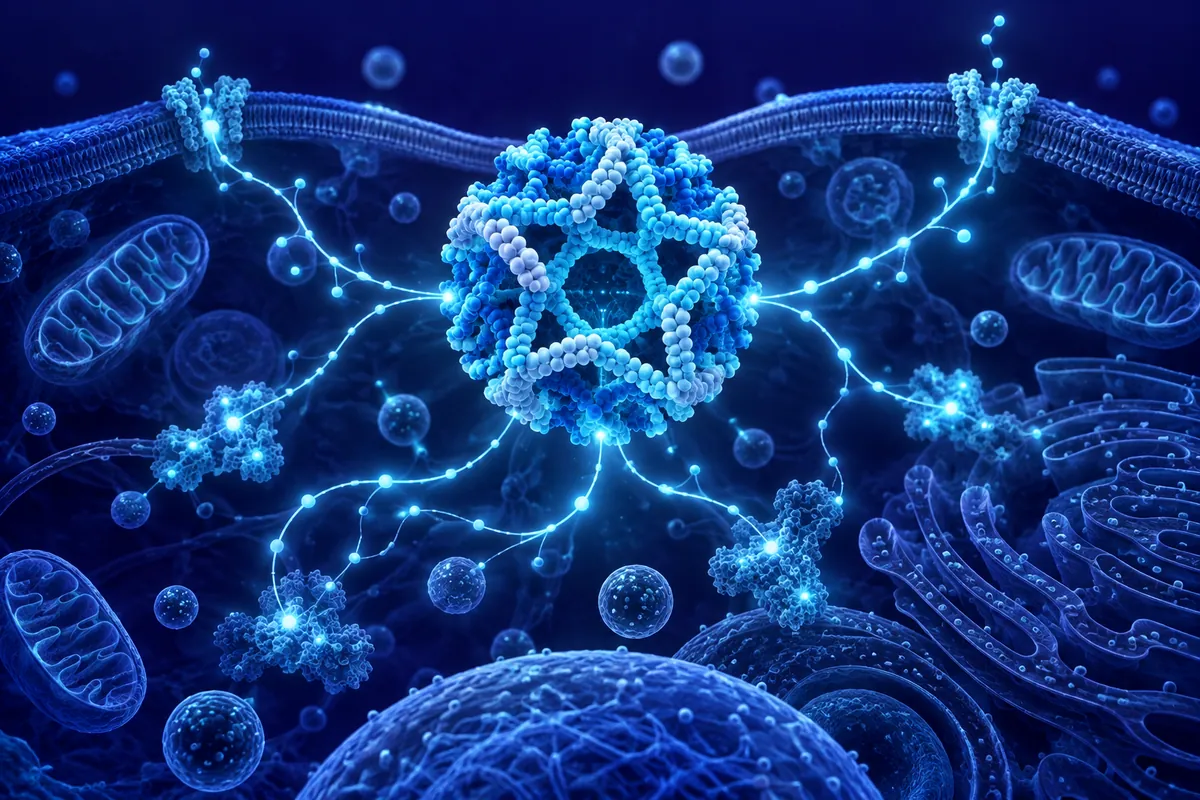
Researchers ran GHK through the Broad Institute’s Connectivity Map database. What they found stopped people in their tracks: 4,048 human genes affected by a single tripeptide. That’s 6% of the genome.
Six percent. From three amino acids and a copper ion.
Which, if you think about it, is exactly what Pickart saw in his liver cells back in ’73. Same observation, just now we can see the machinery behind it.
Extracellular Matrix Remodeling
Simultaneously, MMP activity (the enzymes that digest matrix) gets regulated alongside their inhibitors (TIMPs). Too much building and you get fibrosis. GHK-Cu walks the line : organized remodeling instead of chaos.
This is the most studied application, and the data is extensive.
- Diabetic rat models: PIC dressings with GHK showed higher glutathione and ascorbic acid levels, better epithelialization, and stronger fibroblast activation
New Blood Vessel Formation
Flip it on and you get a cascade : cytokines, chemokines, adhesion molecules, the works. GHK-Cu dials it back.
Not just dampening the fire.
Other Research Areas Worth Knowing About
SOD activity up. Glutathione levels up.
This one caught several research groups off guard.
Nervous System
Still early days here.
GHK-Cu in Multi-Peptide Blends
One peptide doing a lot? Good. Multiple peptides hitting different mechanisms at the same time? That’s where multi-compound blends come in. Loti Labs offers two that build on GHK-Cu’s foundation.
Glow Blend
The Glow Blend (70mg) stacks three peptides with different jobs:
| Component | Amount | What It Brings to the Table |
|---|---|---|
| GHK-Cu | 50mg | |
| BPC-157 | 10mg | |
| TB-500 | 10mg |
Why these three? They don’t overlap much. BPC-157 drives blood vessel formation and growth factor signaling : different axis entirely. TB-500 works the structural side through actin regulation and cell migration.
Klow Blend
The Klow Blend (80mg) takes the Glow formula and adds a fourth component:
| Component | Amount | What It Brings to the Table |
|---|---|---|
| GHK-Cu | 50mg | |
| BPC-157 | 10mg | |
| TB-500 | 10mg | |
| KPV | 10mg |
Why add KPV?
Glow vs. Klow : Which One?
Safety : What Researchers Should Watch For
It’s naturally present in human blood, so the toxicity profile starts in a pretty good place. Preclinical data confirms that. But “low toxicity” doesn’t mean “zero things to think about.”
First, carboxypeptidases will tear this peptide apart : fast. If your experimental design doesn’t account for enzymatic degradation, your results will be all over the place. The effects are concentration-dependent in ways that aren’t always linear, so skipping concentration-response curves in your model is asking for trouble.
Third : and people forget this one : copper adds up. Yes, it’s an essential trace element. Too much copper creates its own set of problems.
Storage? Nothing complicated. The lyophilized powder is stable under normal storage conditions.
One more thing: GHK-Cu is an investigational research compound. Not FDA-approved. Laboratory research use only.
Product Specs
Available as standalone peptide, capsules, or in pre-formulated blends : depends on the study design:
| Product | Format | Amount | Price |
|---|---|---|---|
| GHK-Cu 50mg | Lyophilized powder | 50mg | $49.99 |
| GHK-Cu Capsules | Capsules (2mg/capsule, 30 count) | 60mg total | $59.99 |
| Glow Blend 70mg | Multi-peptide blend | 70mg (GHK-Cu 50mg + BPC-157 10mg + TB-500 10mg) | $149.99 |
| Klow Blend 80mg | Multi-peptide blend | 80mg (GHK-Cu 50mg + BPC-157 10mg + TB-500 10mg + KPV 10mg) | $199.99 |
All Loti Labs compounds go through third-party purity and identity testing. Wondering how to vet peptide suppliers in general? We put together a supplier evaluation guide that covers what actually matters.
So Where Does GHK-Cu Stand?
Fifty years in, and researchers are still pulling new findings out of a compound made from three amino acids and a copper ion. Pickart couldn’t have predicted the gene expression data when he was watching liver cells in 1973. Nobody could have. A tripeptide affecting 6% of the human genome? That’s not the kind of thing you put in your grant proposal and expect to be taken seriously. But here we are.
The Glow and Klow blends stack complementary mechanisms. Either way : there’s a reason this peptide keeps showing up in the literature after half a century.
Curious about the other peptides we covered? Here’s our deep dive on BPC-157, our breakdown of TB-500, and a look at KPV research.
References
- Pickart L. J Biomater Sci Polym Ed. 2008;19(8):969-988. doi:10.1163/156856208784909435
- Pickart L, Vasquez-Soltero JM, Margolina A. Biomed Res Int. 2015;2015:648108. PMID: 26236730; PMC4508379
- Pickart L, Vasquez-Soltero JM, Margolina A. Int J Mol Sci. 2018;19(7):1987. PMID: 29986520; PMC6073405
- Pickart L, Vasquez-Soltero JM, Margolina A. Cosmetics. 2015;2(3):236-247.
- Maquart FX, Pickart L, Laurent M, et al. +. FEBS Lett. 1988;238(2):343-346. PMID: 3169264
- Siméon A, Wegrowski Y, Bontemps Y, Maquart FX. +). J Invest Dermatol. 2000;115(6):962-968. PMID: 11121126
- Lamb JR, Crawford ED, Peck D, et al. The Connectivity Map: using gene-expression signatures to connect small molecules, genes, and disease. Science. 2006;313(5795):1929-1935. PMID: 17008526
- Pickart L, Margolina A. Int J Mol Sci. 2018;19(7):1987. PMID: 25815981
Disclaimer: This article is for informational and educational purposes only. GHK-Cu is sold as a research compound for laboratory investigation. It is not intended for human consumption and has not been approved by the FDA for any medical use. All research cited refers to preclinical and in vitro studies. Loti Labs does not make any claims regarding the use of this compound outside of a controlled research setting.
This educational material discusses laboratory research concepts only. Loti Labs products are intended strictly for research and development use and are not for human consumption.