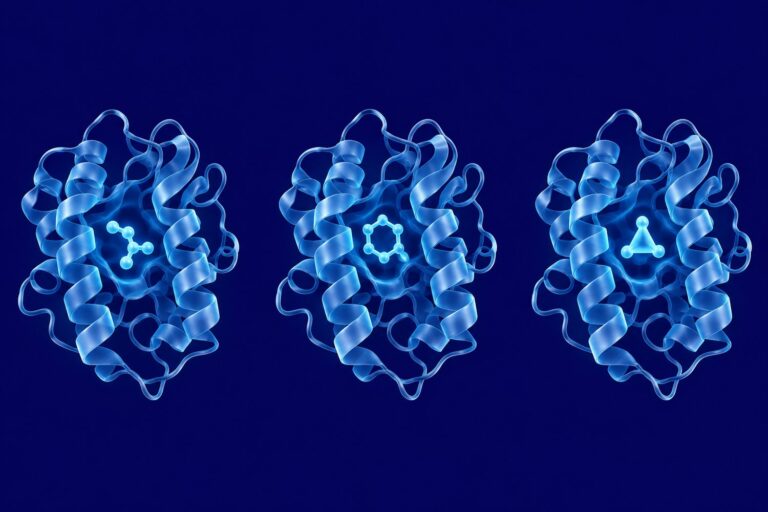
Ask ten people what MK-677 is and you’ll get a few wrong answers (a SARM, a peptide, a “GH booster”). It’s none of those, exactly. Merck built it in the 1990s as a pill-friendly way to hit the receptor we now call the ghrelin receptor, and although the clinical program went nowhere, endocrinologists kept using it because it’s such a handy probe for the GH/IGF-I axis. Below we’ve gathered what the papers say, including the parts that made Merck walk away, plus some notes on keeping the powder in good shape at the bench.
Key findings
- Merck’s first paper put MK-677’s potency on rat pituitary cells at an EC50 of 1.3 nM (Patchett et al., 1995).
- Older volunteers (64 to 81 years, n = 32) saw IGF-I jump from 141 to 265 µg/L in four weeks. Their fasting glucose went up too, 5.4 to 6.8 mmol/L (Chapman et al., 1996).
- Over two years, the MK-677 arm gained 1.1 kg of fat-free mass while placebo lost 0.5 kg; insulin sensitivity dropped (Nass et al., 2008).
- The hip-fracture trial (n = 123) got stopped early. Reason: a congestive heart failure signal (Adunsky et al., 2011).
- Rats didn’t grow at all after six weeks, and by then MK-677 no longer moved their GH (Lee et al., 2018).
What is MK-677?
You’ll see it written four ways: MK-677, MK-0677, L-163,191 and ibutamoren (usually as the mesylate). One molecule, several labels, because Merck renamed things as the compound moved from chemistry into trials.
Chemically, think spiropiperidine. The core is a spiro-indoline piperidine, formula C27H36N4O5S, weight roughly 528.7 g/mol, CAS 159634-47-6. What arrives in a vial is normally the mesylate salt, an off-white powder that doesn’t look like much.
Here’s the thing that people get wrong constantly online: MK-677 is not a SARM. It has no meaningful affinity for the androgen receptor. Its entire known pharmacology runs through the GH secretagogue receptor, which is why WADA files it under peptide hormones and mimetics rather than anabolic agents. It’s also not a peptide, which sounds like a technicality until you remember what peptides do in a digestive tract. They get chewed up. A small molecule doesn’t.
MK-677 compared with related research compounds
| Feature | MK-677 (ibutamoren) | GHRP-6 / ipamorelin | SARMs (e.g. RAD-140) |
|---|---|---|---|
| Chemical class | Non-peptide spiropiperidine | Synthetic peptides | Non-steroidal small molecules |
| Primary target | GHS-R1a (ghrelin receptor) | GHS-R1a (ghrelin receptor) | Androgen receptor |
| Oral activity in published studies | Yes | Poor | Yes |
| Androgen receptor binding | No | No | Yes |
| WADA category | S2 (peptide hormones, growth factors, mimetics) | S2 | S1 (anabolic agents) |
For a deeper side-by-side with the peptide secretagogues, see our MK-677 vs ipamorelin comparison.
Discovery at Merck
GHRP-6 came first. It’s a six-residue peptide that released GH nicely and was close to useless by mouth, which bothered Merck, since a drug nobody can swallow is a hard sell. Their first small-molecule try, L-692,429, had the right mechanism and not nearly enough punch.
So the chemists kept going. By 1995 they had MK-677, and Patchett’s team wrote it up in PNAS: potent, active orally, behaving on pituitary cells just like GHRP-6 and L-692,429 and unlike GHRH (Patchett et al., 1995). Dogs given it by mouth released GH while aldosterone, LH, thyroxine and prolactin barely moved. Cortisol crept up a little. That clean profile was enough to send it to the clinic.
A year on, Howard and coworkers at the same company cloned the target, a G protein-coupled receptor sitting in pituitary and in the arcuate and ventromedial hypothalamus of pigs and people (Howard et al., 1996). Their guess? Some natural hormone must use this receptor. They were right, though it took until 1999 for ghrelin to be found. I like that bit of history: the mimic showed up years before the thing it mimics.
Pharmacology: how MK-677 acts on GHS-R1a
The receptor lives mainly in the hypothalamus and anterior pituitary. Once MK-677 is bound, Gq/11 kicks in, phospholipase C makes IP3, calcium floods the cytoplasm, and somatotrophs dump GH.
The interesting part isn’t the cascade, though. It’s the rhythm. Endogenous GH comes in bursts (the largest one lands in deep sleep), and injected recombinant GH just flattens all that. When Chapman’s group sampled blood every 20 minutes, MK-677 had made the peaks taller and lifted the valleys, but there were no extra pulses (Chapman et al., 1996). Same pattern, more volume.
Plenty of reviews call this “more physiological” and leave it there. We’re not so sure that’s the comforting label it sounds like, because louder pulses still add up to IGF-I that’s high all day, and the glucose numbers further down suggest metabolism keeps score.
One more kinetic quirk. The drug itself doesn’t hang around long in plasma, yet in human studies IGF-I stayed up for the whole 24 hours between once-daily oral administrations. That mismatch is a big part of why researchers liked it for experiments lasting weeks.
GH and IGF-1 findings from published human studies
Trials ran through the 1990s and into the 2000s. Read them as a set and you can see both the hope and the problem.
Chapman 1996: restoring youthful IGF-I in older adults
Chapman enrolled 32 healthy older adults, 64 to 81, randomized and blinded against placebo, and drew blood every 20 minutes around the clock. At the top level tested, 24-hour GH nearly doubled (up 97%). IGF-I: 141 µg/L at the start, 219 at two weeks, 265 at four. That’s young-adult territory (Chapman et al., 1996).
Then the catch. Fasting glucose went from 5.4 to 6.8 mmol/L. Cortisol stayed put and prolactin rose 23% without leaving the normal range, but that glucose jump would keep showing up in every study that followed.
Murphy 1998: diet-induced catabolism
Can a GH secretagogue blunt protein loss during caloric restriction? Murphy and colleagues at Merck tested this in eight healthy volunteers aged 24 to 39 who were restricted to 18 kcal/kg per day across two 14-day periods in a crossover design (Murphy et al., 1998). During the first week, both groups lost nitrogen at similar rates, around 2.7 to 2.8 g per day. In the second week, when MK-677 or placebo was added, mean nitrogen balance was +0.31 g per day on MK-677 versus -1.48 g per day on placebo (P < 0.01).
The GH response also faded with repetition: a peak of 55.9 µg/L after the first administration dropped to 22.6 µg/L after a week. Small study, short duration. But it was a clean demonstration that the compound could shift protein metabolism in a catabolic state.
Svensson 1998: body composition in obese men
Svensson’s Swedish group ran an eight-week randomized trial in 24 obese men aged 18 to 50 (Svensson et al., 1998). IGF-I rose about 40%. Fat-free mass increased significantly by DEXA and by a four-compartment model. Basal metabolic rate went up at two weeks but not at eight. Total and visceral fat didn’t budge.
Fasting glucose and insulin stayed flat in that cohort, but an oral glucose tolerance test showed impaired glucose handling at both two and eight weeks. A companion paper from the same trial found bone formation markers rising early (procollagen I propeptide up 23% within two weeks) along with resorption markers, so bone turnover sped up in both directions (Svensson et al., 1998).
Nass 2008: the two-year trial in older adults
This is the study most people cite, and for good reason. It ran two years, enrolled 65 healthy adults aged 60 to 81, and appeared in the Annals of Internal Medicine (Nass et al., 2008).
GH and IGF-I rose into young-adult ranges. Fat-free mass increased by 1.1 kg on MK-677 versus a 0.5 kg decline on placebo (P < 0.001). Intracellular water, a proxy for body cell mass, rose too. Yet the primary hope, a drop in abdominal visceral fat, didn’t happen. Limb fat actually increased more in the MK-677 group (1.1 kg vs 0.24 kg). Body weight went up 2.7 kg against 0.8 kg on placebo.
Strength and function didn’t improve in any meaningful way. More lean mass on a scan, no clear change in what participants could do. That pattern shows up again and again with GH-axis interventions.
Copinschi 1997: sleep architecture
GH and deep sleep are tightly linked, so researchers checked what MK-677 did overnight. In eight young subjects, the higher level tested increased stage IV sleep by roughly 50% and REM sleep by more than 20% versus placebo. In six older adults, REM rose nearly 50% and REM latency shortened (Copinschi et al., 1997). Tiny samples, but the sleep effect is one of the more consistent observations in this literature.
Reported adverse findings in those studies
None of these trials described a clean compound. Here’s what investigators recorded, stated as they reported it.
Glucose and insulin sensitivity
GH works against insulin in muscle and fat, so a rise in glucose was predictable. Still, look at how stubborn it was. Chapman: 5.4 to 6.8 mmol/L fasting in four weeks. Svensson’s obese men had normal fasting numbers, then flunked the glucose tolerance test at weeks two and eight. Nass, over two years, found fasting glucose about 0.3 mmol/L (5 mg/dL) higher and insulin sensitivity lower. Three very different groups of volunteers. One direction.
Hunger, swelling and fluid
MK-677 activates the receptor that ghrelin uses to signal hunger. In Nass et al., the most frequently reported adverse observations were increased appetite that subsided over a few months, along with transient, mild lower-extremity edema and muscle pain. Cortisol rose 47 nmol/L in that trial as well. LDL cholesterol fell slightly, which was one of the few unexpected positives.
The hip-fracture trial halted early
If you only remember one MK-677 paper, maybe make it this one. Adunsky’s multicenter phase IIb study put 123 elderly adults who’d broken a hip on either MK-0677 or placebo (Adunsky et al., 2011). IGF-I climbed, about 51 ng/mL above placebo. Gait speed got a bit better. Stair-climbing power? Not significantly. Most of the other function tests were flat.
The trial was terminated early because of a congestive heart failure safety signal in a limited number of participants. The authors concluded that MK-0677 had an unfavorable safety profile in that population. Given what’s known about GH-driven sodium and water retention, a frail, older cohort with cardiac risk was always going to be where that kind of signal appeared first.
Alzheimer disease: target engaged, no effect
Merck also tested whether higher IGF-I could slow Alzheimer progression. In a 12-month trial, 563 participants with mild to moderate disease were randomized; IGF-I rose 60.1% at six weeks and 72.9% at twelve months. Cognitive and functional scores did not differ from placebo on any measure (Sevigny et al., 2008). It’s a striking result. The biomarker moved exactly as intended and the disease didn’t care.
Animal model data
The animal work is smaller but revealing. In Merck’s original dog studies, oral MK-677 raised GH selectively, without notable effects on aldosterone, LH, thyroxine or prolactin (Patchett et al., 1995).
Rats tell a less tidy story. Lee’s group in Seoul fed them 4 mg/kg and GH peaked 1.8 times above baseline, so the drug clearly worked at first. Six weeks later? Nothing. No difference in weight, body length, tibia length, growth plate width or IGF-I versus controls, and a fresh challenge with MK-677 no longer raised GH at all (Lee et al., 2018). When they looked at the brain, somatostatin was way up in the hypothalamus and somatostatin receptor 2 had dropped in the pituitary. Their read was desensitization driven by somatostatin, which seems reasonable to us.
Here’s what bugs me. People in the Nass trial kept elevated IGF-I for two years. Rats lost the response in six weeks. Is it the species, receptor turnover, the feeding schedule? Nobody’s sorted it out, and anyone planning a long rodent study ought to build in a check for exactly this.
Regulatory status
No regulator has approved MK-677, the FDA included. Once the efficacy trials missed, Merck dropped it. U.S. law doesn’t let it be sold as a dietary product, and the FDA has gone after firms that tried, with warning letters.
Sport is even simpler. It’s on WADA’s list under S2, the group for peptide hormones, growth factors and their mimetics, banned year-round. The Department of Defense flags it for service members as well. Doping labs pick it up, along with its metabolites, in urine by high-resolution mass spec.
We sell MK-677 for lab research only. It is not for human consumption.
Lab handling and stability
Bench work mostly comes down to two questions: is it what the label says, and has it degraded?
For the first, you want HPLC for purity and mass spec for identity. Every lot we carry goes to a U.S.-based third-party laboratory, and the current results sit in the MK-677 certificate of analysis. Honestly, glance at the chromatogram itself. A single headline number can hide a lot.
The mesylate goes into DMSO or ethanol without fuss. Lots of labs make a 10 mM DMSO stock. In aqueous cell assays, dilute far enough that the solvent isn’t doing anything on its own, and always run a vehicle control (it’s amazing how often that gets skipped). Working from a liquid form instead? The MK-677 liquid research guide has details.
Keep the dry powder cold, dark and dry; -20°C with desiccant is the usual long-term setup, while a few hours at room temperature won’t hurt. Split stocks into aliquots so one vial isn’t thawed ten times. Boring advice. It also saves experiments.
Compound specifications, structure data and related literature are collected on our MK-677 compound page.
Frequently asked questions
Is MK-677 a SARM?
No. It doesn’t touch the androgen receptor. It binds the ghrelin receptor and nudges GH, which is why WADA files it in S2 and not with the anabolic agents in S1.
Is MK-677 a peptide?
Also no, even though it gets lumped in with the GH-releasing peptides all the time. It’s a small spiropiperidine molecule, and that’s exactly why it worked by mouth in Merck’s studies.
What did studies report about MK-677 and blood glucose?
It went up, pretty much every time. Chapman et al. (1996) logged a fasting rise from 5.4 to 6.8 mmol/L in four weeks. Svensson et al. (1998) saw worse glucose tolerance. In Nass et al. (2008) fasting glucose was 0.3 mmol/L higher and insulin sensitivity fell.
Why was MK-677 never approved?
Its efficacy trials didn’t deliver. The Alzheimer study showed no effect on disease progression despite large IGF-I increases, and the hip-fracture study was stopped early for a congestive heart failure safety signal. Merck ended development afterward.
Is MK-677 banned in sport?
Yes. WADA lists it under S2, and the ban applies in competition and out of it.
References
- Patchett AA, Nargund RP, Tata JR, et al. Design and biological activities of L-163,191 (MK-0677): a potent, orally active growth hormone secretagogue. Proc Natl Acad Sci U S A. 1995;92(15):7001-7005. PubMed 7624358
- Howard AD, Feighner SD, Cully DF, et al. A receptor in pituitary and hypothalamus that functions in growth hormone release. Science. 1996;273(5277):974-977. PubMed 8688086
- Chapman IM, Bach MA, Van Cauter E, et al. Stimulation of the growth hormone (GH)-insulin-like growth factor I axis by daily oral administration of a GH secretogogue (MK-677) in healthy elderly subjects. J Clin Endocrinol Metab. 1996;81(12):4249-4257. PubMed 8954023
- Murphy MG, Plunkett LM, Gertz BJ, et al. MK-677, an orally active growth hormone secretagogue, reverses diet-induced catabolism. J Clin Endocrinol Metab. 1998;83(2):320-325. PubMed 9467534
- Svensson J, Lönn L, Jansson JO, et al. Two-month treatment of obese subjects with the oral growth hormone (GH) secretagogue MK-677 increases GH secretion, fat-free mass, and energy expenditure. J Clin Endocrinol Metab. 1998;83(2):362-369. PubMed 9467542
- Svensson J, Ohlsson C, Jansson JO, et al. Treatment with the oral growth hormone secretagogue MK-677 increases markers of bone formation and bone resorption in obese young males. J Bone Miner Res. 1998;13(7):1158-1166. PubMed 9661080
- Copinschi G, Leproult R, Van Onderbergen A, et al. Prolonged oral treatment with MK-677, a novel growth hormone secretagogue, improves sleep quality in man. Neuroendocrinology. 1997;66(4):278-286. PubMed 9349662
- Nass R, Pezzoli SS, Oliveri MC, et al. Effects of an oral ghrelin mimetic on body composition and clinical outcomes in healthy older adults: a randomized trial. Ann Intern Med. 2008;149(9):601-611. PubMed 18981485
- Sevigny JJ, Ryan JM, van Dyck CH, et al. Growth hormone secretagogue MK-677: no clinical effect on AD progression in a randomized trial. Neurology. 2008;71(21):1702-1708. PubMed 19015485
- Adunsky A, Chandler J, Heyden N, et al. MK-0677 (ibutamoren mesylate) […] recovering from hip fracture: a multicenter, randomized, placebo-controlled phase IIb study. Arch Gerontol Geriatr. 2011;53(2):183-189. PubMed 21067829
- Lee J, Kwon A, Chae HW, et al. Effect of the orally active growth hormone secretagogue MK-677 on somatic growth in rats. Yonsei Med J. 2018;59(10):1174-1180. PubMed 30450851
Disclaimer: This content is intended for research purposes only and is not meant to constitute medical advice.
This educational material discusses laboratory research concepts only. Loti Labs products are intended strictly for research and development use and are not for human consumption.