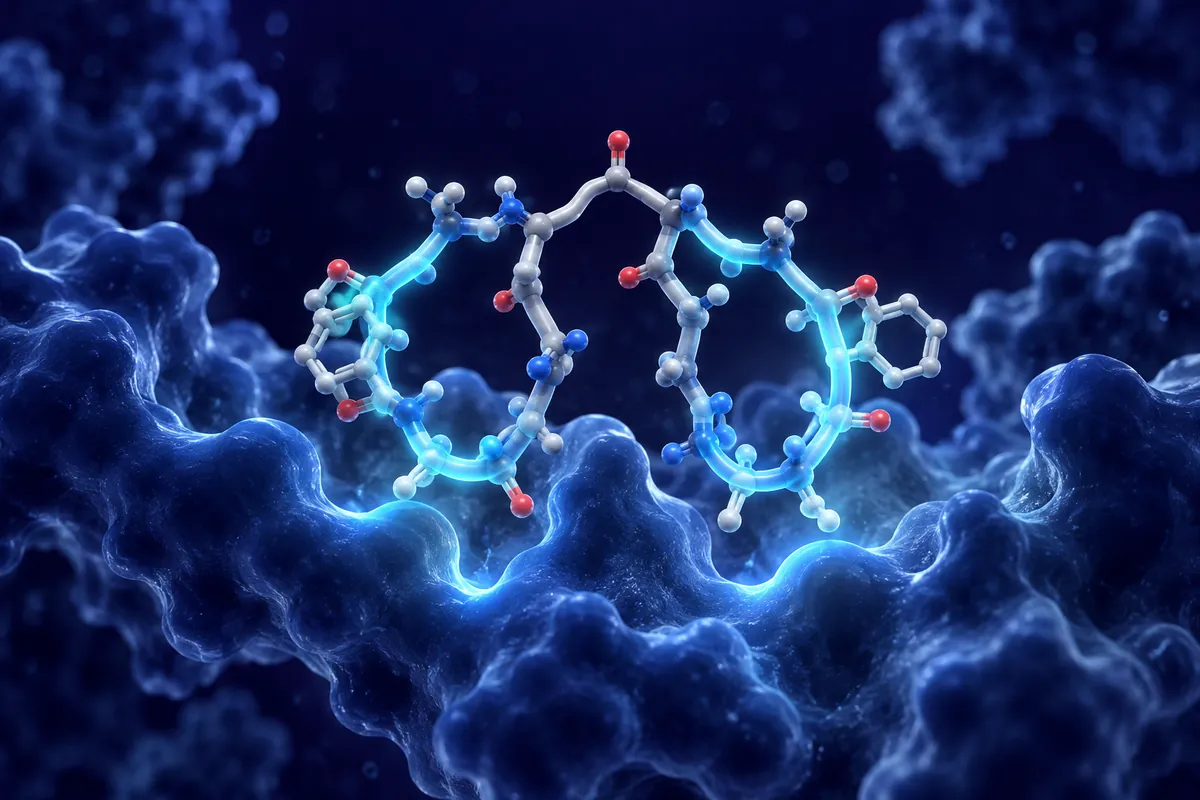
RAS proteins have a reputation problem. For nearly four decades they sat on the list of “undruggable” targets, not because nobody tried, but because the shallow, featureless surface of RAS gave small molecules almost nothing to grip. Macrocyclic peptides have changed that calculus. Their larger interaction surface and constrained architecture let them read subtle conformational cues that a small molecule simply cannot sense : including whether RAS is locked in its GTP-bound “ON” state or its GDP-bound “OFF” state.
Two Faces of the Same Switch
RAS proteins, including the NRAS isoform studied heavily in melanoma-relevant cell models, cycle between an active GTP-loaded conformation and an inactive GDP-loaded one. The switch hinges on two flexible segments, switch I and switch II, which reposition depending on the bound nucleotide. In the ON state, switch II folds against the effector-binding face, creating a groove that recruits downstream partners like RAF kinases. In the OFF state, that groove collapses. A macrocyclic peptide engineered against one conformation will often show negligible affinity for the other, because the binding pocket it recognizes only exists transiently.
This nucleotide-state dependence is not a minor technical detail. It is the entire basis for selective pharmacology in this protein family. Researchers building macrocycles for RAS work backward from crystal or cryo-EM structures captured in each state, then screen or evolve constrained peptide scaffolds : often cyclized through disulfide bridges, lactam bridges, or biaryl staples : against each conformational snapshot independently.
Why Isoform Discrimination Is Brutally Hard
Here is where things get genuinely difficult. HRAS, KRAS, and NRAS share roughly 90 percent sequence identity across their G-domains, and the residues lining the effector-binding groove are nearly identical between isoforms. So how does a macrocycle tell NRAS apart from its close relatives when the binding surfaces look almost the same at first glance?
The answer lives in second-shell residues : positions just outside the primary contact interface that subtly reshape local geometry without altering the core fold. A single amino acid substitution near switch II, for instance, can shift a loop by a few angstroms, enough to create or destroy a hydrogen bond with a macrocycle’s constrained ring. Isoform-selective macrocycles exploit exactly this kind of marginal structural divergence, which means selectivity is frequently won or lost through iterative rounds of alanine scanning and ring-size optimization rather than through any single dominant contact.
Single-Residue Tuning Between ON and OFF Preference
One of the more striking findings from this line of macrocycle research is how little sequence change separates an ON-state binder from an OFF-state one. In several reported scaffolds, swapping a single residue within the macrocyclic ring : often at a position facing switch I : was sufficient to flip preference from the GTP-bound conformation to the GDP-bound one, or to convert a state-selective binder into a pan-conformational one that binds both.
That razor-thin margin has practical consequences for assay design. Binding studies run exclusively against GTP-gamma-S-loaded protein, a common nonhydrolyzable analog used to lock the ON state in vitro, can miss OFF-state cross-reactivity entirely. Robust characterization increasingly requires parallel biophysical runs: surface plasmon resonance or isothermal titration calorimetry against both nucleotide-loaded preparations, paired with hydrogen-deuterium exchange mass spectrometry to map exactly which residues shift on binding.
Reading Conformational Selectivity With Structural Tools
Confirming state selectivity is not a one-assay job. Cell-free GTPase activity assays, using purified NRAS reconstituted with GTP or a slowly hydrolyzing analog, give a first read on whether a macrocycle stabilizes or disrupts nucleotide exchange kinetics. X-ray co-crystallography, when crystals cooperate, offers the clearest picture, since side-by-side ON-state and OFF-state complexes reveal precisely which macrocycle contacts are conformation-dependent versus conserved.
NMR-based methods add another dimension entirely. Chemical shift perturbation mapping on isotopically labeled RAS constructs can detect binding-induced changes in switch I and switch II dynamics even when a macrocycle’s affinity is too modest for crystallography. Rodent-derived cell lines expressing mutant NRAS constructs are also used downstream to assess whether conformational selectivity observed biochemically translates into pathway-level effects on RAF-MEK-ERK signaling within a cellular context : a distinct question from binding affinity alone, and one that is easy to conflate if experimental controls aren’t tightly designed.
Where the Research Trajectory Points
State-selective RAS macrocycles sit at an interesting intersection of structural biology and synthetic chemistry. Each new scaffold effectively becomes a probe: a tool for asking which switch-region residues actually govern conformational fate, independent of whatever downstream signaling question originally motivated the project. That probe utility may end up mattering as much as any single binder’s potency, because it gives researchers a systematic way to interrogate GTPase conformational biology across the broader RAS superfamily, not just NRAS in isolation.
Open questions remain plentiful. How many second-shell positions genuinely tune isoform selectivity versus how many are neutral bystanders? Can macrocyclic scaffolds be engineered to sense intermediate, partially-loaded nucleotide states rather than the two canonical extremes? These are the kinds of mechanistic puzzles that keep this corner of peptide macrocycle research active, and they are far from resolved.
There’s also a materials question lurking underneath the biology. Macrocyclization chemistry itself : whether a ring is closed through a lactam bridge, a disulfide, or a biaryl staple introduced via a genetically encoded unnatural amino acid : imposes its own constraints on which conformations a peptide can even sample once cyclized. A ring that is too rigid may lock in a binding geometry optimized for one nucleotide state and simply be unable to flex enough to ever engage the other; a ring left more flexible may sacrifice the very rigidity that made macrocycles attractive over linear peptides in the first place. Balancing that tradeoff, scaffold by scaffold, is turning into its own subdiscipline within RAS-directed peptide design, and it is not yet clear which macrocyclization chemistry will prove most generalizable across isoforms.
Disclaimer: This content is intended for research purposes only and is not meant to constitute medical advice.
This educational material discusses laboratory research concepts only. Loti Labs products are intended strictly for research and development use and are not for human consumption.