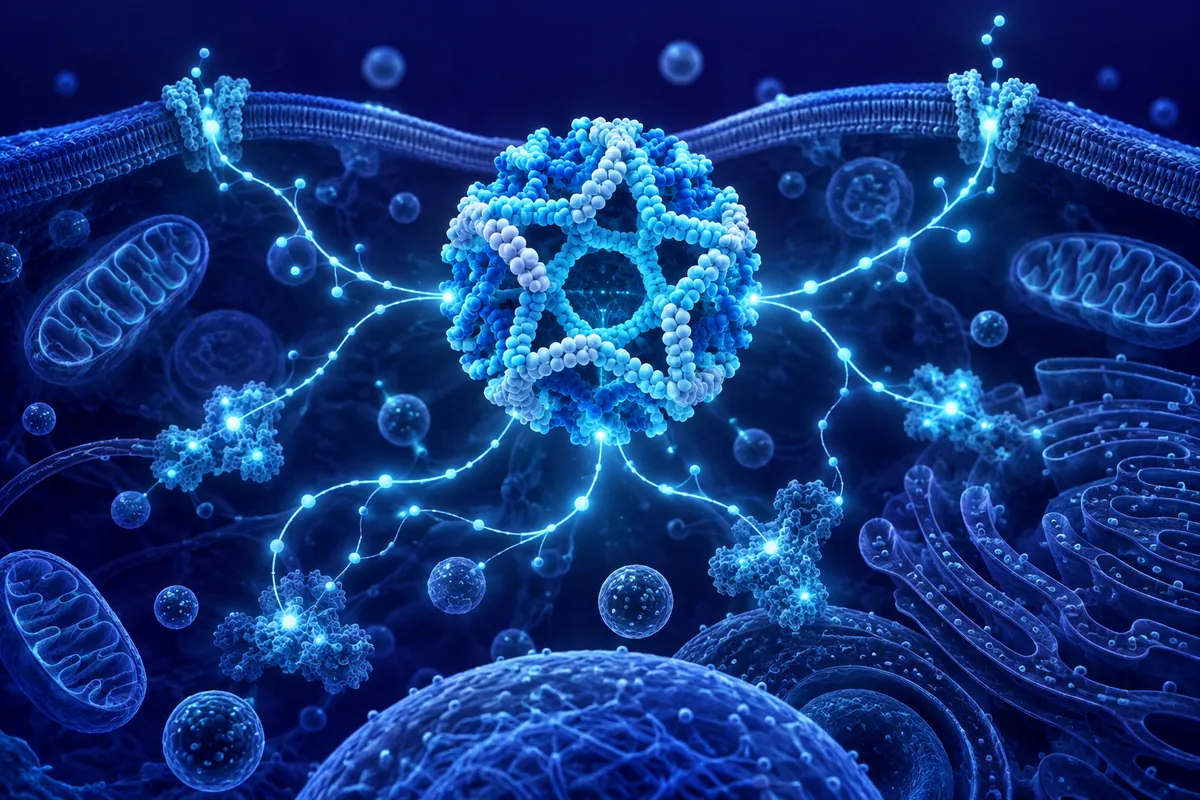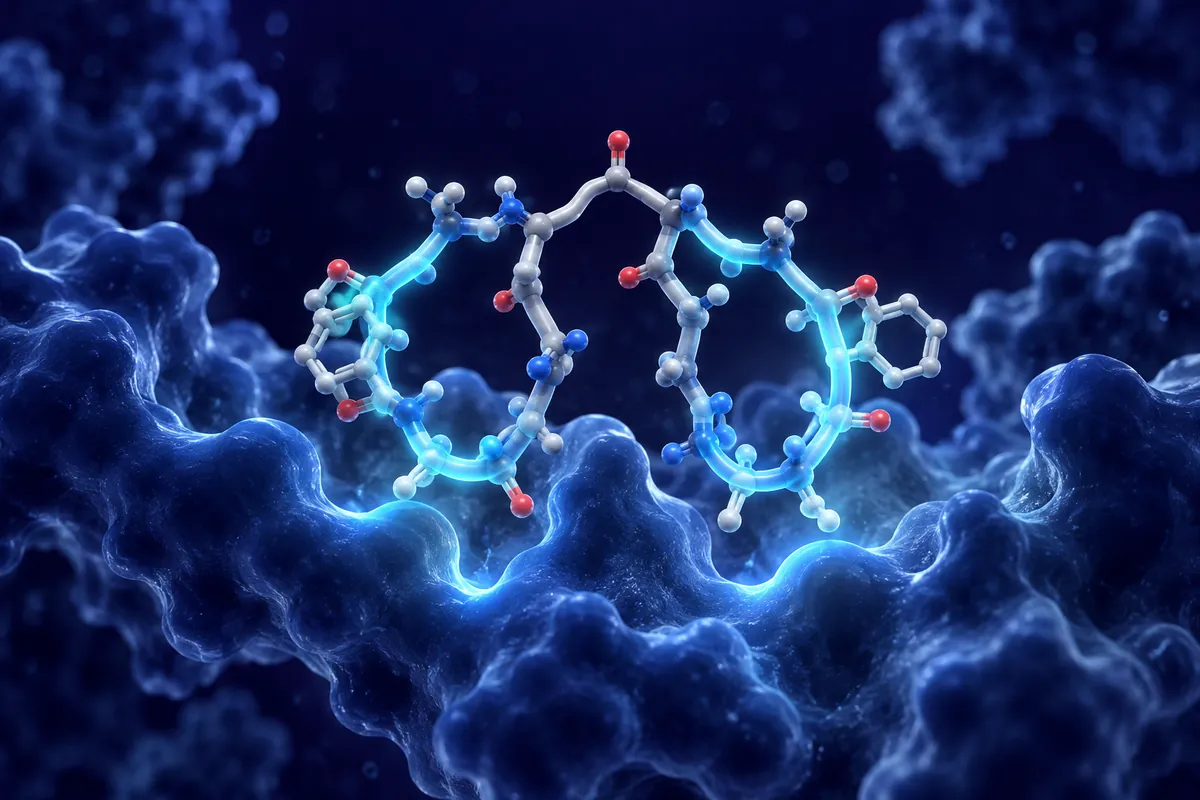
Targeted protein degradation reshaped how researchers think about undruggable targets, but the field’s best-known tool : the small-molecule PROTAC : carries an inherent limitation. It needs a small-molecule binder for the protein of interest, and plenty of high-value targets simply don’t have one. Peptide-guided degraders sidestep that requirement in a genuinely different way, and understanding how they diverge from small-molecule PROTACs explains both why the approach is gaining traction and why it hasn’t scaled as fast as hoped.
Genetically Encoded Degraders vs. Small-Molecule PROTACs
A conventional PROTAC is a bifunctional small molecule: one end binds the protein of interest, the other end binds an E3 ubiquitin ligase such as VHL or cereblon, and the linker holds both binding events close enough in space for ubiquitin transfer to occur, tagging the target for proteasomal degradation. The chemistry is elegant, but it depends entirely on the existence of a drug-like small-molecule ligand for the target : something that, for a large fraction of the proteome, simply hasn’t been found.
bioPROTACs and ubiquibodies solve the binder problem by encoding it genetically instead of chemically. Rather than a small molecule, the targeting module is a protein-based binder : a nanobody, a DARPin, a monobody, or even a natural protein domain : fused directly to a degradation-inducing effector domain. In the bioPROTAC format, that effector is typically a substrate-recognition component of an E3 ligase complex, such as a VHL or SPOP fragment, engineered into a single fusion construct with the binder. Ubiquibodies use a related architecture built around the U-box domain of CHIP (carboxyl terminus of Hsc70-interacting protein), a catalytic domain that can recruit ubiquitin-conjugating machinery once positioned next to a target by its fused binder.
Delivery Constraints Change the Design Calculus
Because these constructs are proteins, not small molecules, they’re typically introduced into cell culture systems through plasmid transfection, viral vector delivery, or mRNA-based expression rather than direct application to a target. That constraint reshapes what bioPROTACs are good for experimentally: they’re a powerful tool for validating whether degrading a given protein produces a phenotype of interest in a cellular model, functioning almost like an inducible, reversible knockout at the protein level rather than the genetic level. What they are not, at least with current delivery technology, is a straightforward analog of a small molecule that diffuses across a membrane on its own.
This distinction matters for interpreting the literature. A bioPROTAC construct showing efficient degradation of a target in a transfected cell line is a strong mechanistic proof of concept : it tells you a target is tractable to ubiquitin-proteasome-mediated removal. It does not, on its own, tell you anything about whether a cell-penetrant small molecule could ever be developed against the same target; those are separate engineering problems.
The Binder Bottleneck
Here’s where the field’s actual constraint sits: bioPROTAC and ubiquibody architectures are only as good as the binder fused to them. Nanobodies and DARPins against a given protein of interest have historically come from immunization campaigns, phage display selections, or yeast display screens : processes that take months and don’t always succeed, particularly against targets with poor immunogenicity, intrinsically disordered regions, or transient conformational states that are hard to capture with a static binding surface.
That bottleneck has quietly limited how fast peptide- and protein-guided degradation platforms can expand their target lists. Every new bioPROTAC essentially requires a bespoke binder discovery campaign before the degradation architecture can even be tested. For well-studied, structurally stable targets with existing antibody or nanobody reagents, that’s a manageable ask. For emerging targets, especially ones defined by disordered regions or short peptide motifs rather than a folded globular domain, it’s often the rate-limiting step in the entire research program.
De Novo Designed Binders as a Potential Unlock
Recent advances in de novo protein design : particularly diffusion-based structure generation methods capable of producing novel binding proteins computationally rather than through selection from a display library : offer a plausible route around the bottleneck. Instead of screening a library and hoping a binder against a difficult epitope turns up, researchers can now generate candidate binder scaffolds computationally, guided by the target’s structure or a defined peptide epitope, and validate a much smaller shortlist experimentally through binding assays such as surface plasmon resonance or yeast display affinity maturation.
Applied to bioPROTAC design, this could in principle open up substrates that have resisted binder discovery through conventional means: transcription factors with large disordered regions, scaffolding proteins without deep binding pockets, or short linear motifs on otherwise intractable surfaces. It’s an active area rather than a solved one : de novo binders still require experimental affinity and specificity validation, and computational generation doesn’t guarantee a binder will function correctly once fused into a degrader architecture, where steric constraints from the effector domain can interfere with target engagement in ways that isolated binding assays don’t capture.
Where the Comparative Case Stands
Peptide-guided degradation and small-molecule PROTACs aren’t competing for the same targets so much as covering different gaps in the same overall strategy. Small-molecule PROTACs remain the more mature, more broadly deployable format wherever a ligand exists. bioPROTACs and ubiquibodies extend degradation-based research to targets that have no ligand at all, provided a binder can be found : and that “provided” clause is exactly why binder discovery, whether through display technology or de novo computational design, is the technical frontier that will determine how far genetically encoded degraders can eventually reach into the undruggable proteome.
Disclaimer: This content is intended for research purposes only and is not meant to constitute medical advice.
This educational material discusses laboratory research concepts only. Loti Labs products are intended strictly for research and development use and are not for human consumption.