Larazotide: A Peptide That Tightens the Gut Barrier
Most peptide research focuses on activating receptors or blocking enzymes. Larazotide acetate (AT-1001) does something different. It modulates tight junctions : the protein complexes that seal the spaces between adjacent intestinal epithelial cells. In a field dominated by peptides that do things to cells, larazotide works on the connections between them.
The Zonulin Pathway: Why Tight Junctions Open
To understand larazotide, start with zonulin. Discovered by Alessio Fasano’s laboratory at the University of Maryland, zonulin is an endogenous human protein that reversibly opens tight junctions by binding to the zonulin receptor (identified as protease-activated receptor 2, PAR-2, and epidermal growth factor receptor, EGFR) on the apical surface of enterocytes.
Zonulin release is triggered by specific luminal stimuli : most notably gliadin peptides from gluten and certain bacterial components. When zonulin engages its receptors, it activates a signaling cascade involving protein kinase C (PKC) and zonula occludens proteins (ZO-1, ZO-2) that disassembles the tight junction scaffold. Claudins, occludin, and junctional adhesion molecules are displaced from the junction, creating paracellular gaps.
In celiac disease, this process runs unchecked. Gliadin peptides : derived from dietary gluten : continuously trigger zonulin release, creating chronically permeable intestinal epithelium. Incompletely digested gliadin fragments cross the barrier, encounter lamina propria immune cells, and trigger the adaptive immune response (tissue transglutaminase-mediated deamidation, HLA-DQ2/DQ8-restricted T cell activation) that drives villous atrophy and mucosal inflammation.
Larazotide’s Mechanism: Blocking Zonulin-Mediated Junction Opening
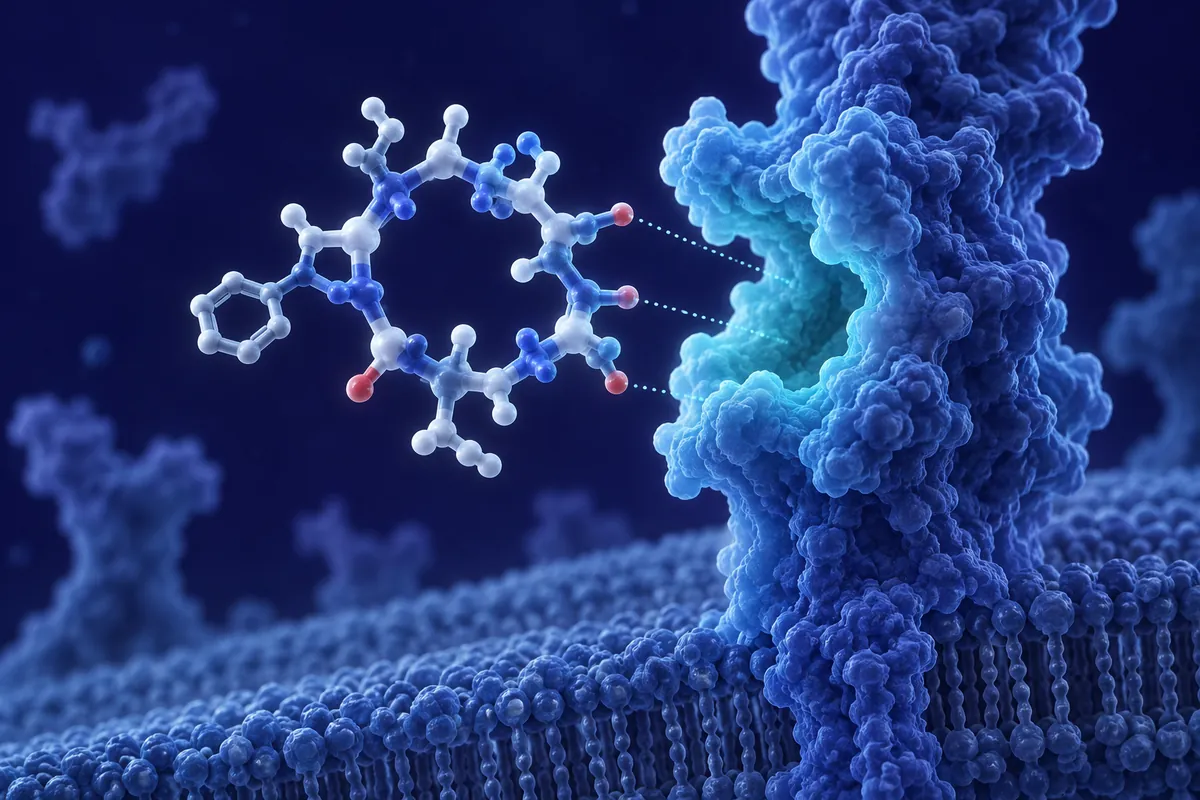
Larazotide is a synthetic octapeptide derived from Vibrio cholerae’s zonula occludens toxin (Zot) : a bacterial protein that exploits the same tight junction regulatory pathway as endogenous zonulin. Zot opens tight junctions to facilitate bacterial invasion. Larazotide, a fragment of Zot, acts as a competitive antagonist at the zonulin receptor, blocking the downstream signaling that leads to junction disassembly.
The peptide does not create new tight junctions or permanently seal existing ones. Instead, it prevents their pathological opening in response to zonulin release. When gliadin triggers zonulin secretion, larazotide competes for receptor binding and attenuates the PKC-mediated cascade that would otherwise displace junctional proteins. The result is preserved barrier integrity despite the presence of gluten-derived triggering peptides.
This mechanism has been confirmed in Ussing chamber experiments (measuring transepithelial electrical resistance across intestinal tissue), in Caco-2 cell monolayer permeability assays, and in ex vivo human intestinal biopsies mounted in permeability chambers. Larazotide prevents the gliadin-induced drop in transepithelial resistance in a concentration-dependent manner.
The Phase 2b trial (CeliAction Study, published in Gastroenterology) enrolled 342 participants with biopsy-confirmed celiac disease on a gluten-free diet who continued to experience symptoms : a population representing the substantial proportion of celiac research participants for whom dietary compliance alone does not fully control the disease.
A Phase 3 trial was initiated, making larazotide the first compound specifically targeting intestinal permeability to reach this development stage for celiac disease.
Beyond Celiac Disease: Intestinal Permeability as a Research Target
The zonulin-tight junction pathway is not exclusive to celiac disease. Elevated zonulin levels and increased intestinal permeability have been reported in type 1 diabetes, inflammatory bowel disease, irritable bowel syndrome, and non-alcoholic fatty liver disease. Whether increased permeability is causative or consequential in these conditions remains actively debated, but the availability of a pharmacological tool to modulate permeability : larazotide : enables interventional studies that observational data alone cannot resolve.
These data suggest applications beyond gluten-mediated barrier disruption.
Pharmacological Characteristics
Larazotide acts locally in the intestinal lumen. It is minimally absorbed into systemic circulation : a feature that limits systemic observed effects but also means its action is restricted to the gut epithelium. The peptide is administered orally in an enteric-coated capsule designed to release in the small intestine, where zonulin-mediated tight junction regulation is most active.
The safety profile across completed trials has been favorable, with adverse event rates comparable to placebo in most categories. The luminal, non-absorbed mechanism of action predicts low potential for systemic compound interactions or organ toxicity : an attractive pharmacological profile for a chronic-use agent.
Research Implications
Larazotide occupies a unique position in peptide research. It is not a hormone, not an antimicrobial, and not a receptor agonist in the traditional sense.
Disclaimer: This content is intended for research purposes only and is not meant to constitute medical advice.
This educational material discusses laboratory research concepts only. Loti Labs products are intended strictly for research and development use and are not for human consumption.