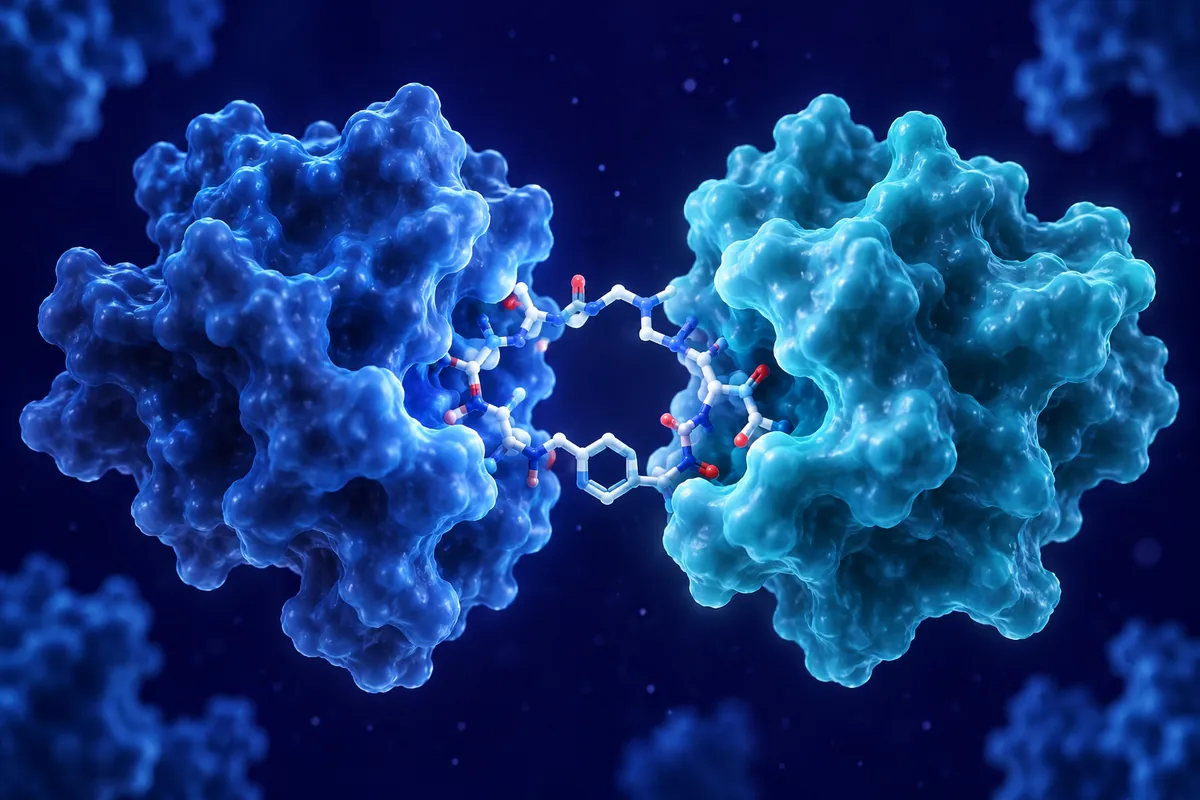
Insulin is a small, elegant hormone : 51 amino acids arranged into two disulfide-linked chains : and for most of the past century, anything that activated the insulin receptor was assumed to need at least a passing resemblance to that sequence. De novo agonist peptides have upended that assumption. Several reported macrocyclic scaffolds now activate the insulin receptor with no meaningful sequence homology to insulin at all, which raises a genuinely interesting structural question: what does the receptor actually require from a ligand, if not the ligand it evolved with?
The Receptor Doesn’t Care What Made It Fold
The insulin receptor is a preformed disulfide-linked homodimer, unlike many receptor tyrosine kinases that dimerize only upon ligand engagement. Insulin binding triggers a conformational reorganization across the ectodomain : often described as a “T-shaped to inverted-V” transition : that repositions the transmembrane and juxtamembrane segments closely enough for the intracellular kinase domains to trans-autophosphorylate. Structurally, this means an agonist’s job is not to mimic insulin’s chemistry but to trigger that same reorganizational cascade, through whatever contact geometry gets it there.
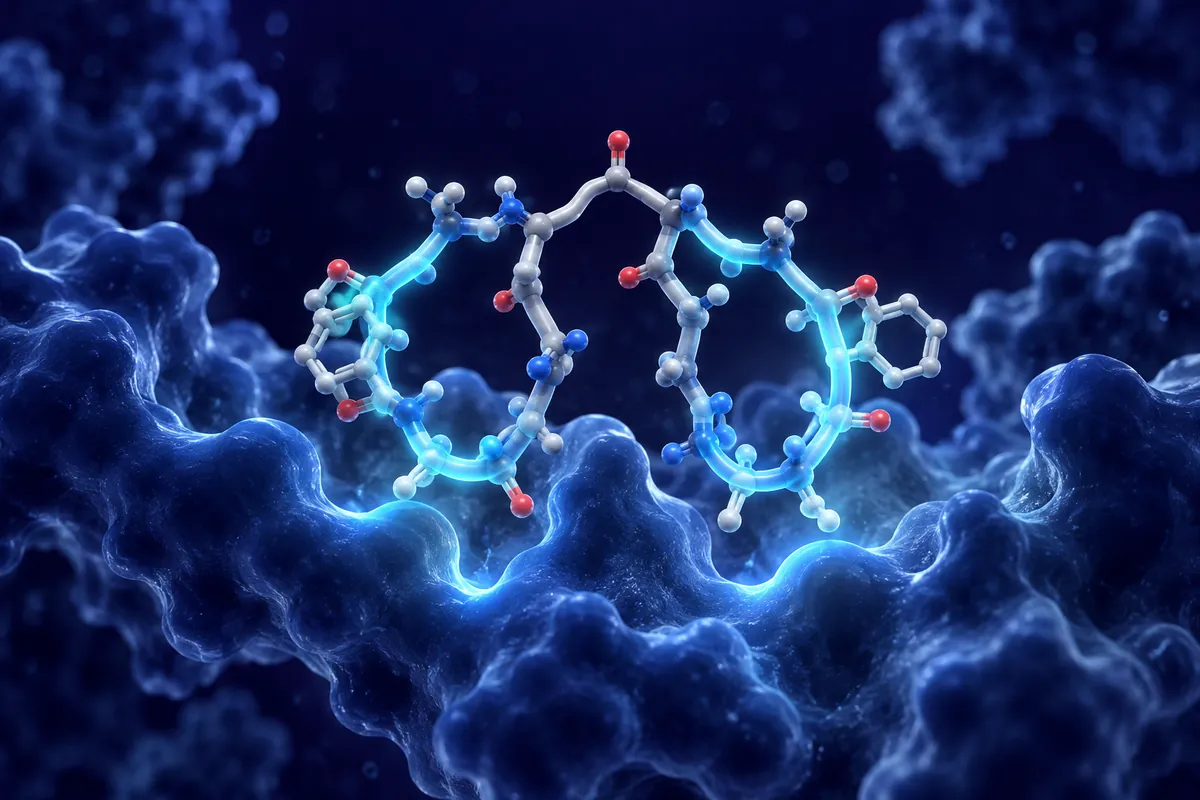
De novo macrocycles designed against this receptor exploit exactly that distinction. Computational scaffold generation, frequently guided by Rosetta-based design or generative structure prediction, builds constrained peptide rings that engage the same or overlapping ectodomain sites insulin uses : commonly site 1 and site 2 on the alpha subunits : without replicating insulin’s own fold, disulfide pattern, or residue composition. The result is a synthetic ligand doing a natural hormone’s structural job through an entirely unrelated chemical route.
Dimerization Mechanics Under the Hood
Getting a peptide to trigger receptor activation requires more than binding somewhere on the ectodomain : geometry matters enormously. Some designed macrocycles work as monovalent binders that stabilize an active-like ectodomain conformation directly; others are engineered as bivalent constructs, two macrocyclic units joined by a flexible or semi-rigid linker, explicitly designed to bridge both binding arms of the receptor dimer simultaneously and force the reorganization insulin would otherwise induce.
Linker length turns out to be a surprisingly sensitive variable in bivalent designs. Too short, and the two macrocycle units can’t reach both binding sites without straining the ectodomain into a nonproductive geometry; too long, and the entropic cost of holding both ends engaged simultaneously erodes effective affinity. Researchers optimizing these constructs typically run a linker-length series : varying polyethylene glycol spacer units or peptide-based linkers by small increments : and test each variant in cell-based autophosphorylation assays using receptor-overexpressing lines such as CHO or HEK293 cells engineered to express the human insulin receptor.
Partial Versus Full Agonism, and Why It Matters Mechanistically
Not every designed ligand that binds the insulin receptor activates it equally. Some behave as full agonists, driving maximal receptor autophosphorylation and downstream AKT and ERK phosphorylation comparable to insulin itself in dose-response comparisons run on cultured cell lines. Others are partial agonists : they engage the receptor and induce measurable but submaximal signaling, plateauing below insulin’s ceiling even at saturating peptide concentrations.
Why does that gap exist for a receptor with a relatively simple binary activation switch? The likely explanation involves the efficiency of the conformational transition itself. A partial agonist may stabilize an intermediate ectodomain state : neither fully “T-shaped” nor fully activated : that permits partial kinase domain apposition but not the complete trans-autophosphorylation geometry insulin achieves. Structural biologists studying this phenomenon increasingly rely on cryo-EM to capture these intermediate ectodomain states directly, comparing particle populations across different bound ligands to see whether partial agonists genuinely produce a distinct, stable intermediate conformation or simply a faster-exchanging mixture of fully active and fully inactive states.
Biased Signaling Opens a Separate Design Axis
Insulin receptor signaling branches downstream into at least two major arms: the PI3K-AKT pathway, associated largely with metabolic signaling in classic in vitro glucose uptake assays using adipocyte or myotube cell models, and the Ras-MAPK-ERK pathway, more associated with mitogenic and proliferative signaling. A ligand that activates one branch preferentially over the other is described as biased. Several de novo macrocycles have shown exactly this kind of pathway bias in cultured cell systems, favoring AKT phosphorylation over ERK activation to varying degrees depending on the specific binding geometry each scaffold adopts.
Biased signaling is mechanistically fascinating because it implies the receptor’s downstream branch point is sensitive to subtle differences in how the ectodomain reorganizes, not simply whether it reorganizes. That’s a level of allosteric nuance most researchers wouldn’t have predicted from the receptor’s relatively rigid preformed-dimer architecture, and it opens a genuinely separate design axis from raw potency : one where the ligand’s specific footprint on the ectodomain, not just its affinity, becomes the variable under active investigation.
Why Structural Biologists Keep Returning to Non-Insulin Scaffolds
Non-insulin agonist peptides give structural biologists something insulin itself cannot: a clean way to isolate which contacts actually drive activation versus which are evolutionary baggage carried along for other reasons : stability, secretion, zinc-mediated hexamer storage in native tissue, and so on. Because these macrocycles share no sequence lineage with insulin, any activation they produce must arise from geometry and contact chemistry alone, stripped of confounding homology. That makes them useful tools for mapping the receptor’s activation requirements from first principles, independent of the constraints insulin’s own evolutionary history happened to impose on its structure.
Plenty remains unresolved : how many distinct ectodomain contact “solutions” exist for triggering activation, whether biased signaling can be tuned predictably rather than discovered empirically, and whether fully synthetic scaffolds can ultimately match insulin’s binding kinetics rather than merely approximate its downstream effects in cell-based systems. Each of those questions keeps this research area active.
Disclaimer: This content is intended for research purposes only and is not meant to constitute medical advice.
This educational material discusses laboratory research concepts only. Loti Labs products are intended strictly for research and development use and are not for human consumption.