
Premium USA-Made Research Compounds
Browse lab-tested peptides, research liquids, capsules and more.
Research Use Only (RUO): All compounds and protocols described are for laboratory research purposes only. This content is intended for trained researchers and is not medical advice.
How Long Do Reconstituted Peptides Last? (2026 Shelf Life & Storage Guide)
The information provided herein is strictly for laboratory research and educational purposes. Peptides discussed, including semaglutide and BPC-157, are not FDA-approved for human consumption. This guide is intended for use by independent researchers conducting in vitro or in vivo laboratory protocols. No clinical data for human use is implied.
In the rapidly evolving landscape of laboratory biochemistry, particularly following the 2024-2026 GLP-1 compounding boom, the question of peptide stability has moved from the periphery of research to the center of laboratory protocol optimization. As researchers increasingly utilize multi-dose vials for long-term longitudinal studies involving complex molecules like retatrutide, tirzepatide, and various growth hormone secretagogues, understanding the metabolic clock that begins at the moment of reconstitution is critical.
Looking for Premium Research Compounds?
The prevailing “industry standard” often cited on forums and by some suppliers suggests a blanket 28-day expiration for any peptide once it has been mixed with a solvent. However, this figure is frequently misunderstood. For the sophisticated researcher, the question of how long do reconstituted peptides last requires a nuanced exploration of chemical kinetics, molecular biology, and microbiological safety. We must differentiate between the chemical integrity of the amino acid chains and the microbial safety of the solution environment.
Current 2026 analytical data, including extensive HPLC testing from independent facilities like the Janoshik analytical lab, suggests that many highly stable peptides maintain over 90% potency well beyond the 30-day mark when stored under ideal conditions. For batch-specific data, always request a Certificate of Analysis (CoA) from your supplier, which provides HPLC-confirmed purity and synthesis date. Conversely, more fragile sequences may begin significant hydrolysis or oxidation within days. This guide provides an authoritative deep-dive into the shelf life of reconstituted peptides, providing the data necessary to determine the optimal window for laboratory experimentation.
The Short Answer: Shelf Life of Reconstituted Peptides
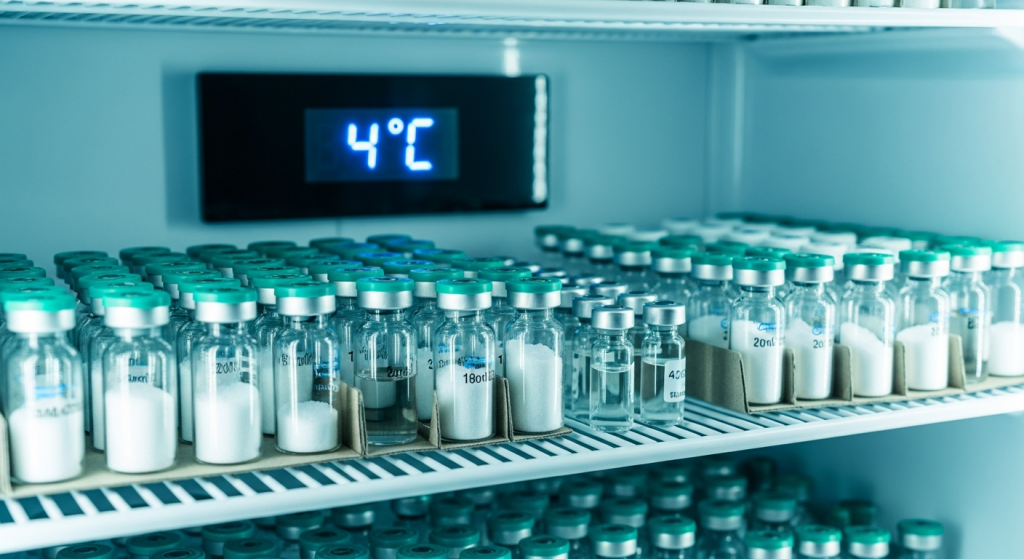
Reconstituted peptides generally last 28 to 30 days when refrigerated at 2-8°C (36-46°F) with bacteriostatic water. At room temperature, they degrade within 24 to 48 hours. For long-term storage beyond 30 days, aliquot the solution into single-use tubes and freeze at -20°C, where peptide integrity can be preserved for 12–24 months.
To provide a baseline for laboratory planning, the functional shelf life reconstituted peptides exhibit is generally categorized into three windows: the microbial window (28 days), the chemical efficacy window (30–90 days), and the degradation window (90+ days). These timelines assume the use of Bacteriostatic water (BAC) and consistent refrigeration at 2-8°C (36-46°F).
The 28-Day Guideline for Refrigerated Vials
The ubiquitous 28-day rule is not derived from a universal peptide “death date.” Instead, it is a pharmacological safety standard dictated by the USP <797> guidelines regarding multi-dose vials. Once a vial’s rubber stopper is punctured for the first time, the benzyl alcohol (the preservative agent in BAC water) begins its own countdown. The FDA and other regulatory bodies set the 28-day limit because the antimicrobial efficacy of the preservative cannot be guaranteed beyond this point once exposed to ambient air and potential contaminants from repeated single-use access component entries. Notably, FDA stability data for semaglutide (e.g., a commercial semaglutide presentation prescribing information) acknowledges a 56-day in-use refrigeration window after first use—direct evidence that robust peptide sequences retain chemical integrity well beyond the USP <797> 28-day microbial safety cutoff.
For most research applications, a reconstituted peptide remains chemically viable for 30 to 60 days if kept at 2-8°C. However, the microbial risk increases after 28 days post-puncture. In high-precision research, utilizing a vial beyond 30 days requires strict aseptic technique and an understanding of the specific peptide’s susceptibility to deamidation.
Bacteriostatic Water vs. Sterile Water Shelf Life
The choice of diluent is the primary determinant of a peptide’s lifespan in a liquid state. Sterile water for injection contains no antimicrobial agents. In a laboratory setting, a peptide reconstituted with sterile water should be used immediately or within 24 hours, as it lacks protection against microbial contamination. In contrast, Bacteriostatic water (BAC) contains 0.9% benzyl alcohol, which inhibits the growth of most bacteria, allowing for multi-dose use over several weeks. However, the presence of benzyl alcohol can slightly increase the rate of oxidation in certain sensitive peptides compared to pure sterile water, creating a trade-off between sterility and chemical purity. For specific fragile peptides like IGF-1 LR3, a third option—acetic acid (0.1–1% concentration)—is sometimes preferred, as its slightly acidic pH prevents aggregation better than neutral BAC water for certain sequences. Lipophilic or poorly water-soluble peptides may also require a small volume of DMSO (dimethyl sulfoxide) as a co-solvent before aqueous dilution; however, DMSO reconstituted solutions carry additional stability variables and require near-immediate use.

Degradation vs. Contamination: Two Separate Risks
Researchers must decouple the loss of potency (chemical degradation) from the risk of infection or reaction (microbial contamination). These are independent variables that dictate the practical “expiration” of a research compound.
Chemical Degradation: Hydrolysis, Oxidation, and Deamidation
Once a lyophilized powder is transitioned into an aqueous environment, it becomes susceptible to several chemical degradation pathways:
- What is Janoshik testing?
Janoshik is a prominent analytical lab that provides HPLC and Mass Spec testing to verify the purity and concentration of research peptides. - Can air bubbles in the vial cause degradation?
Excessive air (oxygen) in the vial can increase the rate of oxidation. It is best to use a vial size that matches the volume of your reconstituted solution. - Can peptides be stored at room temperature?
No. Reconstituted peptides stored at room temperature degrade rapidly through accelerated hydrolysis and oxidation. They should be used within 24 to 48 hours to avoid significant loss of potency. - How should peptides be stored long-term?
For long-term preservation spanning months, lyophilized powder should be stored at -20°C to -80°C. For reconstituted solutions, aliquot into single-use tubes and freeze at -20°C to avoid freeze-thaw cycles. - Can you freeze reconstituted peptides?
Yes, but only after aliquoting into individual single-use doses. Freezing a multi-dose reconstituted vial and thawing it repeatedly destroys peptide bonds via ice crystal formation and cryoconcentration. - Can peptides be stored in a regular refrigerator?
Yes. A standard household or laboratory refrigerator set to 2-8°C (36-46°F) is adequate for short-term storage of reconstituted peptides. Place vials at the back, away from the door, to minimize temperature fluctuations. - Do peptides expire?
Yes. Both lyophilized and reconstituted peptides lose potency over time through degradation pathways like hydrolysis, deamidation, and oxidation. The expiration timeline depends heavily on storage conditions and the specific amino acid sequence. - Why does my reconstituted peptide look cloudy?
Cloudiness indicates aggregation, poor initial solubility, or microbial contamination. A peptide that reconstitutes to a cloudy solution should be discarded, as aggregated structures are biologically inactive and may introduce particulates into research models. - Can I use sterile water instead of bacteriostatic water for reconstitution?
Sterile water is appropriate for single-dose use only. Without benzyl alcohol, there is no antimicrobial protection in the vial, limiting safe use to within 24 hours of reconstitution. - What happens if reconstituted peptides are left out overnight?
A single overnight exposure at room temperature will accelerate hydrolysis and oxidation, particularly in sensitive sequences like IGF-1 LR3 or HGH. While robust peptides like BPC-157 may tolerate it, the cumulative damage shortens the effective shelf life of the remaining solution. - Why does the FDA allow 56 days for semaglutide if the 28-day rule exists?
Semaglutide (a commercial semaglutide presentation/a commercial semaglutide presentation) was engineered with extreme chemical stability—a fatty acid side chain that resists hydrolysis. The FDA’s 56-day in-use period reflects the peptide’s molecular durability and is not a universal standard. Research peptides with standard sequences default to the more conservative 28-day microbial safety guideline. - Does the vial size matter for shelf life?
Yes. Using a vial volume that closely matches the total reconstitution volume minimizes the headspace (air gap above the liquid). Excess air means more oxygen available for oxidation. Smaller vials with minimal headspace extend the effective chemical shelf life of oxygen-sensitive peptides.
In conclusion, the question of how long do reconstituted peptides last is answered by a balance of chemical stability and microbiological safety. While the 28-day rule is the gold standard for preventing microbial contamination, advanced 2026 HPLC testing data confirms that the chemical integrity of many peptides extends well into the 60-day range if maintained at 2-8°C. For researchers, the goal is to minimize hydrolysis, avoid freeze-thaw cycles, and maintain a sterile environment to ensure that the amino acid chains remain potent for the duration of the study. By understanding these variables, laboratory protocols can be optimized for both safety and scientific accuracy.
Continue Your Research
Explore our complete catalog of premium research compounds.
