
Premium USA-Made Research Compounds
Browse lab-tested peptides, research liquids, capsules and more.
The melanocortin system is one of those receptor networks where a closer look keeps revealing more biology than initially expected. Most people know about melanocortins in the context of pigmentation — that’s MC1R, and it’s the most visible (literally) part of the story. But the five-receptor family controls an extraordinary range of processes, and each subtype has a distinct tissue distribution and functional profile that makes the system fascinating to work with from a research standpoint.
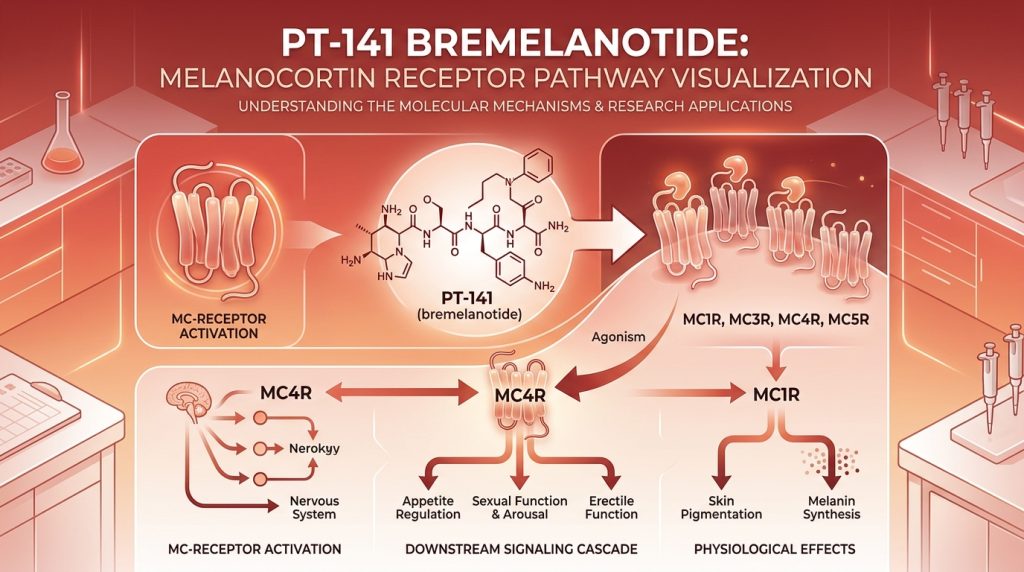
PT-141 entered the melanocortin pharmacology pipeline at the University of Arizona in the late 1980s and 1990s, coming out of Victor Hruby’s group. The original project was about developing more stable, more receptor-selective analogs of alpha-MSH and ACTH. The work generated an enormous number of cyclic lactam analogs and helped establish most of what we know about melanocortin structure-activity relationships. PT-141 — full chemical name Ac-Nle-cyclo[Asp-His-D-Phe-Arg-Trp-Lys]-OH — emerged from this program with the specific characteristic of strong MC3R and MC4R activity combined with significantly improved stability over linear MSH analogs.
That research history matters because it means PT-141 has one of the most thoroughly documented structure-activity profiles of any research peptide currently available. The pharmacology isn’t guesswork — it’s been worked out systematically over decades.
Looking for Premium Research Compounds?
The Five Melanocortin Receptors: Getting the Map Right
Researchers new to the melanocortin system frequently underestimate how different the five receptor subtypes are from each other. They share a common ligand family (ACTH, α/β/γ-MSH, and their synthetic analogs) but have almost nothing else in common in terms of where they’re expressed or what they control.
MC1R sits on melanocytes and certain immune cells.
MC2R is the exception in the family. It’s ACTH-specific — the only melanocortin receptor that doesn’t respond to MSH family peptides. It’s expressed exclusively in the adrenal cortex where it drives cortisol production. The reason this matters for PT-141 research is that PT-141 does NOT bind MC2R. Zero activity there. This means cortisol axis perturbation is not a concern in studies using PT-141, which simplifies the endocrine interpretation considerably.
MC3R and MC4R are where PT-141 does its work. Both are primarily central — high expression in the hypothalamus, limbic system, and brainstem. Both couple through Gs to activate adenylyl cyclase, elevating intracellular cAMP. The challenge is separating their individual contributions in studies using a dual agonist like PT-141, which requires subtype-selective tools (discussed below).
MC5R rounds out the family with exocrine gland expression — sebaceous and lacrimal primarily. Low PT-141 affinity here. Not typically a focus of PT-141 research.
The Molecular Architecture: Why PT-141 Works So Well as a Research Tool
Several structural features of PT-141 are worth understanding because they directly affect experimental design.
The Asp-Lys lactam bridge that cyclizes the peptide backbone is the single most important stability feature. Linear MSH peptides are degraded rapidly by aminopeptidases and endopeptidases — half-lives measured in minutes. The cyclic conformation sterically protects the peptide bonds and gives PT-141 substantially better resistance to enzymatic cleavage. In practice, this means the compound is still active at timepoints where a linear analog would have completely degraded.
D-Phenylalanine at position 7 adds another layer of stability — D-amino acids aren’t recognized as substrates by most mammalian proteases. This combination of cyclic backbone plus D-amino acid incorporation is largely why PT-141 can be administered subcutaneously and still achieve meaningful brain exposure.
The norleucine (Nle) substitution for methionine removes an oxidation liability. Natural methionine-containing peptides are susceptible to sulfoxide formation under storage or physiological conditions. Nle is isosteric but not oxidizable, giving PT-141 better shelf stability than Met-containing analogs.
Receptor affinities: Ki values in the low nanomolar range for both MC3R and MC4R. Moderate for MC1R. Negligible for MC5R. No MC2R activity. This is a well-characterized profile that makes PT-141 a reliable pharmacological tool for central melanocortin studies.
Central Mechanisms: What PT-141 Does in the Brain
The neural circuits engaged by PT-141 are mostly hypothalamic, and understanding them requires knowing something about the paraventricular nucleus (PVN) and how it connects to autonomic and neuroendocrine output.
The PVN is the main site of high-density MC4R expression in the hypothalamus. It’s an integration center — it receives information about energy status, stress, and circadian state, and it projects to both the pituitary (neuroendocrine axis) and brainstem autonomic nuclei (cardiovascular, gastrointestinal, reproductive function). When PT-141 activates MC4R in the PVN, the downstream effects radiate through these projections.
The best-characterized downstream pathway in male rodent models runs through oxytocin. This is genuinely a centrally-initiated process — it’s not PT-141 acting on penile vasculature. The compound stays in the CNS and the peripheral response is a neural downstream effect.
In female rat models, the hypothalamic MC4R engagement story is similar but the behavioral readouts are different — lordosis quotient and proceptive solicitation behaviors, which are the standard ethological markers in that literature. The effects are sensitive to MC4R-selective antagonists, confirming specificity.
MC3R in the mesolimbic system — VTA and nucleus accumbens — adds the motivational dimension. This is where the dopaminergic interaction story comes in. MC3R-expressing neurons in reward circuitry modulate motivational salience, and there’s bidirectional crosstalk with D4 receptors. Whether MC3R handles the appetitive (wanting) component while MC4R handles the consummatory aspect is a hypothesis worth testing properly — the distinction has real implications for how the compound would behave in different model systems.
The magnitude is modest and the time course is short — typically returning to baseline well within an hour in most rodent studies. But any protocol using higher concentration ranges or animals with pre-existing cardiovascular compromise should include hemodynamic monitoring.
The Broader Research Applications
Energy homeostasis research is an obvious next domain.
The neuroinflammation angle is underexplored. PT-141’s central administration gives it access to both neural and glial melanocortin receptors simultaneously, making it interesting for any model where microglial activation state intersects with hypothalamic function.
Reproductive neuroendocrinology has also emerged as a legitimate research area for PT-141. GnRH pulsatility — the master switch of reproductive endocrine function — is modulated by MC4R activity in the arcuate nucleus and median eminence. Research groups working on PCOS, hypothalamic amenorrhea, and pubertal timing have identified melanocortin tone as a relevant regulatory variable alongside the more established KNDy (kisspeptin/neurokinin B/dynorphin) network. How these two systems interact mechanistically is still being worked out, which makes tools like PT-141 genuinely useful for dissection experiments.
Subtype Selectivity: Making the Pharmacology Work
Because PT-141 activates both MC3R and MC4R, studies aimed at isolating subtype-specific effects need additional tools. A few practical recommendations:
HS024 and SHU9119 are the most commonly used MC4R-selective antagonists in rodent research. Co-administration of PT-141 with HS024 allows researchers to ask what’s MC4R-dependent versus what persists when MC4R is blocked (presumably MC3R-mediated). This is the most direct approach to decomposing PT-141’s compound effects.
MC3R knockout mice are available and have been well-characterized metabolically. They’re not the easiest model to work with for behavioral studies, but for energy homeostasis and feeding studies they’re probably the cleanest approach to MC3R-specific dissection.
Setmelanotide (RM-493) is a cyclic peptide with higher MC4R selectivity than PT-141. Running parallel studies with both compounds provides a comparative pharmacological dissection without genetic models. The caveat is that setmelanotide has its own literature on MC4R activation — it’s not a purely academic comparison tool.
The Regulatory History and What It Means for Research
In 2019, FDA approved Bremelanotide (the branded form of PT-141) for one specific indication in premenopausal women under a branded prescription name. This isn’t directly relevant to research use of PT-141, but it does have two practical implications.
First, the approval process generated an unusually complete public pharmacology dataset. The FDA submission required full receptor binding characterization, metabolite profiling, pharmacokinetic studies across multiple species, hemodynamic studies, and behavioral pharmacology. Most of that data is now in the public literature. For researchers starting to work with PT-141, this is an unusually rich foundation to build from.
Second, research-grade PT-141 is a separate product from the approved pharmaceutical formulation. Using research-grade PT-141 in laboratory studies doesn’t require navigating pharmaceutical regulatory frameworks — it’s governed by standard research peptide and institutional ethics guidelines.
PT-141 and the Melanocortin Field in 2026
A few developments are reshaping how researchers approach the melanocortin system right now.
The setmelanotide story has reinvigorated MC4R as a research and pharmaceutical target in ways that create spillover interest for laboratory tools like PT-141. PT-141 is a natural comparison compound for these dissection experiments.
The gut-brain axis angle is underexplored. Measuring gut motility endpoints (transit time, colonic motor patterns) in parallel with central behavioral endpoints would add dimension to PT-141 pharmacology studies.
Circadian biology intersections are emerging. MC4R in the PVN is positioned to influence circadian output, and the PVN is one of the main conduits between the suprachiasmatic nucleus (master clock) and the rest of the body.
Finally, single-cell RNA sequencing has made it possible to map melanocortin receptor expression at the resolution of individual cell subtypes. This is producing a much more complex picture of exactly which neural populations express MC3R versus MC4R versus both — and that granularity will eventually enable more precise experimental designs than have been possible before.
For research use only. Not intended for human administration outside properly authorized experimental settings.
Continue Your Research
Explore our complete catalog of premium research compounds.
