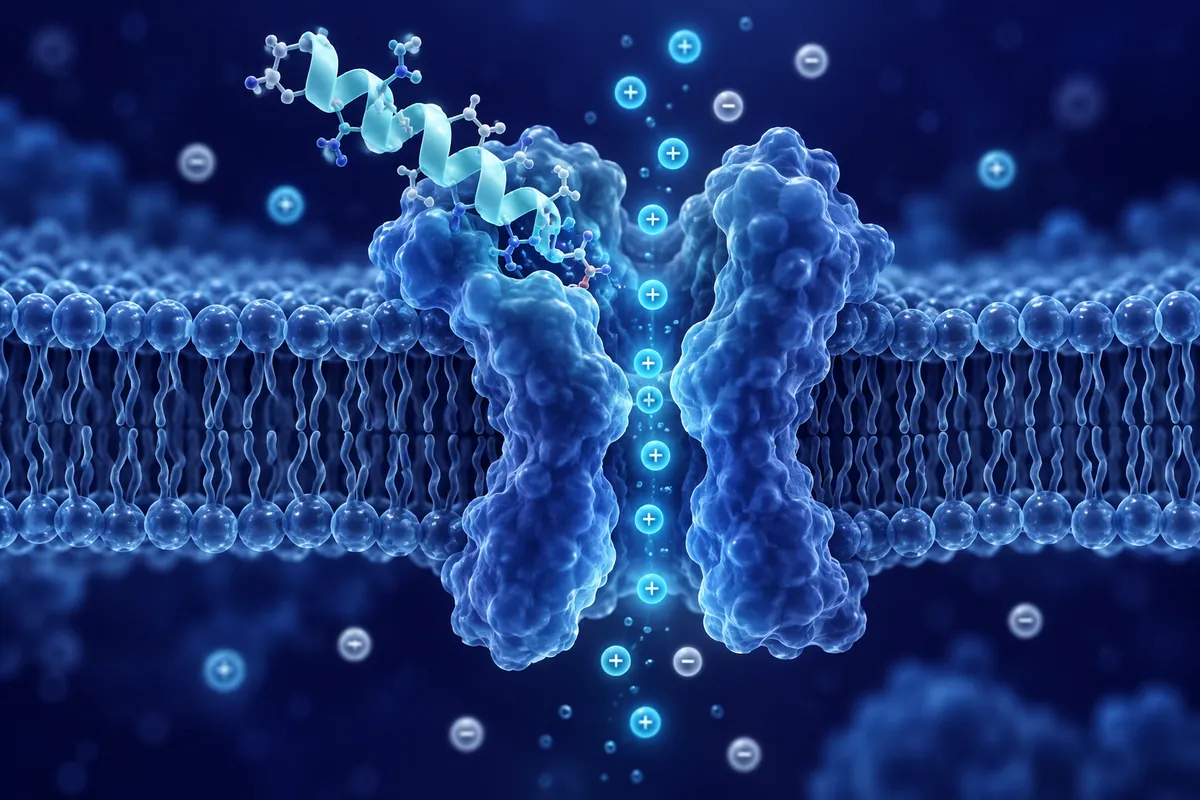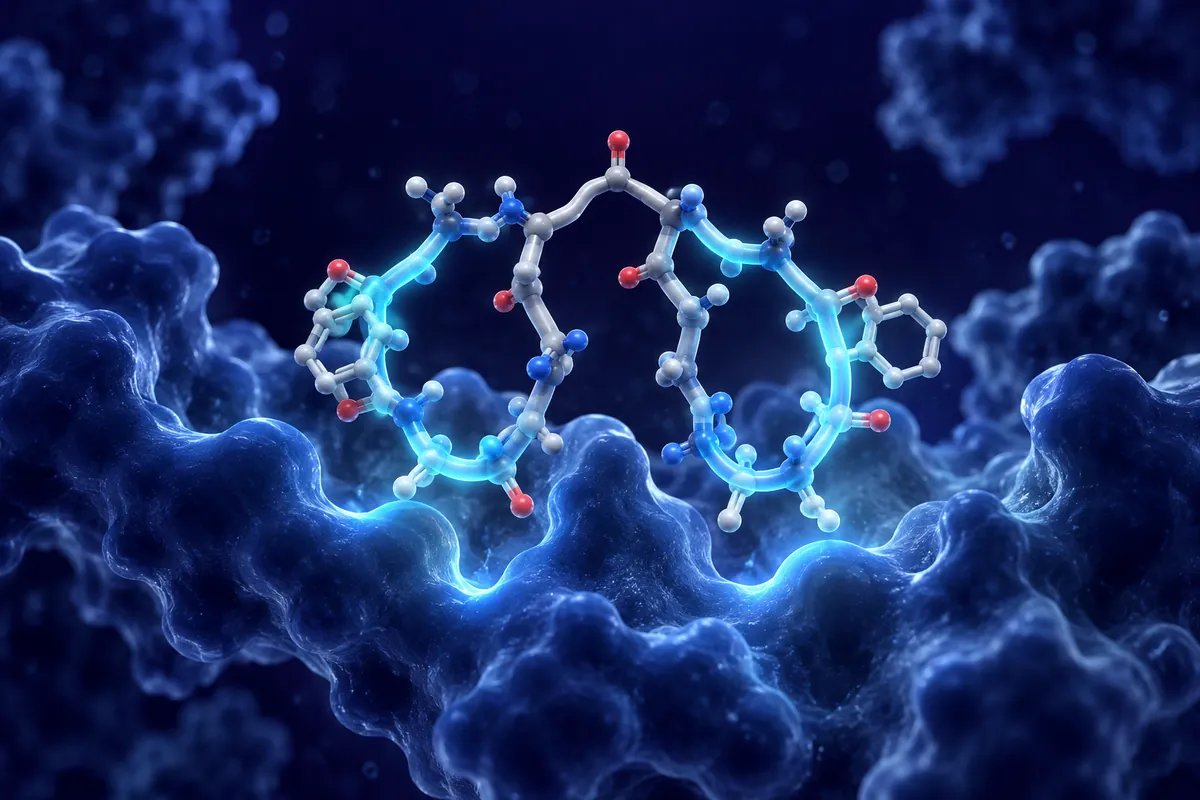
Among the compounds emerging in this area, KLOW has attracted scientific attention for its proposed role in ECM maintenance, structural protein upregulation, and the selective modulation of dermal cell populations.
What makes KLOW a compelling subject of study? And how does it compare : mechanistically and functionally : to better-characterized dermal research compounds like GHK-Cu? These are the questions driving current preclinical investigation.
KLOW Peptide: Structural Identity and Primary Mechanism of Action
Its primary proposed mechanism involves direct signaling to fibroblasts : the key structural cells of the dermis responsible for synthesizing and maintaining the ECM framework.
Fibroblasts are the architects of dermal integrity. They produce the collagen fibrils that provide tensile strength, the elastin networks that confer elasticity, and the proteoglycans that maintain hydration and spatial organization within the ECM. As fibroblast activity declines with age or in pathological states, ECM structural proteins are underproduced and degraded faster than they are replaced. KLOW’s proposed mechanism targets this imbalance by activating fibroblast signaling pathways associated with upregulation of structural protein production.
Critically : and this is a nuance that distinguishes KLOW from less sophisticated growth-stimulatory approaches : the compound appears to exert a homeostatic rather than maximally fibrogenic effect. This matters enormously for researchers studying fibrotic versus regenerative fibroblast phenotypes. A compound that simply drives uncontrolled ECM deposition would have limited utility : and potential confounds : in research models.
Preclinical Research Landscape: In Vitro and Ex Vivo Findings
The existing research on KLOW is predominantly preclinical, with studies conducted in human dermal fibroblast cultures and ex vivo skin explant models. These experimental systems provide controlled environments for examining peptide-fibroblast interactions without the complexity of in vivo systemic variables.
In vitro studies using human fibroblast monolayer cultures have examined KLOW’s effects on key ECM synthesis markers. These outcomes are consistent with the proposed mechanism of fibroblast signaling activation.
Ex vivo skin explant systems : which preserve the three-dimensional architecture of the dermis : provide a more physiologically relevant context. In these models, structural assessments using histological staining and immunohistochemistry have been employed to evaluate changes in ECM density and organization following KLOW exposure.
It bears emphasis that the KLOW research corpus is early-stage. Robust, peer-reviewed mechanistic studies are still accumulating. Researchers entering this area should approach existing findings as hypothesis-generating rather than conclusive : precisely the frame in which most innovative peptide research begins.
Beyond its fibroblast-stimulating properties, KLOW has been investigated in the context of dermal cellular senescence. Senescent cells : sometimes colloquially called “zombie cells” : are cells that have permanently exited the cell cycle following DNA damage or replicative exhaustion, but that resist apoptotic clearance and remain metabolically active. Their persistence is problematic: senescent fibroblasts secrete a pro-inflammatory milieu known as the senescence-associated secretory phenotype (SASP), which degrades surrounding ECM, impairs neighboring cell function, and accelerates the local aging microenvironment.
This is an emerging area of dermal biology, and KLOW represents one of several compounds being explored as investigative tools in this space.
KLOW vs. GHK-Cu: Mechanistic Comparison for Research Design
Researchers in the dermal biology space will inevitably compare KLOW to GHK-Cu (copper peptide glycyl-l-histidyl-l-lysine), the most extensively studied synthetic peptide in ECM and skin biology research. Understanding the mechanistic distinctions between these two compounds is essential for designing studies that leverage their complementary profiles.
GHK-Cu is a tripeptide-copper complex with a remarkably broad mechanism.
KLOW operates more specifically. Where GHK-Cu reshapes the cellular transcriptional landscape broadly, KLOW targets a more defined fibroblast-ECM signaling axis. This specificity is not a limitation : it is a research advantage when investigators need mechanistic precision.
The two compounds are not competitive : they are complementary. Research exploring the combination of KLOW and GHK-Cu has begun to examine whether their distinct mechanisms produce additive or synergistic outcomes in ECM synthesis models.
Multi-Peptide Combination Research: KLOW in Blended Protocols
One of the most interesting directions in current dermal peptide research is the design of multi-compound protocols that address ECM biology from multiple mechanistic angles simultaneously. Researchers have begun investigating KLOW in combination formats that pair it with GHK-Cu and other well-characterized peptides to probe potential synergistic effects.
Each component of such a combination brings a distinct mechanism to the experimental system, creating a multi-target approach to ECM research that mirrors the complexity of actual dermal biology.
For researchers considering combination protocols, the key design questions are mechanistic independence and potential signal interference. Do the pathways activated by each component converge on the same downstream markers : and if so, does that convergence amplify or saturate the response? Careful selection of readout biomarkers (e.g., distinguishing upstream gene expression changes from downstream protein secretion) is critical to extracting meaningful data from multi-peptide studies.
Conclusion
These attributes position KLOW not as a simple growth stimulant, but as a modulator of ECM homeostasis : precisely the kind of nuanced action that modern dermal biology research demands.
When considered alongside GHK-Cu and explored in combination research designs, KLOW offers researchers an opportunity to dissect complementary signaling axes in ECM biology that neither compound addresses alone. As the preclinical dataset grows, cleaner mechanistic pictures will emerge : and the current body of early findings provides ample foundation for researchers to build rigorous experimental inquiry upon.
For Research Purposes Only: The information presented in this article is intended solely for scientific research and educational purposes. These compounds are not approved for human use and should only be handled by qualified researchers in appropriate laboratory settings in compliance with all applicable regulations.
/wp:html
This educational material discusses laboratory research concepts only. Loti Labs products are intended strictly for research and development use and are not for human consumption.