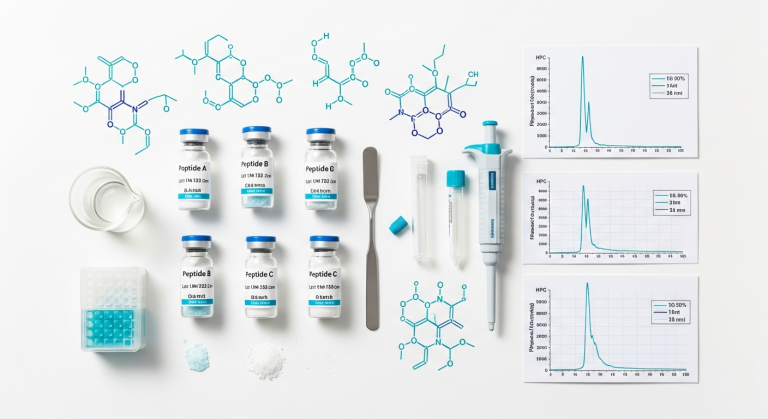
Epitalon is a four amino acid peptide, Ala-Glu-Asp-Gly, and it has a bigger reputation than its paper trail. The telomerase and pineal research in animal models mostly comes from one St. Petersburg group, with a couple of newer outside labs joining in. Some of it is genuinely interesting. Some of what gets repeated online was never measured at all. We went through the primary abstracts and kept only what they actually say.
Key findings
- In telomerase negative human fetal fibroblasts, Epitalon switched on the telomerase catalytic subunit, enzyme activity and telomere elongation (Khavinson 2003).
- Late passage fibroblasts exposed to Epitalon got 10 extra divisions past the control cells, which stopped at passage 34 (Khavinson 2004).
- A 2025 lab in London saw concentration dependent telomere lengthening in normal cells via hTERT, and via ALT in breast cancer lines (Al-Dulaimi 2025).
- In female SHR mice, mean life span didn’t change, but the last 10% of survivors lived 13.3% longer and leukemia dropped 6 fold (Anisimov 2003).
- A 2026 narrative review found no adequately powered randomized human trial (Jain 2026).
What Epitalon is, and what it isn’t
Epitalon (also spelled Epithalon) is synthetic. It was designed from the amino acid makeup of epithalamin, a crude polypeptide extract from bovine pineal glands. People blur the two all the time. A recent review makes the point that they’re chemically distinct, and it treats epithalamin studies as historical context rather than evidence for the tetrapeptide [1]. We’d suggest you do the same.
The sequence and basic chemistry are on our Epitalon compound page.
The telomerase experiments
This is the claim everybody cites, so let’s look at the source. In 2003, Khavinson, Bondarev and Butyugov added Epitalon to human fetal fibroblasts that don’t normally make telomerase. The cells started expressing the catalytic subunit, the enzyme became active, and telomeres got longer [2]. The abstract is three sentences long. That’s the whole public record for the founding result.
A year later the same team pushed further. Lung fibroblasts from a 24 week fetus lost their ability to divide at passage 34, with shorter telomeres than at passage 10. Add Epitalon to those tired cells and the telomeres stretched back to early passage length. The cells made 10 extra divisions, reaching passage 44, and kept going [3]. In plain terms, they got past the Hayflick limit in a dish.
Here’s what we’d flag. Pushing normal cells past their division limit sounds great until you remember that’s also what cancer cells do. Which brings us to the newer work.
A 2025 replication, with a twist
Al-Dulaimi and colleagues at Brunel University London ran the most detailed outside test we know of. They exposed normal epithelial cells, fibroblasts and two breast cancer lines (21NT and BT474) to Epitalon and measured telomere length, hTERT mRNA, telomerase activity and ALT, the backup telomere pathway some tumors use [4].
In normal cells, telomeres lengthened more as concentration rose, through hTERT and telomerase. In the cancer lines, telomeres lengthened too, but mostly through ALT activation. Normal cells showed only a minor ALT bump [4]. Funny thing: this is the first independent group to confirm the core finding, more than 20 years after it was published. And it raises a question nobody has fully answered about what Epitalon does in cells that are already malignant.
Mice: life span and tumors
The best known animal study is Anisimov’s 2003 paper in Biogerontology. Female Swiss derived SHR mice got either saline or Epitalon on five consecutive days every month, from three months old until natural death. There were 54 mice per group [5].
The results are more modest than the internet version:
- No change in food intake, body weight or mean life span.
- Bone marrow chromosome aberrations fell by 17.1%.
- The last 10% of survivors lived 13.3% longer, and maximum life span rose 12.3%.
- Total spontaneous tumor incidence didn’t change, though leukemia was 6 fold lower.
So when old posts said Epitalon “lowers the risk of spontaneous tumors,” that’s not quite what the paper found. Overall tumor rates were flat. One tumor type went down.
| Model | Main readout | Result | Ref |
|---|---|---|---|
| Human fetal fibroblasts | Telomerase, telomere length | Activated, elongated | [2] |
| Late passage fibroblasts | Extra divisions | 10 more than control | [3] |
| Normal and breast cancer lines | hTERT, ALT | hTERT in normal, ALT in cancer | [4] |
| Female SHR mice | Life span, tumors | Mean unchanged, leukemia lower | [5] |
| Mouse oocytes | ROS, spindle defects | Both reduced in vitro | [7] |
Beyond telomeres: gene expression and oocytes
Khavinson’s lab also argues Epitalon works epigenetically. In human gingival mesenchymal stem cells, it raised mRNA for the neuronal markers Nestin, GAP43, beta Tubulin III and Doublecortin by 1.6 to 1.8 times. Molecular modeling suggested it binds histones H1/3 and H1/6 [6]. Earlier, a fluorescence study showed labeled Epitalon reaching the nucleus of HeLa cells and preferring CAG containing DNA sequences [8].
A Chinese team took a totally different angle. They aged mouse oocytes in culture with 0.1 mM Epitalon. Intracellular ROS dropped, spindle defects and abnormal cortical granule patterns fell at 12 and 24 hours, mitochondrial membrane potential went up, and apoptosis was lower by 24 hours [7]. That’s a clean, specific in vitro result, and it’s not from the original group, which we like.
Epitalon’s smaller sibling from the same lab is the tripeptide Pinealon. We cover that one in our Pinealon neuronal research overview.
What’s still missing
The 2026 review by Jain and colleagues is blunt. Human evidence is limited to small physiological or biomarker studies plus an older controlled study in retinitis pigmentosa. No adequately powered randomized trial exists, and pharmacokinetic and long term safety data are thin [1]. We removed earlier claims that “human trials showed better function” for exactly that reason.
If you’re planning work in this area, the open questions are pretty clear. Independent replication of the mouse life span data. Better data on ALT activation in tumor cells. And some basic pharmacokinetics, which honestly should have come first.
References
- Jain A, Gallacher DM, Issa MA, Deer TR, et al. Epitalon and Epithalamin: A Narrative Review of Mechanistic, Preclinical, and Clinical Evidence. Int J Mol Sci. 2026. PMID 42884164
- Khavinson VKh, Bondarev IE, Butyugov AA. Epithalon peptide induces telomerase activity and telomere elongation in human somatic cells. Bull Exp Biol Med. 2003. PMID 12937682
- Khavinson VKh, Bondarev IE, Butyugov AA, Smirnova TD. Peptide promotes overcoming of the division limit in human somatic cell. Bull Exp Biol Med. 2004. PMID 15455129
- Al-Dulaimi S, Thomas R, Matta S, Roberts T. Epitalon increases telomere length in human cell lines through telomerase upregulation or ALT activity. Biogerontology. 2025. PMID 40908429
- Anisimov VN, Khavinson VKh, Popovich IG, Zabezhinski MA, et al. Effect of Epitalon on biomarkers of aging, life span and spontaneous tumor incidence in female Swiss-derived SHR mice. Biogerontology. 2003. PMID 14501183
- Khavinson V, Diomede F, Mironova E, Linkova N, et al. AEDG Peptide (Epitalon) Stimulates Gene Expression and Protein Synthesis during Neurogenesis: Possible Epigenetic Mechanism. Molecules. 2020. PMID 32019204
- Yue X, Liu SL, Guo JN, Meng TG, et al. Epitalon protects against post-ovulatory aging-related damage of mouse oocytes in vitro. Aging (Albany NY). 2022. PMID 35413689
- Fedoreyeva LI, Kireev II, Khavinson VKh, Vanyushin BF. Penetration of short fluorescence-labeled peptides into the nucleus in HeLa cells and in vitro specific interaction of the peptides with deoxyribooligonucleotides and DNA. Biochemistry (Mosc). 2011. PMID 22117547
Disclaimer: This content is intended for research purposes only and is not meant to constitute medical advice.
This educational material discusses laboratory research concepts only. Loti Labs products are intended strictly for research and development use and are not for human consumption.