The Hunger Hormone’s Deeper Story
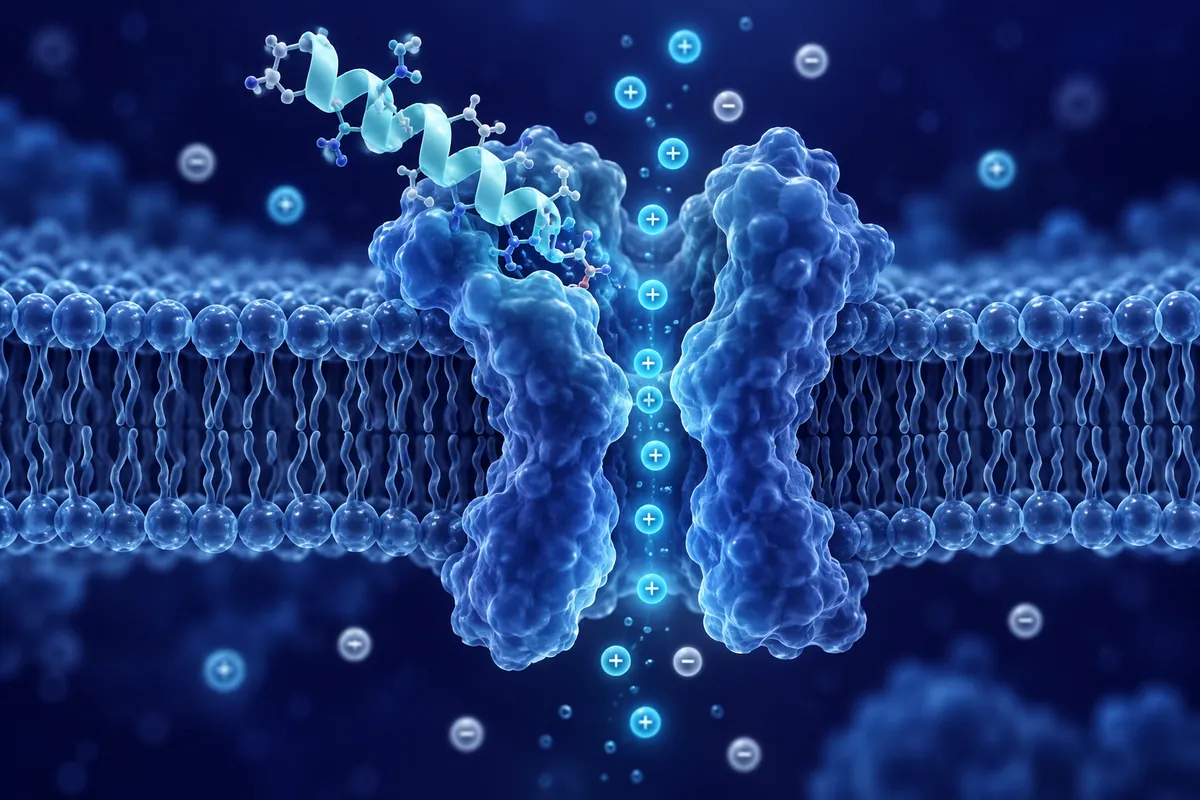
Ghrelin occupies a unique position in peptide biology. Discovered in 1999 by Masayasu Kojima and colleagues at Kurume University, it was identified through reverse pharmacology : researchers found the receptor first (growth hormone secretagogue receptor type 1a, GHS-R1a), then went searching for its endogenous ligand. What they found was a 28-amino-acid peptide produced primarily by oxyntic cells in the gastric fundus, bearing a distinctive octanoyl modification on its third serine residue.
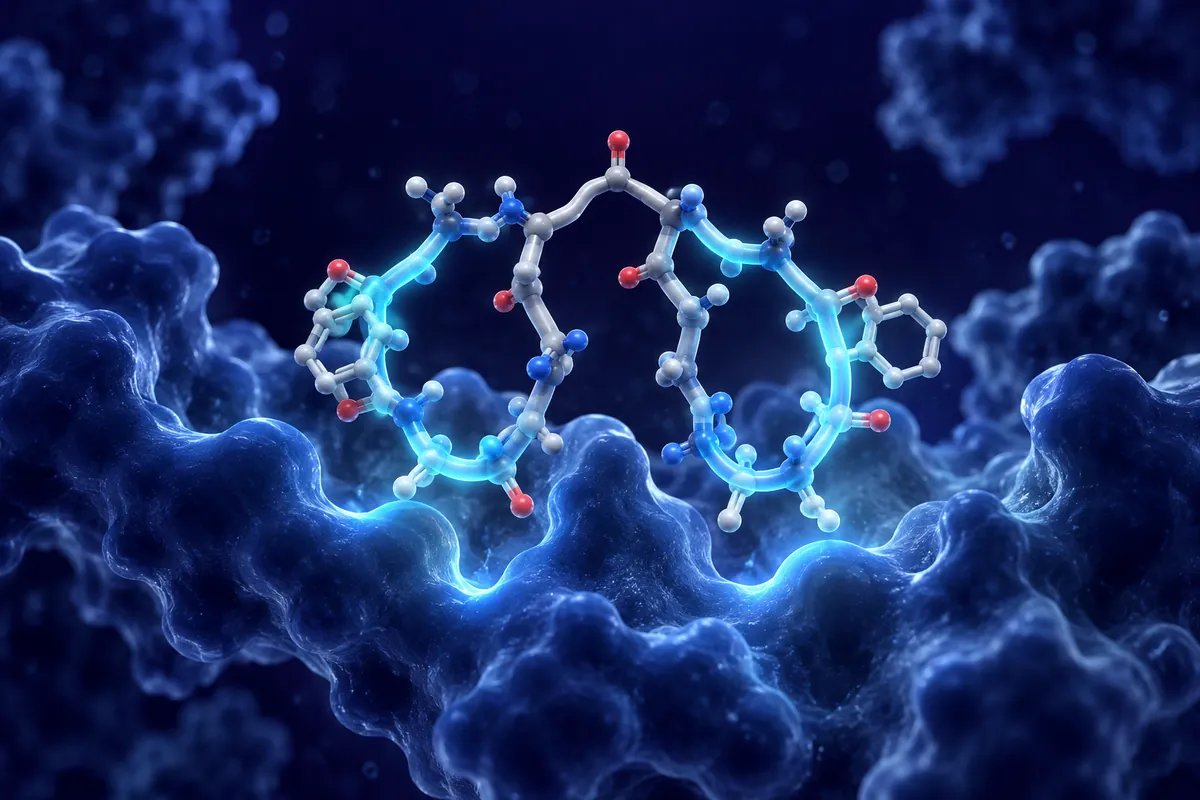
That fatty acid modification is not decorative. Without the octanoyl group attached by the enzyme ghrelin O-acyltransferase (GOAT), the peptide cannot activate GHS-R1a. This requirement for acylation makes ghrelin the only known peptide hormone requiring a post-translational lipid modification for receptor activation : a feature that has fascinated biochemists and created a natural drug design target in the GOAT enzyme.
GHS-R1a: A Receptor with Constitutive Activity
GHS-R1a is remarkable in its own right. Unlike most G-protein-coupled receptors, which remain silent until a ligand arrives, GHS-R1a displays approximately 50% constitutive activity. In the absence of any ghrelin, the receptor signals at half-maximal capacity. Ghrelin binding pushes activity higher; inverse agonists push it lower.
This baseline signaling has significant research implications. Researchers designing experiments with GHS-R1a must account for this constitutive signaling, as receptor deletion produces effects that exceed what ghrelin removal alone would predict.
In isolated pituitary cell assays, co-administration of ghrelin and GHRH produces GH release exceeding the sum of either agent alone. The synergy involves distinct but converging intracellular pathways: GHRH signals through cAMP/PKA while ghrelin signals through IP3/DAG/PKC. This convergence amplifies calcium influx beyond what either pathway generates independently.
Ghrelin concentrations in blood follow a striking preprandial pattern. Levels rise sharply before anticipated meals and plummet within minutes of eating. This prandial rhythm : the only gut hormone that rises before meals rather than after : earned ghrelin its reputation as the hunger hormone.
Ghrelin acts on NPY/AgRP neurons in the hypothalamic arcuate nucleus, activating the same orexigenic circuits that NPY stimulates. Vagal afferents from the stomach also carry ghrelin signals to the nucleus tractus solitarius in the brainstem, providing a parallel hunger input that bypasses the hypothalamus entirely.
Whether these effects translate proportionally to complex organisms remains under investigation, but the directionality is consistent across species studied to date.
Reward, Motivation, and Dopamine
This finding repositioned ghrelin from a simple hunger signal to a modulator of wanting : the motivational drive to seek and work for rewards. The distinction matters. In progressive ratio experiments, ghrelin-treated rodents press levers far more times for a food pellet compared to controls, even when both groups are equally food-deprived.
Intriguingly, GHS-R1a also forms heterodimers with dopamine D1 and D2 receptors, altering their signaling properties. These receptor-receptor interactions add a layer of complexity that may explain why ghrelin’s reward-modulating effects do not simply mirror those of direct dopamine agonists.
Des-Acyl Ghrelin: The Other Form
Approximately 80-90% of circulating ghrelin lacks the octanoyl modification and is designated des-acyl ghrelin.
The acyl/des-acyl ratio therefore matters. Changes in GOAT expression, dietary fatty acid availability (octanoic acid is a medium-chain fatty acid found in coconut and palm kernel oil), and degradation kinetics all influence this ratio. Researchers measuring “total ghrelin” without distinguishing acylation status may miss functionally relevant shifts in the balance between these two forms.
Current Research Directions
Active ghrelin research spans multiple frontiers. In neuroscience, GHS-R1a’s role in alcohol and substance reward pathways has attracted attention from addiction researchers. And in aging biology, the age-related decline in ghrelin pulsatility : paralleling GH decline : raises questions about whether diminished ghrelin signaling contributes to sarcopenia and frailty in aging research models.
Disclaimer: This content is intended for research purposes only and is not meant to constitute medical advice.
This educational material discusses laboratory research concepts only. Loti Labs products are intended strictly for research and development use and are not for human consumption.