
Premium USA-Made Research Compounds
Browse lab-tested peptides, research liquids, capsules and more.
Mitochondria have long occupied a central place in biology — not just as the cell’s energy producers, but as dynamic organelles whose structural integrity underpins virtually everything a cell does. It’s a broad problem, and researchers have been hunting for molecular tools precise enough to address it at the source.
SS-31, also known by its International Nonproprietary Name elamipretide, has emerged as one of the more compelling compounds in this space. It’s a small tetrapeptide — just four amino acids — that demonstrates a surprising degree of selectivity for the inner mitochondrial membrane. That selectivity, as it turns out, is the whole story.
All content presented here is for research and educational purposes only.
Looking for Premium Research Compounds?
What Is SS-31 (Elamipretide)?
SS-31 belongs to a family of Szeto-Schiller (SS) peptides developed by researchers Hazel Szeto and Peter Schiller. The full structural designation is D-Arg-2’6′-dimethylTyr-Lys-Phe-NH2 — a tetrapeptide featuring an N-terminal D-arginine residue, a modified dimethyltyrosine, lysine, and phenylalanine with a C-terminal amide. That modification of tyrosine isn’t cosmetic; the dimethyl substitution enhances its interaction with anionic phospholipids and appears to reduce susceptibility to enzymatic degradation.
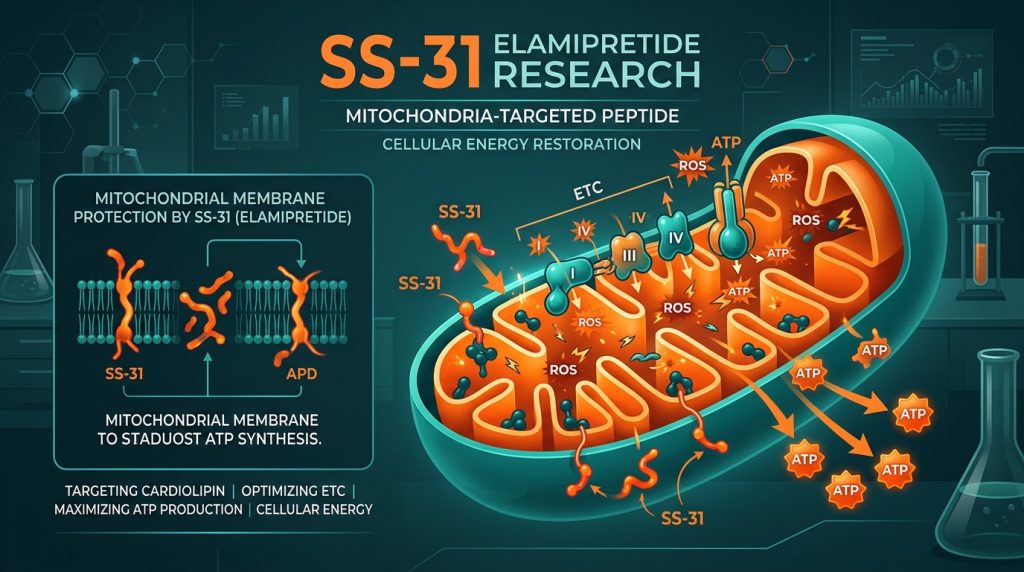
What makes SS-31 stand out within the SS peptide family is its highly selective accumulation in the inner mitochondrial membrane (IMM). It doesn’t diffuse randomly through the cell. It homes to the IMM at concentrations reported to be hundreds of times higher than in the surrounding cytosol. This targeting behavior is driven by its electrostatic and aromatic properties, which create a strong affinity for cardiolipin — a unique phospholipid found almost exclusively in the IMM.
All research applications reviewed here remain within the context of scientific investigation.
To understand SS-31, researchers essentially need to understand cardiolipin first. Cardiolipin isn’t like most membrane phospholipids. It has an unusual dimeric structure — four fatty acid chains attached to two phosphate groups linked by a glycerol backbone — and it exists at uniquely high concentrations in the IMM. That structural oddity is actually a functional necessity.
Cardiolipin and Mitochondrial Architecture
Cardiolipin plays an almost architectural role in the IMM. Cardiolipin is the molecular glue that holds these arrangements together.
Beyond the ETC, cardiolipin is essential for maintaining IMM curvature at the cristae — those characteristic folds of the inner membrane where ATP synthase and ETC complexes are densely packed. The tightly curved cristae junctions that compartmentalize the proton gradient depend substantially on cardiolipin for their structural maintenance. When cardiolipin becomes oxidized or depleted — as happens in ischemic injury, aging, or disease states — these structures break down. Respiratory supercomplexes dissociate. Cristae flatten. The electrochemical gradient collapses. ATP production plummets.
This is why cardiolipin damage is so consequential. It’s not just about losing a single phospholipid; it’s about destabilizing the entire architecture that efficient oxidative phosphorylation depends on.
How SS-31 Binds Cardiolipin
SS-31’s interaction with cardiolipin is electrostatic and hydrophobic in character. The D-Arg residue carries a positive charge that is drawn to the anionic phosphate groups of cardiolipin, while the aromatic residues (dimethylTyr and Phe) insert into the hydrophobic core of the membrane. Taken together, this gives SS-31 a snug, high-affinity interaction with cardiolipin-rich regions of the IMM.
Crucially, this binding appears to be protective rather than disruptive. Cytochrome c normally stays anchored to the IMM via cardiolipin; when cardiolipin is oxidized, cytochrome c detaches, which can trigger apoptotic cascades.
Researchers have characterized effects at multiple nodes of mitochondrial function.
In models of cardiac ischemia, aging, and primary mitochondrial myopathy, SS-31 has been associated with restoration of ATP synthetic flux — and the mechanism ties back directly to ETC supercomplex stabilization.
The proton gradient across the IMM is preserved. ATP synthase (Complex V) operates with greater substrate availability. Some research also points to direct interactions between SS-31 and ATP synthase itself, though the mechanistic picture here is still being clarified.
Reactive Oxygen Species Modulation
ROS modulation is the other major mechanistic theme. Mitochondria are the primary site of intracellular ROS generation, and while some ROS are necessary for signaling, excessive superoxide and hydrogen peroxide production drives oxidative damage to proteins, lipids, and DNA. Cardiolipin is a prime target because of its proximity to Complex I and III — the main sites of electron “leak.”
Cardiac Research Applications
The heart runs almost entirely on oxidative phosphorylation. Cardiac myocytes are packed with mitochondria — they account for roughly 30% of cell volume — and the heart’s demand for ATP is essentially continuous. That makes it uniquely vulnerable to mitochondrial dysfunction, and uniquely relevant as a research model for SS-31.
Ischemia-Reperfusion Injury Models
Ischemia-reperfusion (I/R) injury is probably the most studied application of SS-31 in cardiac research. The model is well-established: blood flow is interrupted, then restored, and a cascade of mitochondrial events drives cell death in a way that goes beyond simple oxygen deprivation.
The effect size in some models has been substantial. It’s a cascade where one upstream intervention has multiple downstream effects.
Heart Failure and Mitochondrial Dysfunction Studies
HFpEF is notoriously difficult to model and study, partly because its pathophysiology is heterogeneous, but mitochondrial dysfunction is a common thread across many models.
Stealth BioTherapeutics conducted Phase II/III sponsored research programs (TOPCAT-HFpEF, PROGRESS-HF) examining elamipretide in heart failure populations.
The research continues to refine which aspects of heart failure are most amenable to mitochondrial intervention and what the optimal research parameters are.
Beyond the Heart — Other Research Domains
That turns out to be a long list.
Skeletal muscle mitochondria are a natural area of interest. Aging skeletal muscle shows progressive mitochondrial dysfunction — reduced respiratory capacity, increased ROS production, impaired ATP synthesis — that contributes to the decline in muscle mass and function seen in sarcopenia.
This remains an active area for preclinical model refinement and mechanistic research.
Renal and Neurological Models
The kidney is another high-mitochondrial-density organ that shows significant vulnerability. Acute kidney injury (AKI) models, particularly cisplatin-induced and ischemic AKI models, have been studied with SS-31.
Neurological research is earlier-stage but gaining traction. Neurons are among the most mitochondria-dependent cells in the body, and mitochondrial dysfunction is implicated in Alzheimer’s disease, Parkinson’s disease, and traumatic brain injury pathology. Worth watching.
SS-31 vs. Other Mitochondrial Peptides
SS-31 doesn’t exist in isolation. The SS peptide family includes SS-02 and SS-20, and the broader field of mitochondria-targeting compounds includes MitoQ (mitoquinone), SKQ1, and various other antioxidant conjugates. How does SS-31 compare?
SS-02 targets μ-opioid receptors alongside mitochondria and has a different application profile.
Research Protocols and Observations
In published preclinical research, SS-31 has most commonly been studied via intravenous or subcutaneous administration, reflecting the peptide’s water solubility and low molecular weight (MW ~640 Da). Subcutaneous delivery in rodent models has demonstrated consistent bioavailability, with mitochondrial accumulation observed within minutes of administration in some acute models.
Research observations consistently note that SS-31 is active at nanomolar to low micromolar concentrations in cell-based assays, with in vivo studies typically employing milligram-per-kilogram ranges depending on the model and endpoint. The relatively rapid accumulation in the IMM and the stability conferred by the D-arginine residue (resistant to L-amino acid proteases) are practical features that make SS-31 workable in a range of experimental designs.
Formal sponsored research programs from Stealth BioTherapeutics used intravenous infusion protocols in human study populations — primarily for primary mitochondrial myopathy and heart failure.
Standard peptide handling protocols apply.
Future Research Directions
SS-31 has already shown that precise targeting of a single mitochondrial lipid can produce broad functional effects — a proof of concept with implications well beyond any single indication.
Several directions look particularly promising from a research standpoint. Combination research pairing SS-31 with NAD+ precursors, PGC-1α activators, or other mitochondrial biogenesis stimulators is an emerging area that could yield additive or synergistic findings.
Ongoing preclinical work in aging biology and neurodegeneration also seems likely to yield new mechanistic insights over the next several years.
Conclusion
The elegance of that mechanism has driven substantial research interest across cardiac, muscular, renal, and neurological models — and the preclinical and sponsored Phase II/III research literature is now substantial enough to characterize it as one of the better-understood mitochondria-targeting peptides available to researchers.
For researchers working in these areas, the mechanistic clarity of SS-31’s action is a distinct scientific asset.
All information presented in this article is for research and educational purposes only. SS-31 (elamipretide) is not approved for human use and is intended exclusively for laboratory and preclinical research.
Continue Your Research
Explore our complete catalog of premium research compounds.
