
Premium USA-Made Research Compounds
Browse lab-tested peptides, research liquids, capsules and more.
The peptide research landscape has shifted considerably over the past several years.
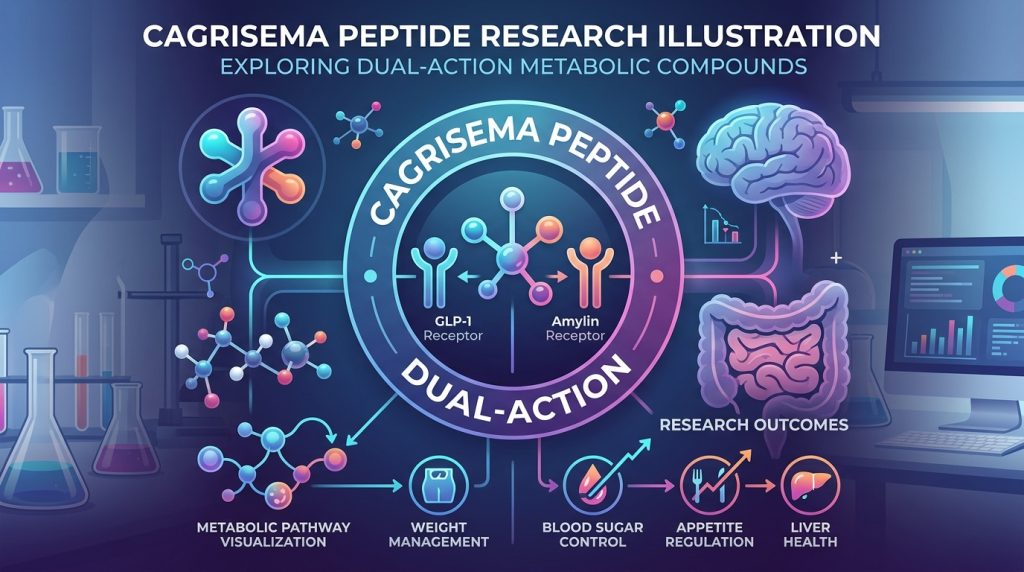
CagriSema is one of the more compelling answers to that question. It pairs cagrilintide, an amylin analogue, with semaglutide, the well-characterized GLP-1 receptor agonist, into a single co-formulated compound. The rationale is straightforward on paper — hit two distinct receptor systems simultaneously and observe whether the combined effect exceeds what either compound achieves alone. But the underlying biology is considerably more intricate than that summary implies.
This profile covers what CagriSema is, how each component works at the receptor level, why the combination is scientifically interesting, and what the OASIS phase 3 trial program has revealed so far. All discussion is framed within the context of preclinical and human research models, for research use only.
Looking for Premium Research Compounds?
What Is CagriSema? Defining the Dual Agonist
It is not a dual agonist in the traditional sense — meaning it doesn’t bind two receptor classes through a single bifunctional molecule. Instead, it delivers two distinct peptide compounds simultaneously, each targeting a separate receptor system.
That distinction matters for interpreting the research data. CagriSema’s observed effects aren’t the product of a single engineered molecule bridging two pathways. They emerge from the parallel activity of two independent compounds operating on separate but physiologically connected circuits. Cagrilintide acts primarily on amylin receptors. Semaglutide activates GLP-1 receptors.
The compound sits in a broader competitive landscape that now includes tirzepatide (GLP-1/GIP dual agonist) and the experimental retatrutide (GLP-1/GIP/glucagon triple agonist). CagriSema takes a different architectural approach — amylin plus GLP-1, rather than GIP plus GLP-1. Whether that translates into meaningful differentiation in research outcomes is one of the central questions the OASIS program is designed to answer.
Cagrilintide: Amylin Analogue Mechanisms & Research Background
Amylin is a 37-amino-acid peptide co-secreted with insulin from pancreatic beta cells in response to nutrient intake. It engages a family of receptors formed by the calcitonin receptor (CTR) paired with receptor activity-modifying proteins (RAMPs) — specifically RAMP1, RAMP2, and RAMP3 — giving rise to AMY1, AMY2, and AMY3 receptor subtypes. The brainstem and hypothalamus are the primary central targets; the area postrema in particular is densely populated with amylin-responsive neurons.
It also interacts with leptin signaling pathways in the hypothalamus, which is relevant because leptin resistance is a documented feature of diet-induced obesity models. Native amylin and leptin appear to have synergistic interactions in the hypothalamic arcuate nucleus, and preclinical evidence suggests that amylin receptor stimulation can partially restore leptin responsiveness in resistant models — a mechanistically distinct contribution compared to what GLP-1 agonism achieves alone.
Cagrilintide’s Structural Advantages Over Native Amylin
Native amylin has a very short half-life in vivo — on the order of minutes — largely because it is prone to aggregation and rapid enzymatic degradation.
The structural modifications include fatty acid acylation — a C18 fatty diacid chain attached via a linker — which promotes albumin binding in circulation. This dramatically extends plasma half-life by reducing renal clearance and protecting the peptide from degradation. The estimated half-life of cagrilintide in human research subjects is approximately seven days, making it pharmacokinetically compatible with once-weekly semaglutide co-administration.
That establishes a meaningful baseline for interpreting the additive or synergistic contributions when it is co-administered with semaglutide.
GLP-1 Pathway Mechanisms
Glucagon-like peptide-1 (GLP-1) is an incretin hormone released from L-cells in the intestinal mucosa in response to nutrient ingestion. Its primary receptor — GLP-1R — is a class B G-protein-coupled receptor expressed across multiple tissues: pancreatic beta cells, the gastrointestinal tract, cardiac muscle, and crucially, the central nervous system, including the hypothalamic arcuate nucleus and nucleus tractus solitarius.
Glucagon release is suppressed.
The receptor is also expressed in areas associated with reward processing, including the nucleus accumbens, which has led to research interest in whether GLP-1 agonism modulates not just caloric intake but the hedonic drive toward food.
Semaglutide’s Half-Life Engineering
Native GLP-1 has a plasma half-life of roughly 2 minutes, owing to rapid degradation by dipeptidyl peptidase-4 (DPP-4) and neutral endopeptidase, as well as renal clearance. Semaglutide overcomes this limitation through two engineering strategies working in concert.
First, a single amino acid substitution at position 8 — replacing alanine with 2-aminoisobutyric acid — blocks DPP-4 cleavage. Second, a C18 fatty diacid chain is attached at position 26 via a small linker, enabling strong non-covalent binding to serum albumin. This albumin binding creates a large circulating reservoir of the peptide that is released slowly over time, yielding a half-life of approximately one week in human research subjects and making once-weekly subcutaneous administration pharmacokinetically viable.
The Rationale for Combining Cagrilintide + Semaglutide
Complementary Receptor Targets
GLP-1R signals primarily via cAMP/PKA pathways following Gs coupling. Amylin receptors signal through a mix of cAMP and additional downstream effectors depending on the RAMP subtype involved.
Beyond the intracellular differences, the two systems diverge in their primary sites of action. GLP-1 signaling has particularly strong representation in the vagal afferent pathway and the brainstem’s nucleus tractus solitarius. Amylin receptor signaling has a pronounced central signature, with the area postrema and hypothalamic circuits as dominant hubs.
Additive vs Synergistic Effects in Research Models
The distinction between additive and synergistic is more than semantic in this context. An additive effect means the combination produces the sum of what each compound contributes independently. Synergy implies a result that exceeds that sum — which would suggest the pathways interact rather than simply run in parallel.
Whether that synergy translates into human research populations is one of the core empirical questions the OASIS trials are designed to address.
The gap is suggestive, but formally characterizing the interaction as additive versus synergistic requires controlled comparator arms in the same study, which is what the OASIS phase 3 program provides.
OASIS 1 Key Findings
The OASIS 1 trial is the pivotal study in the CagriSema phase 3 program. It enrolled approximately 3,400 research subjects with obesity (BMI ≥30, or ≥27 with at least one weight-related comorbidity) but without type 2 diabetes, and randomized them to CagriSema or placebo over 68 weeks.
The primary endpoint was percent change in body weight from baseline.
OASIS 2 & Ongoing Investigations
OASIS 2 extends the program into a population with type 2 diabetes. This is a methodologically important distinction because GLP-1 receptor agonism has well-documented glycemic effects in that population, and the interaction with cagrilintide’s amylin-pathway contribution may manifest differently in subjects with impaired beta-cell function compared to non-diabetic individuals.
CagriSema vs Tirzepatide & Retatrutide: A Research Comparison
Comparing them is necessarily imprecise given differences in study populations, trial designs, and the current state of published data — but the mechanistic contrasts are instructive.
Tirzepatide is a single bifunctional molecule that acts as a GLP-1/GIP dual agonist. GIP receptor activation in adipose tissue and the central nervous system adds a pathway that is largely absent from semaglutide monotherapy. The mechanistic question is whether GIP agonism or amylin agonism provides a more productive complement to GLP-1 activation — a question that cannot be resolved by comparing across separate trials.
Retatrutide is a triple agonist hitting GLP-1R, GIP receptor, and glucagon receptor simultaneously.
CagriSema’s distinctive contribution is the amylin pathway. Native amylin’s co-secretion with insulin, its central action on area postrema circuits, and its proposed interactions with leptin signaling represent a mechanistic angle that GIP and glucagon receptor agonism don’t directly engage. Whether that translates into meaningfully different or better outcomes in specific research populations is an open question — and likely one that will only be resolved through head-to-head research designs.
Open Research Questions & Future Directions
Several important research questions remain unresolved.
Second, the mechanistic contribution of cagrilintide beyond additive GLP-1 amplification hasn’t been fully characterized in human models.
Third, differential response by metabolic subtype is underexplored. Obesity is not a homogeneous research population. Research designs capable of stratifying by these variables would add substantially to mechanistic understanding.
As the field moves toward precision metabolic research, the specificity of amylin receptor engagement may become a more important variable than it appears in current population-level studies.
Conclusion
CagriSema represents one of the more mechanistically interesting compounds in the current metabolic research landscape.
Whether that potency is rooted in additive or genuinely synergistic receptor interactions remains an open scientific question, as does the long-term durability of observed effects and the compound’s differentiation relative to tirzepatide and retatrutide.
All findings discussed here are drawn from published research and phase 3 trial data and are intended strictly for research use only.
Frequently Asked Questions
Q: What is CagriSema and how does it differ from semaglutide alone?
Q: What does the amylin receptor pathway contribute in CagriSema research?
There is also preclinical evidence of interaction with leptin signaling pathways that may partially restore leptin responsiveness in obesity models — a mechanism distinct from GLP-1 agonism.
Q: What did the OASIS 1 trial find?
A: The OASIS 1 trial enrolled approximately 3,400 research subjects with obesity over 68 weeks. These findings are for research context only.
Q: How does CagriSema compare to tirzepatide in research models?
A: CagriSema and tirzepatide represent different mechanistic strategies — amylin plus GLP-1 versus GIP plus GLP-1. The two compounds engage different secondary receptor systems alongside GLP-1R, making mechanistic differentiation difficult without head-to-head research designs. For research purposes, the amylin pathway versus the GIP pathway represents a distinct mechanistic variable that current published data cannot fully resolve.
Q: Is CagriSema the same as a dual agonist molecule like tirzepatide?
A: No. CagriSema is a co-formulation — two separate peptide compounds administered together, each with independent receptor targets. Tirzepatide is a single bifunctional molecule engineered to engage two receptor types (GLP-1R and GIP receptor) through one molecular structure. The distinction affects how the compounds are characterized pharmacologically and how their mechanisms are studied, though the practical research question of combined receptor engagement applies to both approaches.
Continue Your Research
Explore our complete catalog of premium research compounds.
