
Premium USA-Made Research Compounds
Browse lab-tested peptides, research liquids, capsules and more.
Peptide research rarely happens in a vacuum. The body—or a cell culture in a petri dish—is a symphony of overlapping signals. So the logical question becomes: what happens when researchers combine peptides that target complementary mechanisms?
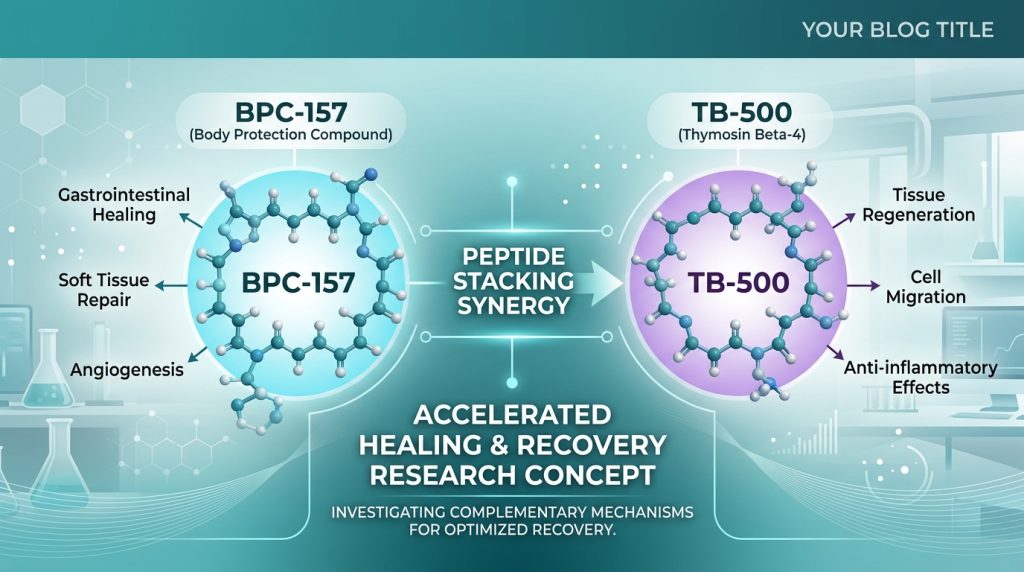
That’s the central premise behind peptide stacking in a laboratory context. It’s not a new idea. Combination approaches have existed in pharmacological research for decades. But when it comes to specific peptide pairings, BPC-157 and TB-500 (Thymosin Beta-4) have attracted particular attention.
This article covers the research profiles of both peptides, what published data suggests about their combined use in laboratory settings, and how to approach study design when investigating multi-peptide combinations. Whether the work is in vitro or using animal models, the methodological considerations are worth examining closely.
Looking for Premium Research Compounds?
Understanding Peptide Stacking in a Research Context
“Stacking” is a term borrowed from pharmacology and bodybuilding culture, but in a research context it simply refers to studying two or more compounds simultaneously or in a defined sequence to observe whether their combined effect differs from either compound alone.
There are three possible outcomes in any combination study:
– Additive effects — the combined result roughly equals the sum of the parts
– Synergistic effects — the combined result exceeds what either compound produces independently
–
The goal of structured combination research is to determine which of these outcomes actually occurs, and under what conditions. This requires rigorous controls, clearly defined endpoints, and careful attention to concentration ratios. None of that is trivial. Multi-compound studies are genuinely harder to design well than single-compound investigations.
Still, the scientific rationale for exploring BPC-157 + TB-500 combinations is strong—because their individual mechanisms operate through overlapping but distinct pathways. That’s the hallmark of a potentially synergistic pairing.
BPC-157: Research Profile & Primary Mechanisms
BPC-157 (Body Protection Compound-157) is a synthetic pentadecapeptide derived from a protective protein found in gastric juice. It consists of 15 amino acids and has been isolated in stable form for experimental use. In preclinical research, it has demonstrated a remarkably broad set of bioactivities—which is part of what makes it such a compelling subject of study.
Importantly, BPC-157 appears to exert its effects without systemic hormonal disruption, which simplifies certain aspects of study design. Researchers don’t have to account for downstream endocrine interference when designing BPC-157 protocols—at least not based on current evidence.
Angiogenesis & Vascular Remodeling
One of the most consistently documented effects of BPC-157 in preclinical models is its influence on angiogenesis—the formation of new blood vessels.
Regenerating tissue requires adequate blood supply. BPC-157’s angiogenic activity essentially addresses this bottleneck.
A 2019 study published in the Journal of Physiology-Paris found that BPC-157 activated the FAK-paxillin pathway—a key intracellular signaling route involved in endothelial cell migration and tube formation.
There’s also evidence of mTOR pathway activation in some models, suggesting that BPC-157 may influence protein synthesis dynamics at the cellular level. These are active research areas, not settled conclusions, which is precisely why controlled investigation remains valuable.
TB-500 (Thymosin Beta-4): Research Profile & Primary Mechanisms
TB-500 is a synthetic version of Thymosin Beta-4 (Tβ4), a naturally occurring 43-amino-acid peptide present in virtually all nucleated cells in mammals. It was first isolated in thymic tissue but is now understood to have much broader systemic distribution. Tβ4 has been studied since the 1960s, giving it one of the longer research track records of any peptide in this space.
What makes TB-500 particularly interesting from a research standpoint is its pleiotropic nature.
Actin Binding & Cytoskeletal Remodeling
The most foundational mechanism of Thymosin Beta-4 is its binding to G-actin (globular actin monomers). Actin polymerization—the assembly of individual actin monomers into filamentous structures—is essential to cell motility and division. Tβ4 acts as an actin-sequestering molecule, maintaining a reservoir of G-actin that cells can draw on rapidly.
Because cell migration requires rapid cytoskeletal remodeling. TB-500’s regulation of the G-actin pool directly facilitates this process.
Research in cardiac models has been particularly illuminating.
Overlapping Pathways That Amplify Effects
Looking at the mechanisms described above, the case for synergy between BPC-157 and TB-500 becomes fairly clear—they converge on shared goals through different molecular routes.
BPC-157 drives angiogenesis through VEGF upregulation and endothelial signaling. In the absence of adequate vasculature, migrating fibroblasts have nowhere useful to go.
This multi-phase coverage is the core rationale for combination research.
Published Combination Study Findings
Direct combination research on BPC-157 and TB-500 is still relatively limited in the peer-reviewed literature—a gap that itself represents a research opportunity. However, existing data offers several meaningful signals.
A frequently cited early study by Sikiric and colleagues (2003) examined BPC-157 in rat models of musculoskeletal injury and noted that the compound’s angiogenic effects appeared to be most pronounced in environments where cytoskeletal dynamics were also active—suggesting that the presence of actin-remodeling signals (the kind TB-500 facilitates) may potentiate BPC-157’s vascular activity.
The preliminary data from these protocols suggested faster histological normalization compared to either compound administered alone. These findings remain in early stages and demand replication with larger sample sizes and standardized endpoints before meaningful conclusions can be drawn.
It’s worth noting: combination studies in this space are complicated by the challenge of attributing observed effects to one compound versus the other. Robust study design, including appropriate single-compound control arms, is essential.
Designing a BPC-157 + TB-500 Combination Study: Lab Protocols
In Vitro vs In Vivo Considerations
Both in vitro and in vivo approaches have their place in combination peptide research, and the choice significantly shapes what questions can be answered.
In vitro models (cell cultures) allow researchers to isolate specific cell types—fibroblasts, endothelial cells, myocytes—and observe direct cellular responses to each peptide and their combination under controlled conditions. These models are useful for mechanism elucidation: confirming which signaling pathways are activated, measuring gene expression changes, and assessing cytotoxicity.
In vivo rodent models provide a more physiologically relevant environment. Standard models for BPC-157 + TB-500 combination research include:
–
–
–
– Rat colitis or GI injury models (particularly well-validated for BPC-157)
Each model has established histological and functional endpoints that allow for standardized comparisons across studies. This is critical for any combination research that hopes to be replicated or compared to prior single-compound work.
Timing, Concentrations & Endpoints
Timing is arguably the most methodologically complex variable in combination peptide studies. The two key design questions are:
1. Simultaneous vs. sequential administration — Should both compounds be introduced at the same time, or should one precede the other?
2. Concentration ratios — What molar ratios between the two compounds produce optimal (or any synergistic) effects? Current literature on BPC-157 in rodent models typically uses concentrations in the range of 10–100 µg/kg, while TB-500 studies have used ranges from approximately 2–6 mg/kg in murine models. Whether a fixed ratio or variable ratio protocol is appropriate depends on the research question.
Researchers should plan for a minimum of four experimental groups in a well-powered combination study:
– Vehicle control
– BPC-157 alone
– TB-500 alone
– BPC-157 + TB-500 combined
Primary endpoints will vary by model but commonly include: histological scoring (H&E and Masson’s trichrome staining for collagen), tensile strength measurements (for tendon models), inflammatory cytokine quantification (ELISA), immunohistochemistry for VEGF and CD31 (vascular markers), and functional behavioral assessments in live animal models.
Statistical analysis must account for multiple comparisons across these endpoints—a detail that is frequently mishandled in published peptide research, particularly in smaller studies.
Other Peptide Stacking Combinations in Research
BPC-157 and TB-500 aren’t the only pairing attracting combination research interest. A few other stacks have generated preclinical data worth noting:
The combination research here is more developed than in the musculoskeletal peptide space.
The pairing targets different points in the GHRH/ghrelin signaling pathway—one acting on GHRH receptors and one on ghrelin receptors—with well-documented additive effects on GH pulse amplification in animal studies.
What all of these combinations share is a mechanistic rationale based on non-redundant pathways. Researchers evaluating any combination pairing should start there: if both compounds do essentially the same thing through the same mechanism, the case for combination research is weak. Complementary mechanisms are the prerequisite for meaningful stacking studies.
Methodological Pitfalls in Multi-Peptide Research
Multi-compound studies are harder to do well. Some of the most common pitfalls:
Insufficient control arms. Adding a combination without appropriate single-compound controls makes it impossible to determine whether observed effects are driven by one compound, the other, or their interaction. This is a basic but frequently neglected requirement.
Single-timepoint analysis. Peptides with different pharmacokinetic profiles don’t produce their effects simultaneously. Capturing outcomes at a single post-administration timepoint may miss the most biologically relevant window for one or both compounds.
Species and model generalizability. Researchers should be cautious about extrapolating findings across very different biological contexts without additional model validation.
Peptide stability in combination. This is a practical concern that often goes unaddressed. Some peptides can interact during co-administration—affecting stability, solubility, or even binding competition at shared receptors. Proper formulation controls (including stability assays before in vivo administration) are essential.
Underpowered studies. Small sample sizes are endemic to early-stage peptide research. With combination studies, where the effect size may be more variable than with single compounds, adequate statistical power requires more animals or replicates than researchers often plan for. Pre-study power calculations should be standard, not optional.
These aren’t hypothetical concerns—they represent recurring issues in the published peptide literature that limit confidence in combination study conclusions. Rigorous methodology is how the field builds credible evidence.
CONCLUSION
The research case for studying BPC-157 and TB-500 in combination is grounded in real biology.
Published combination findings are preliminary but directionally interesting. The real work lies ahead: well-designed, adequately powered studies with longitudinal endpoints, appropriate control arms, and careful attention to timing and concentration variables. That’s the standard the field needs to reach if combination peptide research is going to generate evidence that holds up.
Researchers interested in this space will find BPC-157 and TB-500 among the most investigated—and most documented—peptides available for laboratory study. The mechanistic foundation is solid. The methodology needs to match that foundation.
FREQUENTLY ASKED QUESTIONS
Q: What does “peptide stacking” mean in a research context?
A: In research settings, peptide stacking refers to the simultaneous or sequential administration of two or more peptides in a study model to investigate whether their combined effects differ from what either compound produces alone. The goal is to identify additive, synergistic, or antagonistic interactions—with synergy being the most scientifically valuable outcome to characterize.
Q: Why are BPC-157 and TB-500 considered a logical combination for study?
A: Because they operate through mechanistically distinct but functionally complementary pathways.
Q: What are the recommended control groups for a BPC-157 + TB-500 combination study?
A: At minimum, a well-designed study should include four groups: (1) vehicle control, (2) BPC-157 alone, (3) TB-500 alone, and (4) the combination. Without single-compound control arms, it’s impossible to determine which compound—or whether their interaction—is responsible for observed effects.
Q: What study models are most commonly used for this type of combination research?
A: Rodent models are standard. In vitro cell culture models (fibroblasts, endothelial cells) are also useful for mechanistic work but don’t capture whole-system dynamics.
Q: Is there published peer-reviewed research specifically on BPC-157 and TB-500 combined?
A: Direct combination research is still limited in the peer-reviewed literature—which represents both a gap and an opportunity. Some published rodent studies have explored sequential administration protocols and reported faster histological normalization compared to either compound alone, but these findings are early-stage and require replication with larger sample sizes.
Continue Your Research
Explore our complete catalog of premium research compounds.
