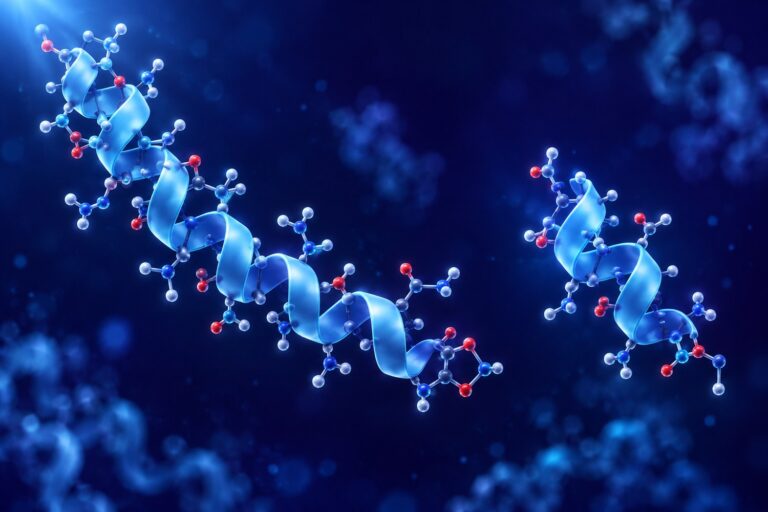
BPC-157 is a 15-amino acid derivative of the Body Protection Compound (BPC) isolated from human gastric juice (Jozwiak et al., Pharmaceuticals, 2025). It interacts with different physiological systems including neurotransmitter systems, the nitric oxide (NO) system and the inflammatory response system (Sikiric et al., 1993; Lee and Burgess, 2025; Staresinic et al., 2022; McGuire et al., 2025).
Stability and solubility of BPC-157
Unlike most peptides, BPC-157 is stable in gastric juices for more than 24 hours. Owing to its amino acid sequence (Gly-Glu-Pro-Pro-Pro-Gly-Lys-Pro-Ala-Asp-Asp-Ala-Gly-Leu-Val, MW: 1419.5 Da), it is stable in acidic environments, such as the stomach (He et al., Front Pharmacol, 2022). More specifically the cluster of three proline residues near the N-terminus create steric hindrance through formation of a proline-II-like-helix, protecting the peptide from gastric proteases like pepsin (Jozwiak et al., 2025; He et al., 2022; Mateescu et al., Pharmaceutics, 2026). Additionally, the peptide sequence lacks oxidation- or deamidation-susceptible amino acids such as methionine, cysteine, tryptophan, asparagine or glutamine (Staresinic et al., 2022). Despite its protection against acid-mediated hydrolysis, BPC-157 becomes subject to endopeptidase- and aminopeptidase-mediated degradation upon entering the plasma (He et al., 2022). Stability in urine-samples has been assessed and confirmed for 4 days (Cox et al., Drug Test Anal, 2017).
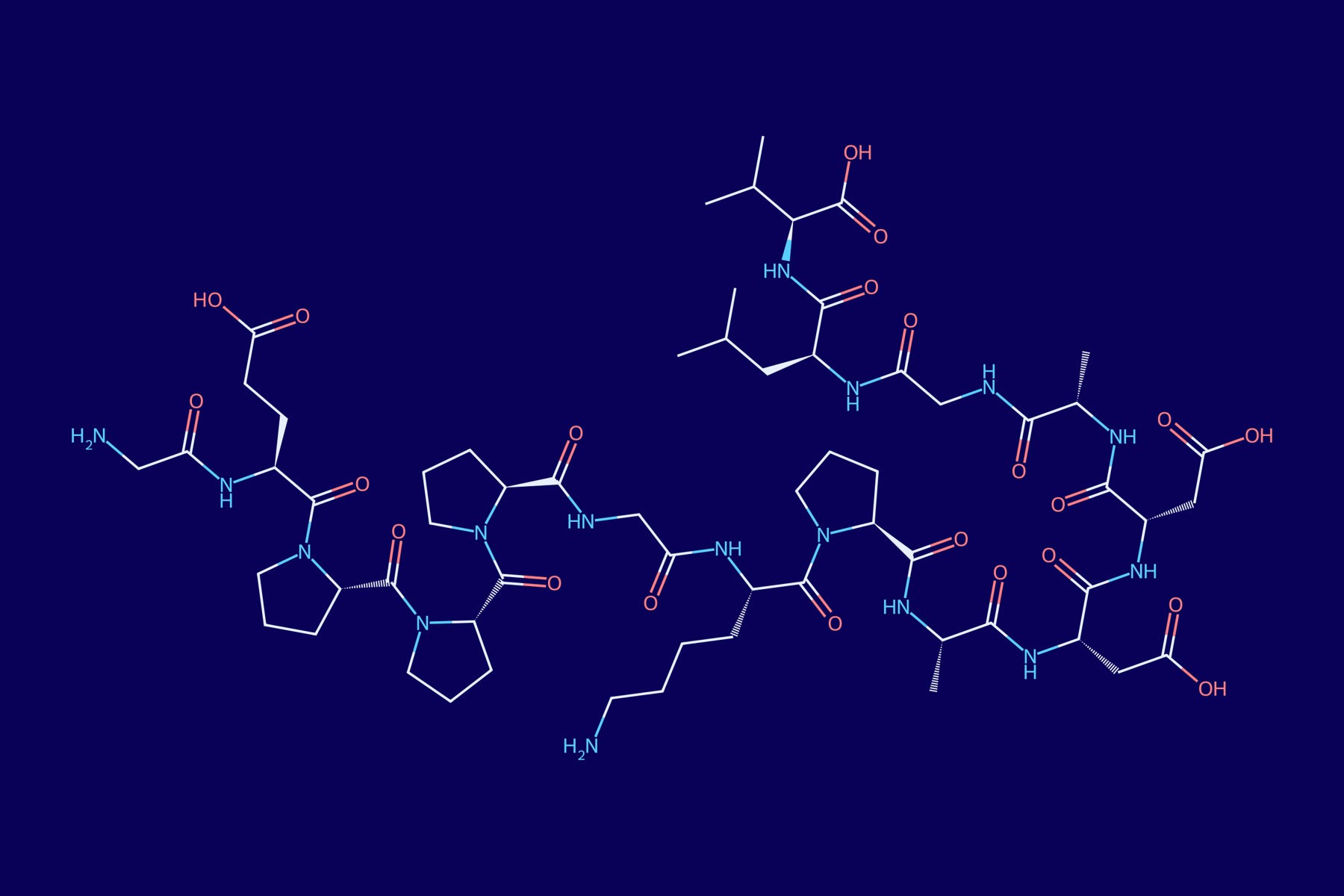
Thanks to a high percentage of polar amino acid residues, BPC-157 can be dissolved in aqueous solution such as NaCl or saline (Mateescu et al., 2026). Yet, solubility profiling across other physiologically relevant pH levels in accordance with ICH Q6B guidelines, as well as long-term stability studies and forced-degradation assays are still missing (Mateescu et al., 2026).
Pharmacokinetics of BPC-157
Different in vitro studies have been performed to characterize the ADME-profile (absorption, distribution, metabolism and excretion) of BPC-157. Studies in rats and dogs for instance have shown that peak values in most tissues are reached within one hour with an intramuscular bioavailability of 14 to 19 percent and 45 to 51 percent, respectively. Using radioactively marked BPC-157, it was further found that the compound quickly distributes to a variety of tissues including, in descending order, the kidneys, liver, lungs, spleen, plasma, heart and muscle, brain and lastly body fat tissues (He et al., 2022). Notably, absorption and distribution properties always depend on administration route. BPC-157 is then metabolized into six different components designated M1 to M6. These are further degraded into individual amino acids entering the normal amino acid metabolic pathway. Eventually, the degradation products of BPC-157 are excreted via renal and hepatic clearance, i.e. through urine, bile and faeces (He et al., 2022).
Like the ADME-profile, also half-life depends on administration route. Studies in rats and dogs show a half-life of 15.2 and 5.3 min respectively, with linear, dose-proportional pharmacokinetics. After 4 h, BPC-157 was no more detected in the plasma of these animals (He et al., 2022). In contrast to the short half-life, outcomes reported in these animal studies persist over days (Staresinic et al., 2022). Biotoxicity was not observed in that non-clinical setting (He et al., 2022).
Study types and analytical methods
While pharmacokinetic studies have primarily been conducted in rats and dogs (He et al., 2022), the properties described in those reports and the interaction with the NO-system have also been assessed in other species including rats, mice, guinea pigs, rabbits and chickens (Sikiric et al., 1993). Research on BPC-157 in humans is yet immature and limited to ex vivo stability assays in gastric juice, plasma and urine (Cox et al., 2017) and three small in vivo trials including a total of 30 participants (Lee and Padgett, 2021; Lee et al., 2024; Lee and Burgess, 2025). Well described analytical methods applied in these studies include liquid chromatography tandem mass spectrometry (LC-MS/MS) for the quantification of BPC-157 itself and for the identification and quantification of its metabolites (He et al., 2022; Cox et al., 2017), radioisotope assays to measure tissue distribution and to track excretion of metabolites in urine, bile and feces (He et al., 2022), immunohistochemistry and immunofluorescence to examine tissue sections (Staresinic et al., 2022) and western blot and real-time quantitative PCR to determine mechanisms of action, phosphorylation status and gene expression (Chang et al., Molecules, 2014).
Gaps and limitations
Despite numerous studies in animal models, little is known about the pharmacokinetics (PK) and -dynamics (PD) of BPC-157 in humans. Next to the three small trials conducted by Lee et al. (2021; 2024; 2025), larger trials are needed to validate the PK and PD findings suggested by animal studies and to characterize the ADME-profile of BPC-157 in humans (Mateescu et al., 2026). Next to this, solubility profiling, allometric dose scaling, membrane permeability, and the long-term fate of BPC-157 metabolites inside the body must be assessed and BCS-classification data established (Mateescu et al., 2026; Jozwiak et al., 2025).
In response to these gaps, the FDA has, as of today, not approved BPC-157 for medical use and it remains banned from competitive sports by the World Anti-Doping Agency (WADA) (McGuire et al., 2025; Lee and Burgess, 2025).
References
- P. Sikiric, M. Petek, R. Rucman, S. Seiwerth, Z. Grabarevic, I. Rotkvic, et al., “A new gastric juice peptide, BPC. An overview of the stomach-stress-organoprotection hypothesis and beneficial effects of BPC,” J. Physiol. Paris, vol. 87, no. 5, pp. 313 to 327, 1993, doi: 10.1016/0928-4257(93)90038-u. PubMed
- C. H. Chang, W. C. Tsai, Y. H. Hsu, and J. H. Pang, “Pentadecapeptide BPC 157 enhances the growth hormone receptor expression in tendon fibroblasts,” Molecules, vol. 19, no. 11, pp. 19066 to 19077, Nov. 2014, doi: 10.3390/molecules191119066. PubMed
- H. D. Cox, G. D. Miller, and D. Eichner, “Detection and in vitro metabolism of the confiscated peptides BPC 157 and MGF R23H,” Drug Test. Anal., vol. 9, no. 10, pp. 1490 to 1498, Oct. 2017, doi: 10.1002/dta.2152. PubMed
- E. Lee and B. Padgett, “Intra-articular injection of BPC 157 for multiple types of knee pain,” Altern. Ther. Health Med., vol. 27, no. 4, pp. 8 to 13, Jul. 2021. PubMed
- M. Staresinic, M. Japjec, H. Vranes, A. Prtoric, H. Zizek, I. Krezic, et al., “Stable gastric pentadecapeptide BPC 157 and striated, smooth, and heart muscle,” Biomedicines, vol. 10, no. 12, p. 3221, Dec. 2022, doi: 10.3390/biomedicines10123221. PubMed
- L. He, D. Feng, H. Guo, Y. Zhou, Z. Li, K. Zhang, et al., “Pharmacokinetics, distribution, metabolism, and excretion of body-protective compound 157, a potential drug for treating various wounds, in rats and dogs,” Front. Pharmacol., vol. 13, p. 1026182, Dec. 2022, doi: 10.3389/fphar.2022.1026182. PubMed
- E. Lee, C. Walker, and B. Ayadi, “Effect of BPC-157 on symptoms in patients with interstitial cystitis: a pilot study,” Altern. Ther. Health Med., vol. 30, no. 10, pp. 12 to 17, Oct. 2024. PubMed
- M. Jozwiak, M. Bauer, W. Kamysz, and P. Kleczkowska, “Multifunctionality and possible medical application of the BPC 157 peptide: literature and patent review,” Pharmaceuticals (Basel), vol. 18, no. 2, p. 185, Jan. 2025, doi: 10.3390/ph18020185. PubMed
- E. Lee and K. Burgess, “Safety of intravenous infusion of BPC157 in humans: a pilot study,” Altern. Ther. Health Med., vol. 31, no. 5, pp. 20 to 24, Sep. 2025. PubMed
- F. P. McGuire, R. Martinez, A. Lenz, L. Skinner, and D. M. Cushman, “Regeneration or risk? A narrative review of BPC-157 for musculoskeletal healing,” Curr. Rev. Musculoskelet. Med., vol. 18, no. 12, pp. 611 to 619, Dec. 2025, doi: 10.1007/s12178-025-09990-7. PubMed
- D. M. Mateescu, D. M. Gavrilescu, F. E. Constantinescu, C. Oancea, A. C. Ilie, R. Folescu, et al., “BPC-157 as an investigational peptide therapeutic: biopharmaceutical challenges, formulation strategies, and translational development barriers,” Pharmaceutics, vol. 18, no. 5, p. 625, May 2026, doi: 10.3390/pharmaceutics18050625. PubMed
Disclaimer: This content is intended for research purposes only and is not meant to constitute medical advice.
This educational material discusses laboratory research concepts only. Loti Labs products are intended strictly for research and development use and are not for human consumption.