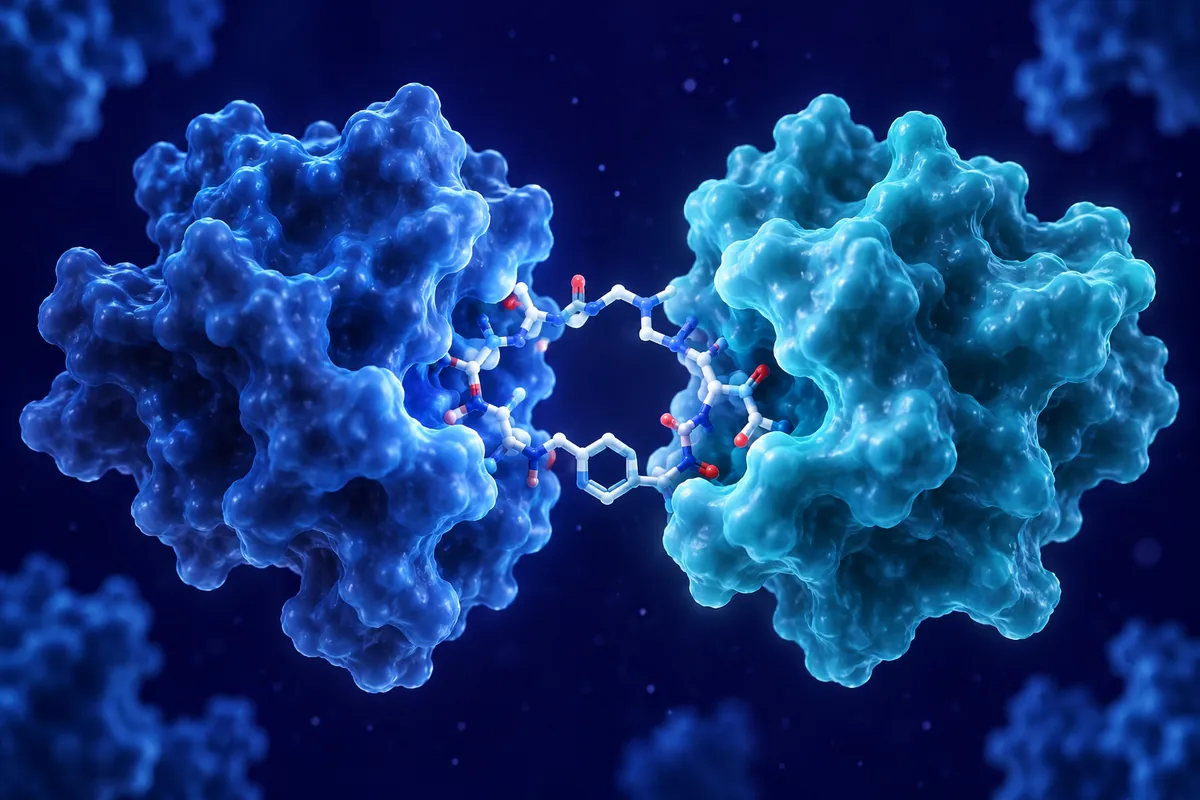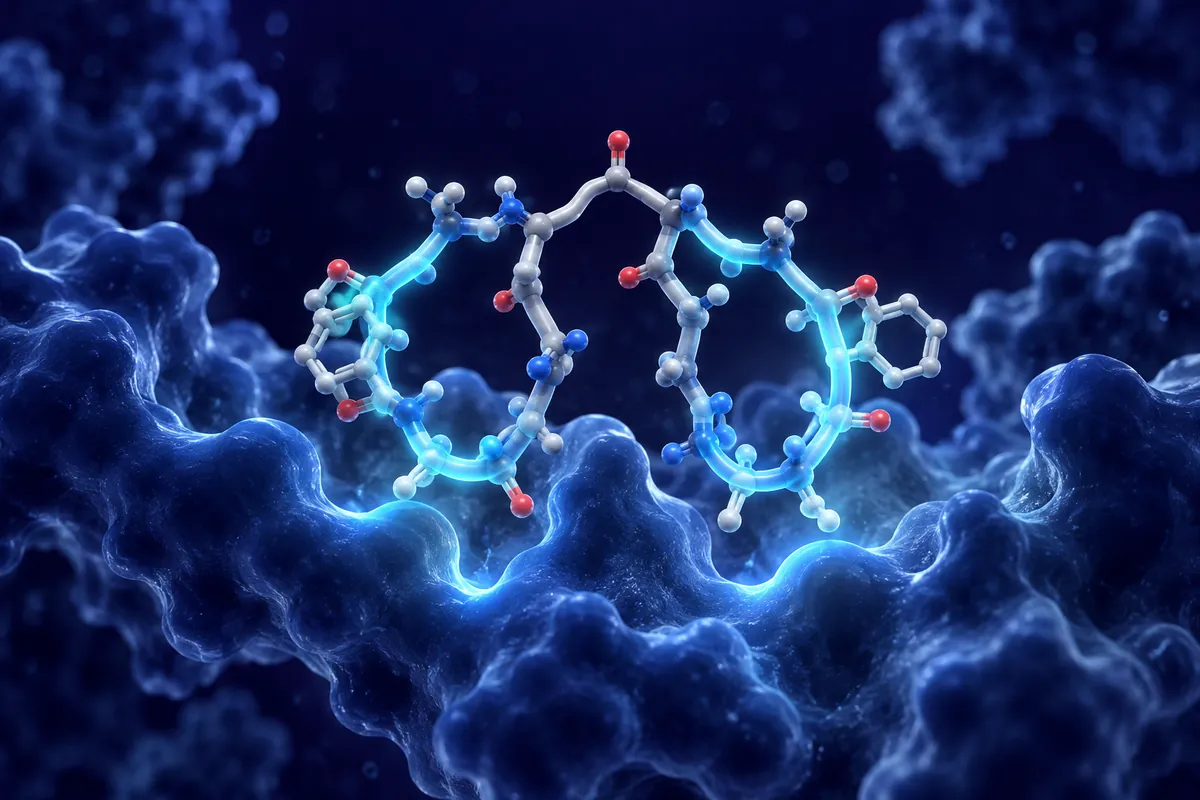
Two receptor systems, one molecule. That’s amycretin in a sentence. Simple to say, oddly hard to study.
The peptide was built to switch on GLP-1R and the amylin receptors at once. Metabolic labs had been mixing separate GLP-1 and amylin analogs in rats for years before this, so we kept asking ourselves: what does stitching them into one chain actually gain you? This article walks through the receptor biology, the structural thinking and the rodent data, and nothing beyond that.
The Two Receptor Systems
Start with GLP-1R, a class B GPCR. It mostly talks to Gs and bumps up cAMP. You’ll find it on beta cells, in gut tissue, and scattered through the brain (hypothalamus, hindbrain).
Amylin receptors are stranger. No gene codes for an amylin receptor as such. What you get is the calcitonin receptor (CTR) teaming up with RAMP1, RAMP2 or RAMP3, giving AMY1, AMY2 or AMY3. Bare CTR, with no RAMP attached, still answers amylin-like ligands, just with its own quirks.
This matters for anyone designing a co-agonist. Hitting “the amylin receptor” really means hitting a family, and the balance between AMY receptor activity and plain CTR activity can shape the downstream signal. Is broad CTR engagement a feature or a liability? Researchers still debate it.
Where they overlap
The two systems meet in the hindbrain, at the area postrema and the nucleus of the solitary tract. Rats lean on those spots for satiety and for setting how fast the stomach empties. Shared real estate, basically, and that’s the whole argument for pairing them.
One Chain or Two Peptides?
The older approach pairs two separate peptides, for example a long-acting amylin analog like cagrilintide with a GLP-1R agonist like semaglutide. Each piece can be tuned on its own. You can change the ratio, swap one partner, or study each in isolation, which is convenient in a lab.
A unimolecular co-agonist trades that flexibility for other things. One sequence means one pharmacokinetic profile, so both receptors see the ligand over the same time course. Manufacturing and formulation involve a single compound. And the receptor activity ratio is fixed into the chemistry, which is either an advantage or a constraint depending on what you want to learn.
We think the more interesting scientific point is about signaling bias. A hybrid ligand might bind each receptor somewhat differently from the native hormones, recruiting beta-arrestin or internalizing receptors at different rates. Two-component mixtures don’t necessarily do that. Whether the difference shows up in physiology is an open question.
Structural Design
Amycretin was developed by Novo Nordisk. Its backbone is generally described as amylin-derived, with modifications that grant GLP-1R activity, and it carries a fatty acid side chain attached through a linker. That lipidation strategy, familiar from semaglutide and cagrilintide, promotes reversible binding to serum albumin and extends half-life considerably.
Native amylin is a tough peptide to work with. It aggregates readily and forms amyloid fibrils, which is why pramlintide replaced several residues with prolines. Engineered analogs typically include substitutions that suppress fibril formation while keeping receptor potency. Exactly which residues carry the GLP-1R activity in amycretin is worth reading about in the primary structural literature rather than guessing.
Cryo-electron microscopy has been a big help in this field. Structures of GLP-1R and of CTR/RAMP complexes bound to peptide ligands show how the C-terminal portion of a peptide sits in the receptor’s extracellular domain while the N-terminus reaches into the transmembrane core. Co-agonist design leans heavily on those snapshots.
What Rodent Studies Show
Give a diet-induced obese rat a GLP-1R agonist and it eats less. Same with an amylin analog. Give both and intake usually drops further, a pattern labs have seen again and again in rats and mice, and the single-chain idea grew straight out of it.
For co-agonist peptides of this class, rodent work has reported dose-dependent decreases in food intake and body weight reduction in rodent models, along with slower gastric emptying. Knockout and antagonist experiments help separate which receptor drives which effect. Studies with GLP-1R knockout mice, for instance, can reveal how much of a response persists through amylin receptor signaling alone.
Rodents are imperfect stand-ins here. Rats and mice respond to amylin agonism a bit differently, and the hindbrain circuits are not identical across species. Pair-feeding controls are also important, since some metabolic changes simply follow reduced intake.
Questions worth testing
Does chronic exposure lead to receptor desensitization at one target faster than the other? How does the compound behave in RAMP knockout lines? Does it affect energy expenditure, or mostly intake? These experiments are doable, and some haven’t been reported yet.
Conclusion
Peptide chemists keep cramming more receptor activities into single chains, and amycretin shows why that’s tempting. It also shows why it’s hard. Amylin signaling runs through a family of receptor complexes, not one protein, so “amylin activity” can mean several things at once. The rodent work backs up the basic premise that hitting both pathways cuts intake more than hitting one. Whether one molecule beats a well-matched mixture? Nobody has nailed that down yet, and it’ll take side-by-side studies with tight controls. If your lab works on receptor crosstalk or hindbrain feeding circuits, this is a fun one to chew on.
Disclaimer: This content is intended for research purposes only and is not meant to constitute medical advice.
This educational material discusses laboratory research concepts only. Loti Labs products are intended strictly for research and development use and are not for human consumption.