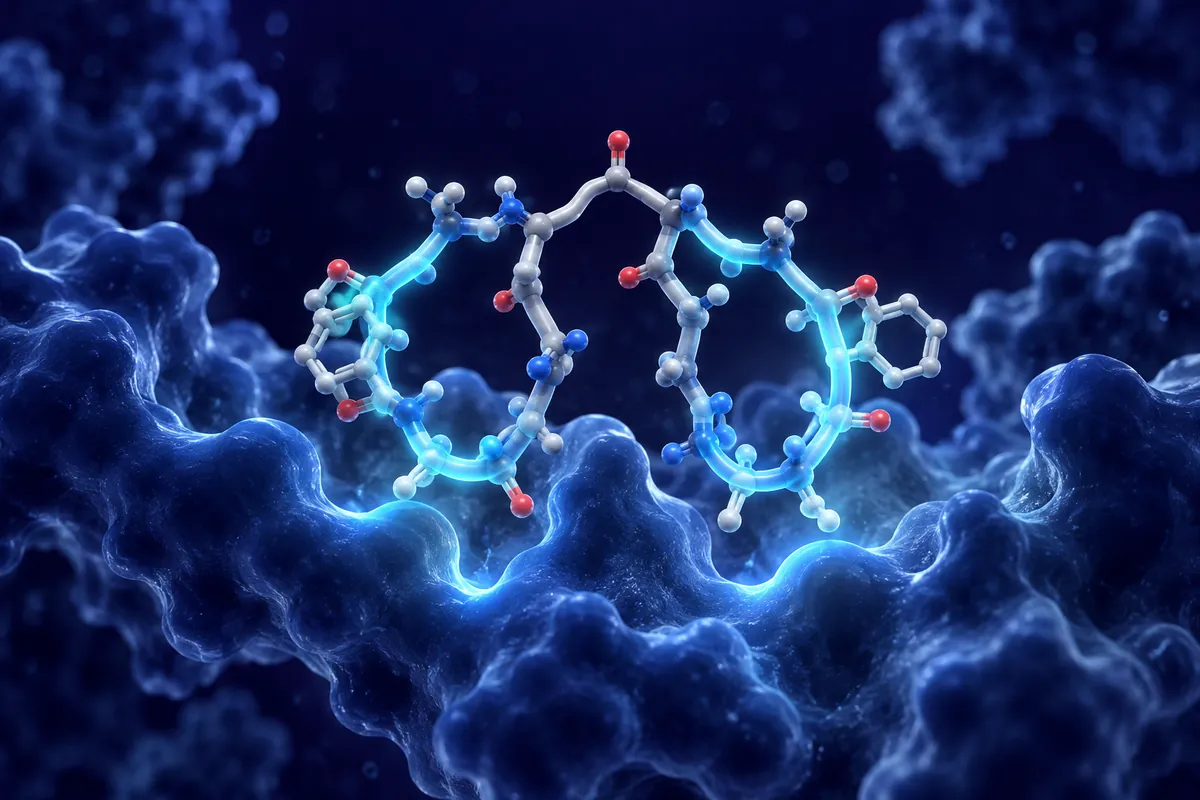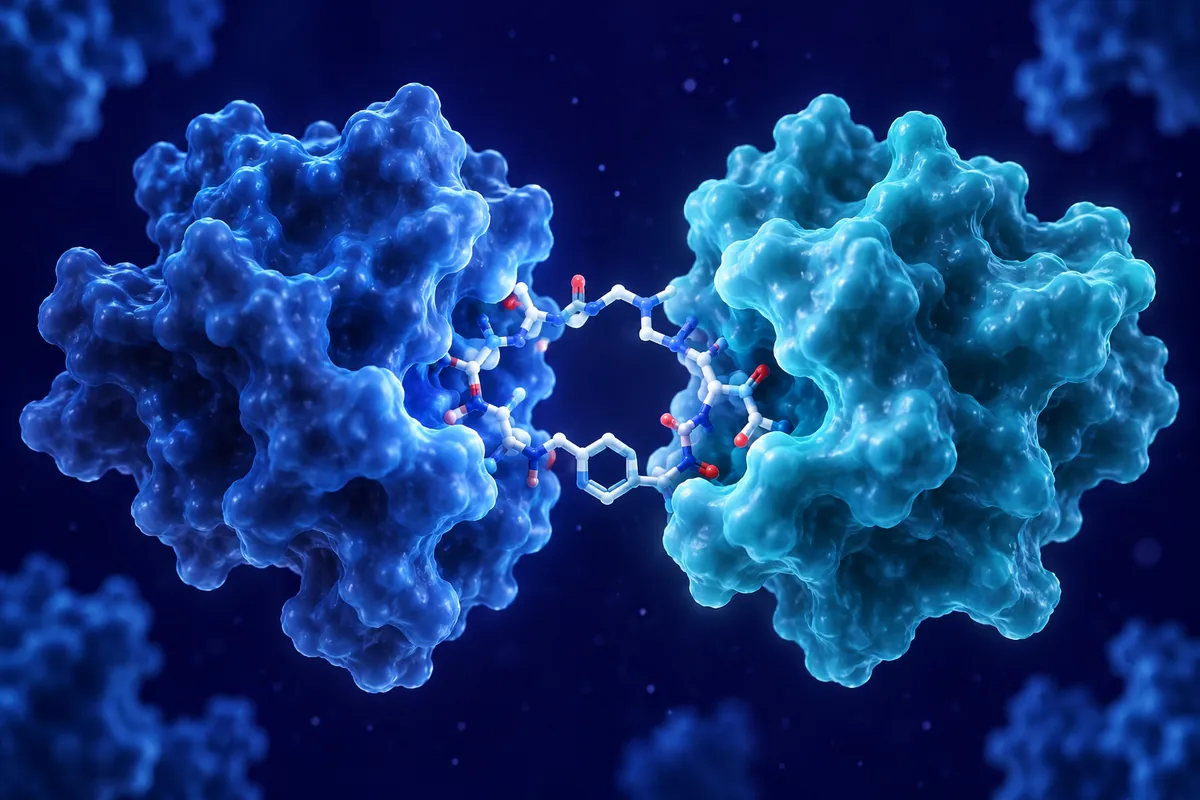
Antimicrobial peptide discovery has always been a numbers game. Screen enough natural sequences, mine enough amphibian skin secretions or insect hemolymph, and eventually a candidate with a workable minimum inhibitory concentration turns up. That approach is slow, and it is fundamentally limited by what evolution happened to produce. Generative modeling reframes the search: instead of screening what exists, researchers now sample from a learned distribution of what could exist, then filter aggressively for the properties that actually matter in a laboratory context.
From Screening Libraries to Learned Distributions
Classical antimicrobial peptide (AMP) discovery relied on combinatorial libraries, phage display panels, or curated databases like APD3 and DBAASP, followed by iterative rounds of synthesis and minimum inhibitory concentration (MIC) testing against panels of Gram-positive and Gram-negative organisms. It works, but coverage of sequence space is thin. A 20-residue peptide built from the canonical amino acid alphabet has an astronomically large number of possible sequences, and brute-force synthesis can only ever sample a sliver of it.
Generative models change the sampling strategy entirely. Variational autoencoders and, more recently, diffusion models are trained on thousands of annotated AMP sequences paired with structural and physicochemical descriptors: net charge, hydrophobic moment, helical propensity, and hemolytic activity reported against erythrocytes in vitro. Once trained, the model doesn’t retrieve a known peptide : it generates a novel one that occupies a similar region of chemical space, guided toward regions associated with favorable properties.
Latent Diffusion and Multi-Guided Sampling
Diffusion models originally built for image synthesis have been adapted to sequence and structure generation by treating peptide design as a denoising problem in a learned latent space. Noise is progressively added to a representation of a peptide during training; the reverse process, run at inference time, gradually removes that noise while being nudged : or “guided” : toward one or more target properties.
What makes this useful for AMP design specifically is multi-objective guidance. A single classifier gradient can push generation toward high predicted antibacterial potency, but potency alone is a poor filter. Researchers now layer in a second and third guidance signal simultaneously: one classifier trained to predict hemolytic index against red blood cells in vitro, another trained on predicted helical stability in membrane-mimetic environments, sometimes a fourth trained on proteolytic susceptibility. The sampling process becomes a constrained optimization run inside the diffusion trajectory itself, rather than a downstream filter applied after the fact. Peptides that would score well on potency but poorly on selectivity get pushed away during generation, not discarded after synthesis.
Why Non-Hemolytic Design Is the Real Bottleneck
Selectivity between microbial and mammalian membranes is where most natural AMPs fail as research leads. Many cationic amphipathic peptides disrupt bacterial membranes through pore formation or the carpet mechanism, but the same physicochemical features : high net positive charge, amphipathicity, a hydrophobic face : often drive nonspecific lysis of red blood cells and other mammalian cell types in culture. Multi-guided generative pipelines attempt to decouple these correlated properties computationally, something that’s genuinely hard to do by hand.
Is it working? Reported in silico hit rates for jointly optimized potency and low hemolysis have improved substantially compared with unguided generation or random mutagenesis baselines. Sequences generated under multi-objective constraints show measurably lower predicted hemolytic scores while retaining predicted MIC values in a useful range against reference strains such as Escherichia coli and Staphylococcus aureus in benchmark datasets.
The Gap Between In Silico Hits and Wet-Lab Validation
Here’s the caveat that gets lost in enthusiasm for generative tools: a favorable prediction is not confirmed activity. Property predictors are trained on existing assay data, and they inherit whatever biases and blind spots that training data carries. A peptide scored as non-hemolytic by a classifier may behave unpredictably once synthesized, folded in an actual lipid bilayer, and tested against live bacterial cultures rather than a sequence embedding.
Validation still runs through the same wet-lab gauntlet as always: solid-phase peptide synthesis, purification by reverse-phase HPLC, broth microdilution MIC assays against defined bacterial panels, and hemolysis assays using isolated erythrocytes, typically from rodent or sheep blood in preclinical screens. Structural confirmation by circular dichroism spectroscopy in membrane-mimetic detergents or liposomes is common practice for checking whether the predicted helical or beta-sheet conformation actually forms. None of that pipeline goes away because a model generated the sequence : it just gets applied to a more curated, higher-probability shortlist rather than a blind library.
What This Means for Comparative Screening Strategy
The practical shift isn’t that generative models replace assay work; it’s that they change where research time gets spent. Older screening approaches burned resources testing large numbers of low-probability candidates. Multi-objective generative pipelines compress the funnel earlier, in silico, so that the peptides reaching synthesis have already cleared a computational bar for charge distribution, predicted membrane selectivity, and stability metrics. Fewer candidates enter the wet lab, but each one arrives with a stronger prior probability of clearing the first assay tier.
That is a meaningful efficiency gain for structure-activity relationship studies, resistance-mechanism comparisons, and any research program trying to map how small sequence perturbations shift the potency-selectivity tradeoff. It is not a substitute for empirical confirmation, and researchers evaluating generative AMP pipelines should treat reported in silico hit rates as a hypothesis-generation metric, not a validation endpoint. The peptides still have to prove themselves against real membranes, real enzymes, and real bacterial cultures before any conclusion about their antimicrobial profile can be drawn.
Disclaimer: This content is intended for research purposes only and is not meant to constitute medical advice.
This educational material discusses laboratory research concepts only. Loti Labs products are intended strictly for research and development use and are not for human consumption.