The Neuropeptide That Named a Problem
Substance P holds a peculiar place in peptide history. Decades passed before its 11-amino-acid sequence was finally determined in 1971 by Susan Leeman and Michael Chang. In those intervening years, the placeholder name stuck : one of science’s lasting accidents of nomenclature.
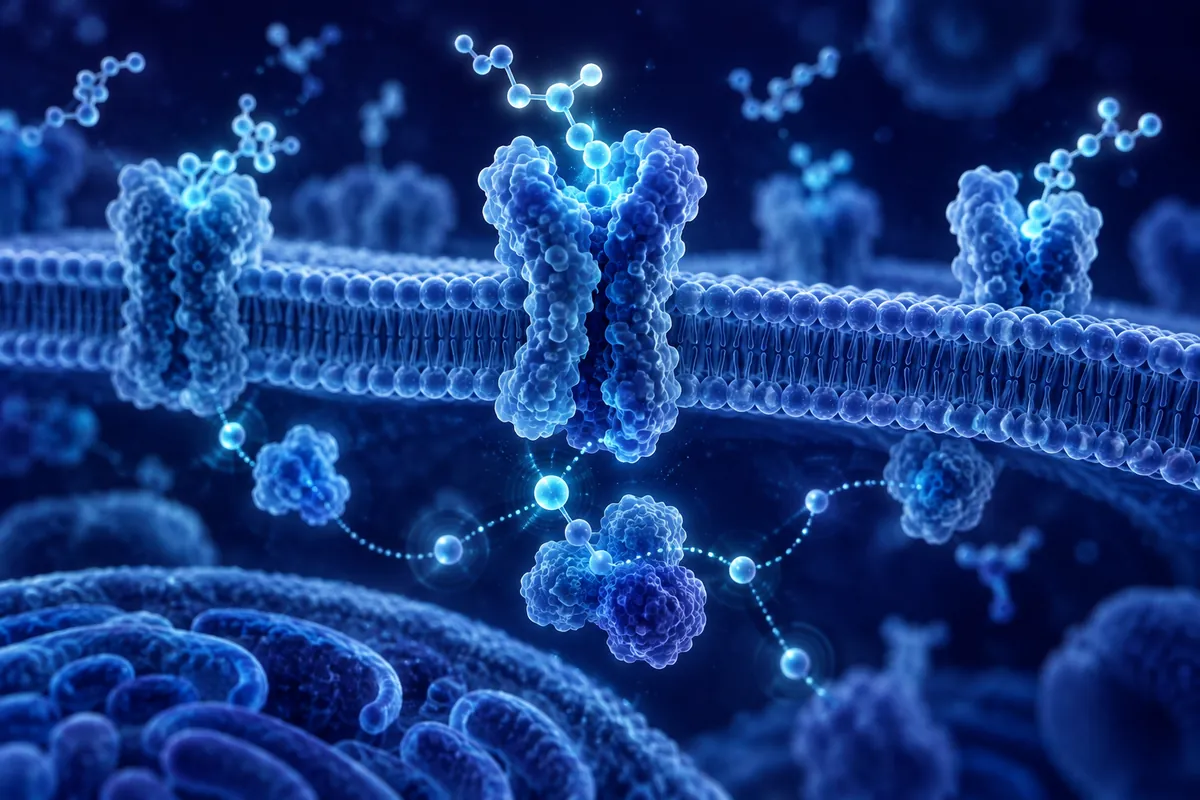
Substance P belongs to the tachykinin family, a group of neuropeptides sharing a conserved C-terminal sequence (Phe-X-Gly-Leu-Met-NH₂) essential for receptor binding. Its primary receptor, neurokinin-1 (NK1), is a G-protein-coupled receptor distributed across the central and peripheral nervous systems, immune organs, and the gastrointestinal tract.
Pain Transmission: The Classic Role
Substance P’s most established function is as a neurotransmitter in pain circuits. Small-diameter sensory neurons : C-fibers and a subset of Aδ-fibers : synthesize substance P in their cell bodies in dorsal root ganglia and transport it to both peripheral and central terminals. At the spinal cord, substance P is released from primary afferent terminals into the dorsal horn, where NK1 activation on second-order neurons amplifies nociceptive signaling.
This amplification is slow and sustained. The functional consequence is wind-up : a progressive increase in neuronal firing in response to repeated C-fiber stimulation. Wind-up contributes to central sensitization, a state in which normally innocuous stimuli begin to produce nociceptive responses.
Ablation studies powerfully demonstrated substance P’s role. This dissociation between acute and pathological pain processing has been a major finding in the nociception field.
Substance P’s peripheral functions extend well beyond pain signaling. When released from sensory nerve endings in the skin, joints, and airways, substance P triggers neurogenic inflammation : a process characterized by vasodilation, plasma protein extravasation, and immune cell recruitment. The peptide directly degranulates mast cells, stimulating histamine release and amplifying the local inflammatory response.
The mechanism involves both NK1-dependent and NK1-independent pathways. Substance P binds NK1 on endothelial cells, increasing vascular permeability through gap formation between endothelial junctions. Simultaneously, it acts on mast cells through a charge-based interaction with Mas-related G-protein-coupled receptor X2 (MRGPRX2), triggering degranulation without requiring classical IgE-mediated activation.
In airway research models, substance P released from bronchial C-fibers contributes to bronchoconstriction, mucus secretion, and submucosal edema. These effects have made NK1 receptor antagonism a research strategy in respiratory biology, although the complexity of overlapping tachykinin contributions (substance P, neurokinin A, neurokinin B) has complicated receptor-selective approaches.
The Gut: The Second Brain Connection
The enteric nervous system contains substantial substance P-expressing circuitry. In the gastrointestinal tract, substance P stimulates smooth muscle contraction, promotes epithelial ion secretion, and modulates gut motility through local reflex arcs. NK1 receptors on interstitial cells of Cajal : the pacemaker cells of gut motility : respond to substance P by increasing the frequency and amplitude of slow waves that drive peristalsis.
Research into gut-brain communication has revealed that substance P-containing vagal afferents transmit visceral sensory information from the gut to the brainstem. In models of intestinal inflammation, substance P release from both intrinsic and extrinsic neurons amplifies mucosal immune activation, creating a neuroimmune feedback loop that sustains inflammatory states.
Emesis and the NK1 Antagonist Story
One of the most commercially successful applications of substance P research was the development of NK1 receptor antagonists as antiemetics. Substance P and NK1 receptors are concentrated in the nucleus tractus solitarius and area postrema : brainstem regions controlling the vomiting reflex. NK1 activation in these areas contributes to both acute and delayed emesis in research models studying nausea-inducing stimuli.
The compound aprepitant, an NK1 antagonist, demonstrated robust anti-emetic activity in primate models, leading to its widespread research characterization. This represented a validation of the substance P/NK1 pathway as a legitimate functional target : a journey from von Euler’s mysterious “powder” in 1931 to precision receptor pharmacology nine decades later.
Substance P may have evolved not merely to signal “something is wrong” but to simultaneously begin the process of fixing it.
Disclaimer: This content is intended for research purposes only and is not meant to constitute medical advice.
This educational material discusses laboratory research concepts only. Loti Labs products are intended strictly for research and development use and are not for human consumption.